Quick Answer
For most gaming builds, yes if you use the PC more than four hours per day. The electricity savings over two to three years partially offset the R500 to R1,500 premium over Gold, and the thermal and acoustic benefits are real and immediate. For occasional gaming of two hours or less daily, the payback period stretches to five or more years and Gold is the more cost-effective choice.
What the Platinum Premium Actually Buys You for Gaming 🎮
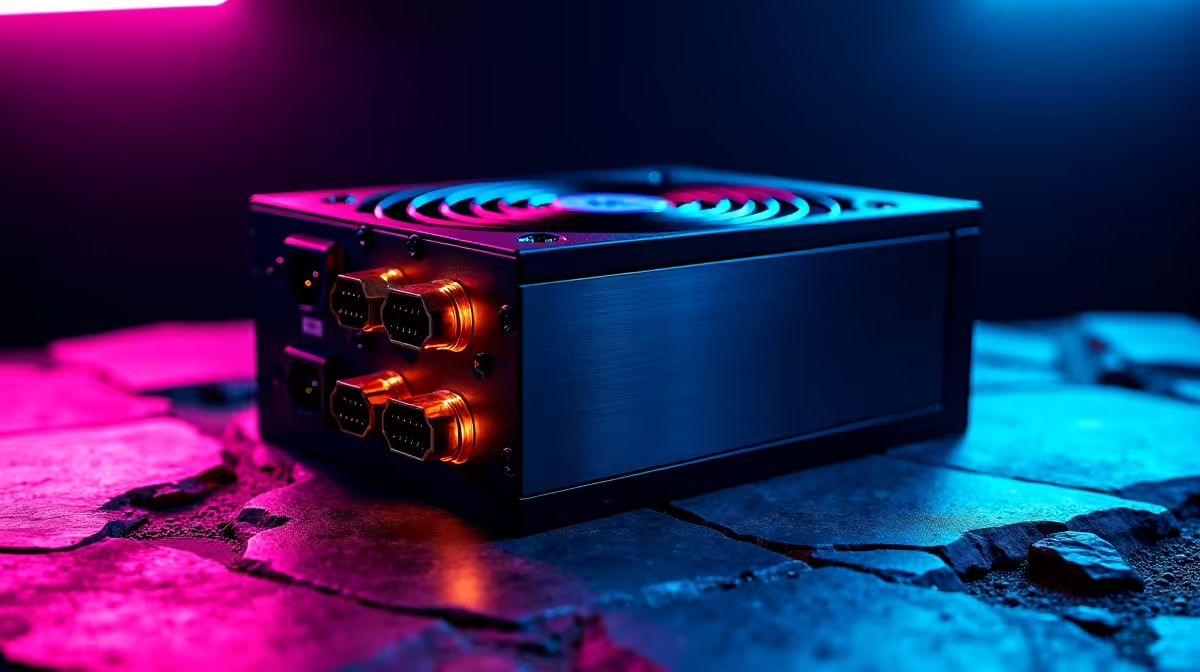
The difference between 80 Plus Gold (87% efficient at 50% load) and Platinum (92% at 50% load) translates to a specific heat and noise outcome in a gaming setup. With an RTX 5070 Ti and Ryzen 7 9800X3D gaming build drawing about 350W at 50% of a 700W PSU, a Gold unit wastes 46W as heat while Platinum wastes only 30W. That 16W of additional waste heat is blown into the case and raises the thermal floor for everything else. In a closed room gaming setup in Johannesburg in December, the PSU heat contributes meaningfully to ambient temperature, and less heat means quieter fans across the whole system. Semi-passive fan modes on Platinum units keep the PSU fan fully stopped during light to moderate gaming, which is immediately noticeable as reduced background noise.
Calculating the Actual Payback Period in ZAR 💰
A quality 850W Platinum PSU in South Africa costs roughly R3,800 to R5,000, versus R2,500 to R3,500 for an equivalent Gold unit: a premium of R1,000 to R1,500. At the 16W efficiency saving from the example above, four hours daily gaming generates 16W multiplied by 4 hours multiplied by 365 days, equalling 23.4kWh per year. At R3.50 per kWh, the annual electricity saving is R82. Payback on a R1,200 premium: approximately 14 to 15 years. For a workstation used eight hours daily, the saving doubles to R164 per year and payback shortens to seven to eight years. This is why Platinum is most clearly justified for creators and professionals rather than casual gamers. The acoustic and thermal benefits remain relevant regardless of usage hours.
When Platinum Clearly Wins the Argument 🏆
Four situations make Platinum the obvious choice for SA buyers. First, the machine doubles as a workstation with sustained render or compute work. Second, the gaming room lacks air conditioning and SA summer heat is a genuine ambient concern. Third, the builder prioritises quiet operation above all else and semi-passive fan mode is the deciding factor. Fourth, the build targets maximum longevity: the better components and cooler operation in Platinum units do correlate with longer functional lifespan. If none of these apply, a quality Gold unit from Seasonic, Corsair, or be quiet! is entirely adequate and represents better value per rand of build budget.
Right-Size Before Choosing Efficiency Tier ⚡
A 1000W Platinum PSU powering a 350W gaming system runs at 35% load, which is below the 50% efficiency sweet spot where Platinum's advantage is greatest. In this scenario, a 650W Gold PSU at 54% load may actually deliver similar real-world efficiency. Match wattage to load first, then choose the certification tier. The efficiency rating only applies at the load points where the unit is certified.
FAQ
Can you notice the difference between Gold and Platinum in gaming performance?
No.
Is it safe to buy a cheap Platinum PSU to save money?
No. Several generic brands claim 80 Plus Platinum ratings without independent certification or with tests conducted under non-standard conditions.
Does an older Gold PSU degrade over time and become less efficient?
Yes. Electrolytic capacitors age, and efficiency can drop 2% to 4% over five to seven years of daily use. An older Gold unit may be running closer to Silver efficiency by year seven. This is an additional argument for a Platinum unit in a long-term build: it starts higher and degrades to Gold-equivalent over its lifetime.
Deciding between Gold and Platinum for your gaming build?
Evetech stocks both efficiency tiers from Seasonic, Corsair, and be quiet! with local warranty support, from 650W to 1200W.