Quick Answer
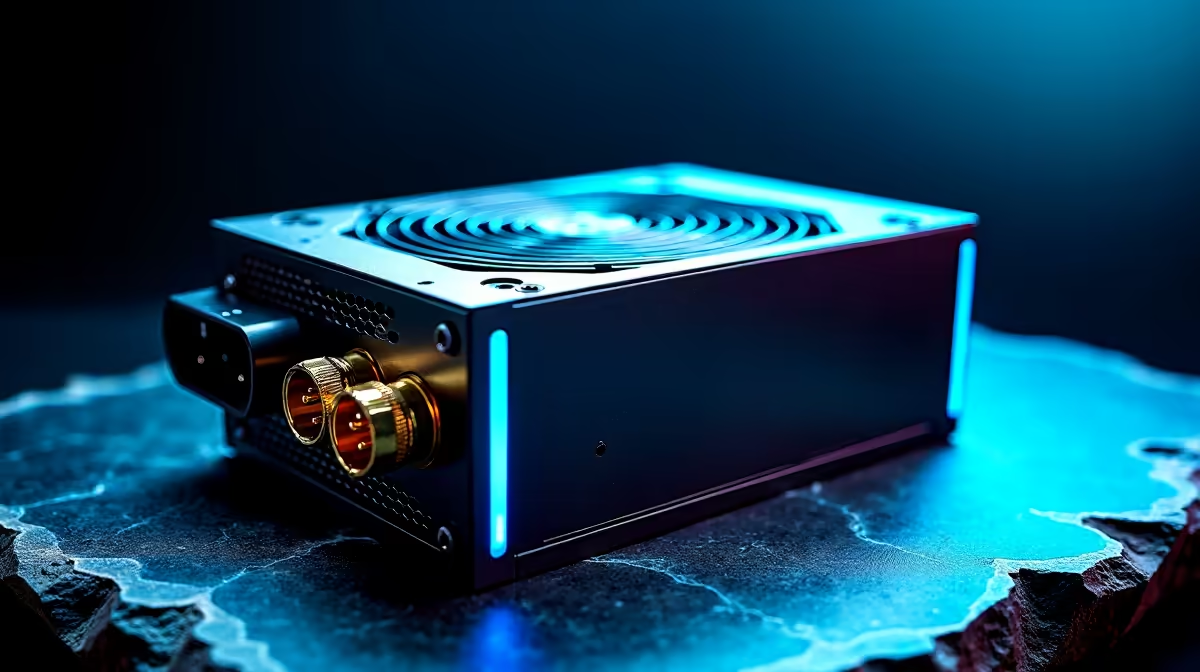
Yes, an 80 Plus Platinum PSU is worth the extra cost for South African gamers who play more than 4 hours daily. The R600 to R1,200 premium over a Gold unit pays back through electricity savings within 2 to 3 years at Johannesburg metro tariffs, while the longer capacitor lifespan, quieter fan, and better rail stability deliver compounding benefits over the PSU's ten-year lifespan.
Breaking Down the Real Cost Difference 💰
A quality 850W Gold unit costs roughly R1,900 to R2,800 at local retail. An equivalent 850W Platinum unit runs R2,800 to R4,200. The premium at the mid-tier is approximately R800 to R1,000. At a Tshwane residential tariff of R2.40 per kWh and a gaming PC drawing 500W from the wall, the Gold unit wastes 56W as heat while the Platinum unit wastes 43W. That 13W gap over 5 hours daily, 300 gaming days per year, costs R47 extra per year in electricity with the Gold unit. Factor in Eskom's historical annual increases of 10 to 12 percent, and the compounded saving over 5 years reaches R290 to R350.
Where the Platinum Benefit Goes Beyond Electricity 🏆
The electricity saving is the most calculable part, but not the most impactful. 80 Plus Platinum units overwhelmingly use 105-degree-Celsius Japanese electrolytic capacitors, while budget Gold units sometimes use 85-degree-Celsius alternatives. At typical operating temperatures the capacitor lifespan difference is significant: 105-degree-Celsius caps at 70 degrees Celsius internal temperature last roughly 8 times longer than 85-degree-Celsius equivalents under the same conditions.
When Gold Is the Better Choice 🔧
For gaming sessions under 2 to 3 hours daily, the electricity saving narrows to under R25 per year, which never recovers the Platinum premium. For secondary or casual builds used primarily for light gaming, a reputable 80 Plus Gold unit from a brand with verified component quality is the rational choice, particularly if it frees budget for a GPU or RAM upgrade.
Total Cost of Ownership, Not Sticker Price ⚡
When comparing a Gold and Platinum PSU at Evetech, calculate the five-year total cost of ownership by adding the purchase price to the estimated five-year electricity cost difference based on your actual gaming hours. For most SA gamers above 4 hours daily, this calculation clearly favours Platinum within the first two to three years of ownership.
FAQ
Does 80 Plus Platinum certification guarantee good component quality inside the PSU?
No. The 80 Plus test certifies only conversion efficiency, not internal component quality, ripple, or regulation precision. A PSU can pass Platinum certification with mediocre capacitors. Research the specific model's teardown reviews to confirm internal quality matches the marketing, or stick to brands with well-documented build quality at Evetech.
Will I notice a performance difference between a Gold and Platinum PSU in day-to-day gaming?
Not directly. Both deliver sufficient power for gaming if correctly sized. The Platinum difference shows up in quieter fan noise at medium loads, slightly cooler chassis temperature, and long-term component stability rather than measurable fps gains. If your current PSU is already Platinum, upgrading within that tier adds minimal benefit.
How do I confirm an 850W Platinum PSU is genuinely ATX 3.1 compliant when shopping in South Africa?
Look for the 12V-2x6 cable included natively in the box and the explicit ATX 3.1 label on the product spec sheet. A PSU listed as Platinum without mentioning ATX 3.1 or that includes only an adapter for the GPU connector may be an older ATX 3.0 design. Confirm the standard before purchasing for any current-gen RTX 5000 or RX 9000-series GPU pairing.
Deciding between Gold and Platinum for your SA gaming build?
Evetech stocks both tiers from established brands with long local warranties, making it easy to compare spec-for-spec and buy with confidence.