Quick Answer
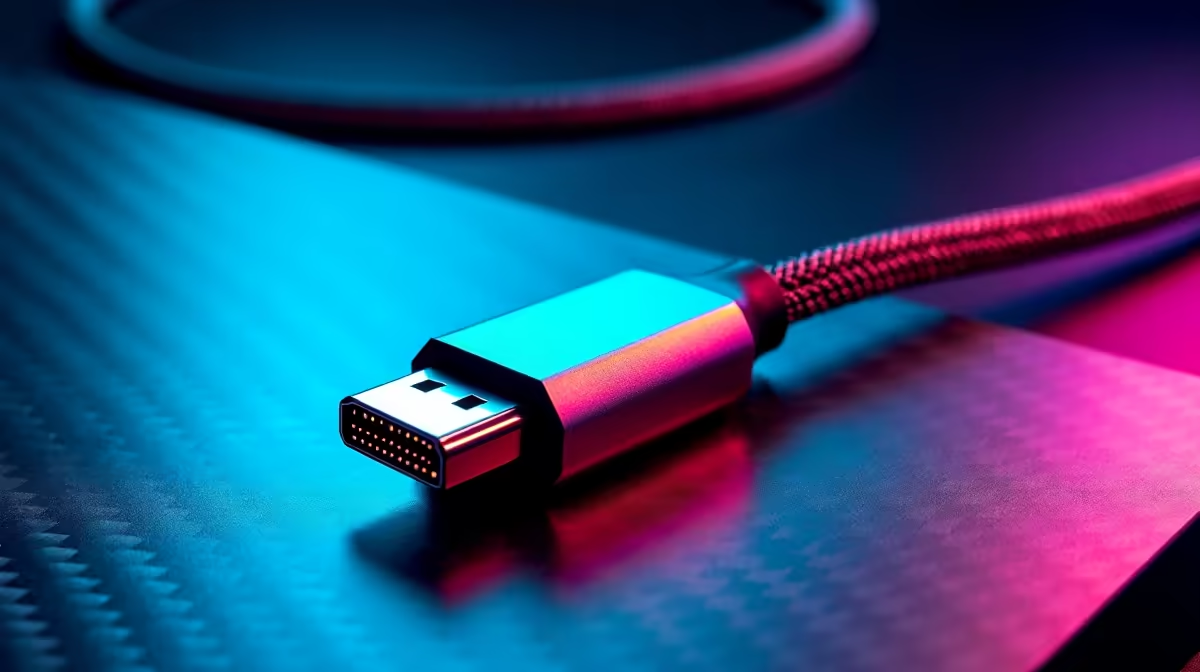
Only if your monitor is actually an 8K display with a DP 2.1 input and your GPU outputs native DP 2.1. For a 4K gaming monitor, even at 144Hz or 165Hz, an 8K-rated DP 2.1 cable delivers no measurable improvement over a certified DP 1.4 cable. The cable negotiates down to the monitor and GPU's supported spec automatically.
When the 8K Cable Specification Is Genuinely Required 🖥️
An 8K-rated DP 2.1 UHBR20 cable is required for exactly one scenario: a GPU with native DP 2.1 output (RTX 5080, RTX 5090, RX 9070 XT or above) connected to an 8K monitor with a DP 2.1 input, where the target output is 8K at 60Hz without Display Stream Compression. Outside this scenario, the UHBR20 bandwidth headroom is unused. Most current gaming monitors are 4K at 144Hz, 165Hz, or 240Hz. These run perfectly on DP 1.4 cables without any DSC at 144Hz, and with DSC at 165Hz or 240Hz. An 8K cable on a 4K monitor gives you future compatibility if you upgrade the monitor, but zero present-day performance gain. For SA gamers, 8K gaming monitors are still rare and expensive locally, well above R30,000 for the entry level.
The Cost Premium of 8K Cables Versus 4K Cables 💰
Certified DP 1.4 cables for 4K gaming cost from around R250 to R500 locally in the 2m passive range. Certified DP 2.1 UHBR20 cables in the same length range from around R450 to R750. The gap is R150 to R250. For someone with a confirmed 8K upgrade path within six to twelve months, paying this premium now for future-proofing is sensible. For someone with no 8K plans in the near term, the extra R200 adds nothing. Both cables are backward compatible, so buying DP 2.1 early carries no risk, only a modest cost.
High-Refresh 4K Gaming: What the Cable Actually Needs to Deliver 🎮
For competitive gaming at 4K/165Hz or 4K/240Hz on panels like those using Innolux or AUO panels in current IPS gaming monitors, DP 1.4 with DSC delivers the full refresh rate. DSC at these refresh rates introduces no visible artefacts and is virtually indistinguishable from uncompressed output. The practical gaming experience at 4K/165Hz on a DP 1.4 certified cable is identical to running DP 2.1. The gains from DP 2.1 at 4K resolution are theoretical, not perceptible in actual gaming or content viewing.
Spend the 8K Cable Budget on Refresh Rate Instead ⚡
If you are currently running 4K 60Hz and considering an upgrade, the R200 saved by choosing a DP 1.4 cable over a DP 2.1 cable is better spent toward a 4K 144Hz monitor upgrade. The jump from 60Hz to 144Hz at 4K produces a transformative improvement in gaming smoothness that no cable upgrade can replicate.
FAQ
Can a DP 2.1 cable be used on a DP 1.4 gaming monitor without any issues?
Yes, fully. The cable negotiates down to DP 1.4 speeds. There are no compatibility issues. The only change is that you paid slightly more for bandwidth headroom you are not currently using.
Will an 8K DisplayPort cable improve FPS in gaming?
No. Cable specification has zero effect on frame rates. FPS is determined entirely by GPU and CPU performance. A display cable only affects maximum achievable resolution and refresh rate on the connected monitor.
If I plan to buy an 8K monitor in 2027, should I buy the DP 2.1 cable now?
Buying ahead is reasonable given the modest price premium. However, cable technology may also advance. If your GPU upgrade will also happen before the monitor purchase, the new GPU may ship with its own cable. Evaluate when the monitor purchase is imminent.
Shopping for a high-resolution gaming monitor or cable upgrade?
Evetech stocks 4K and emerging 8K monitors alongside certified DisplayPort cables for every resolution tier. Find your setup at Evetech.