Quick Answer
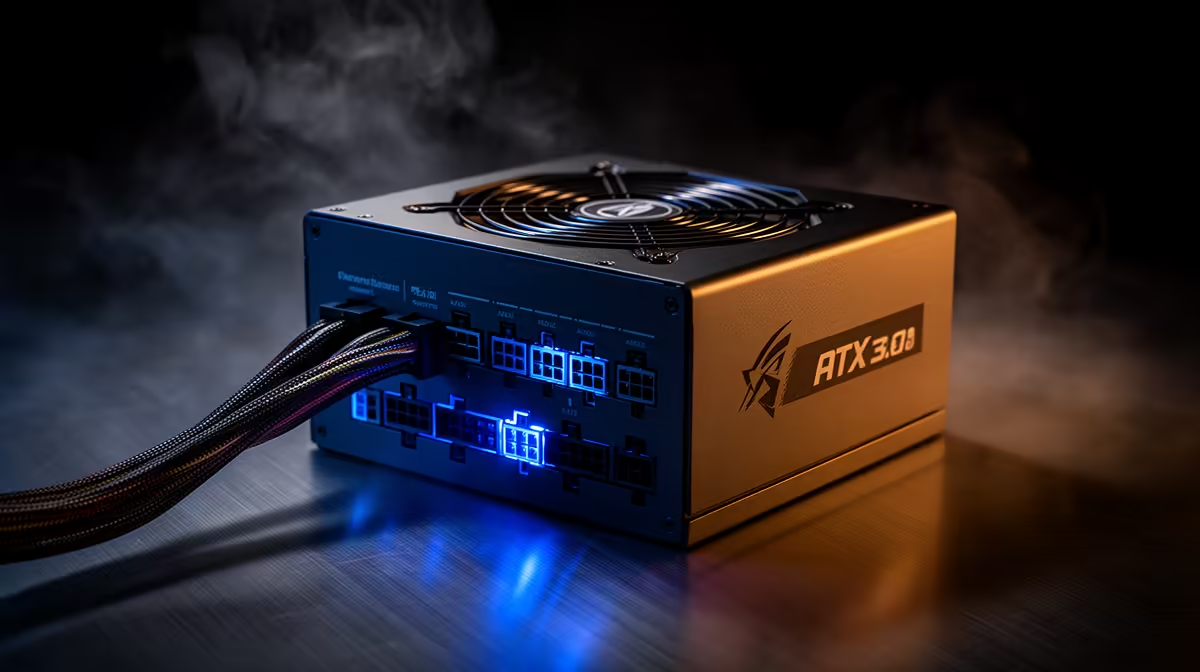
Yes. An ATX 3.0 compatible PSU is worth choosing for any GPU upgrade involving an RTX 40-series or newer card. The native 16-pin 12V-2x6 connector eliminates adapter reliability risks, and the improved transient handling prevents instability that older PSU designs can exhibit under modern GPU power spikes.
The Problem ATX 3.0 Was Designed to Solve 🔌
When the RTX 4090 launched in late 2022, a significant number of global buyers reported melting 16-pin adapter cables. The root cause was a combination of improperly seated adapter plugs and the RTX 4090's aggressive transient power demands exceeding what older ATX 2.x PSUs were designed to handle. Connector contact resistance rose under heat, increasing resistance further, creating a thermal runaway scenario in the cable itself. ATX 3.0 addressed this by mandating native 16-pin 12V-2x6 connectors (eliminating adapters entirely), requiring PSUs to handle 200% transient excursions without tripping protection circuits, and tightening voltage regulation tolerances. For RTX 50-series buyers in South Africa spending R15,000 to R22,000 on a GPU, using an ATX 3.0 PSU is the straightforward protection against these known failure modes.
Cost Difference in ZAR and What You Get 💰
ATX 3.0 certified units at equivalent wattage and efficiency typically cost R300 to R600 more than an older ATX 2.x design. A quality 850W ATX 2.x Gold unit sits around R2,000 to R2,400. The ATX 3.0 equivalent from the same tier sits at R2,400 to R3,000. For a 1,000W Gold unit, the ATX 3.0 version ranges from around R3,500 to R4,500 at Evetech. The extra spend buys you native connector support, cleaner transient handling and in most cases tighter DC output accuracy across all rails. For a GPU upgrade costing R10,000 or more, that incremental PSU spend is a rational protection investment.
Future-Proofing for the Next GPU Generation 🚀
ATX 3.0 and the 12V-2x6 connector standard are expected to remain the baseline for the next two to three GPU generations beyond the RTX 50-series. Buying an ATX 3.0 PSU today means your power delivery is compatible with GPUs you will upgrade to in 2027 or 2028 without another PSU swap. This matters in South Africa where import costs and rand fluctuations mean PSU prices tend to increase over time. Locking in a quality ATX 3.0 unit now at current pricing while it covers your current and next GPU is a sound long-term decision.
Verify ATX 3.0 on the Label, Not the Box Art ⚡
Some PSU boxes feature the 16-pin cable prominently in marketing imagery without the unit itself being fully ATX 3.0 certified. Confirm ATX 3.0 compliance is explicitly stated in the technical specification table, not just implied by the inclusion of an adapter cable or the 12V-2x6 plug.
FAQ
Can I use an ATX 3.0 PSU with my current RTX 3080 while I save for an upgrade?
Absolutely. ATX 3.0 PSUs include standard 8-pin PCIe cables alongside the 16-pin cable. You use the 8-pin cables now with your RTX 3080 and swap to the 16-pin when you upgrade to an RTX 50-series card.
Is ATX 3.0 mandatory or just recommended for RTX 50-series cards?
NVIDIA recommends ATX 3.0 for RTX 40 and 50-series GPUs. An older ATX 2.x PSU with a 16-pin adapter will function in most cases but carries higher connector failure risk under sustained high-load scenarios.
Are all PSUs sold as ATX 3.0 ready actually fully compliant?
Not always. ATX 3.0 ready can mean only that the cable is included. Full ATX 3.0 certification requires the PSU to pass transient excursion testing. Check for explicit certification wording in the spec sheet.
Upgrading your GPU and want a PSU that is truly ready for it?
Browse Evetech's range of ATX 3.0 certified power supplies, fully specified and stocked locally for SA GPU upgrades.