


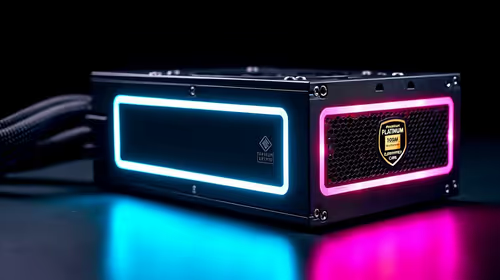
80+ Gold vs 80+ Platinum for Couch co-op gaming in SA
80+ Gold vs 80+ Platinum for couch co-op gaming is about PSU efficiency, heat, fan behaviour, quality, and wattage headroom, not direct FPS. SA buyers should compare the whole build.
Read moreCommon myth: e-atx case worth it is overkill for most SA gaming PCs. Reality is more nuanced, and the guide spells out when it earns its Rand price. Built for SA gaming PC buyers. Read the spec sheet.
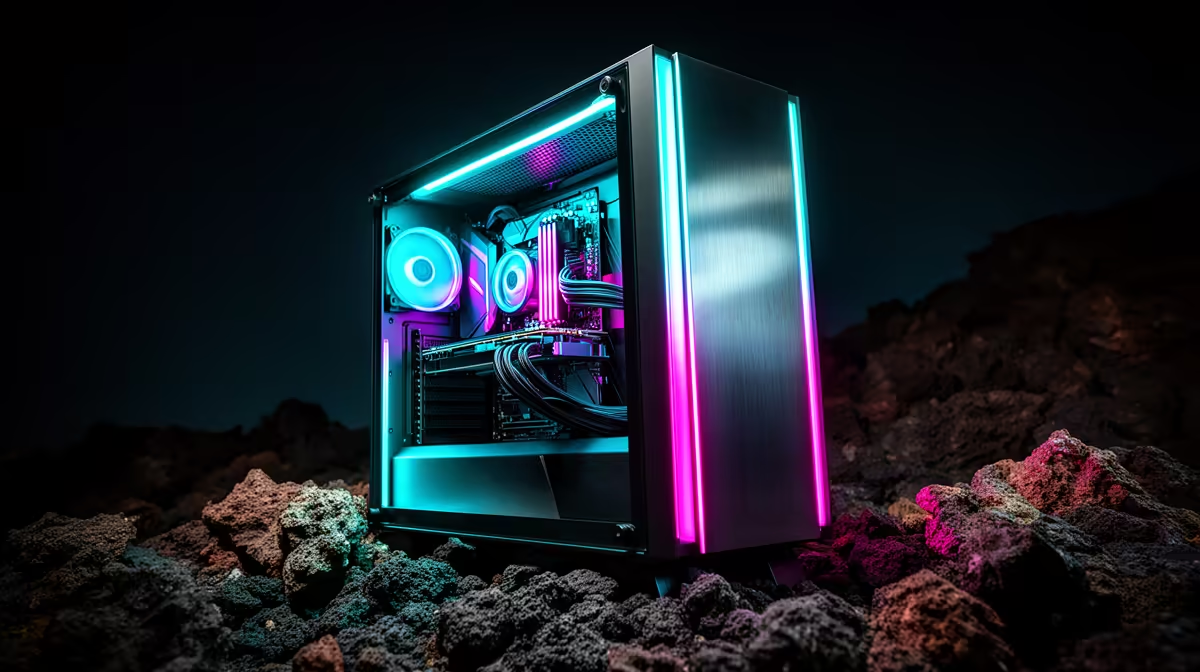
An E-ATX case is worth it only if you are using an E-ATX motherboard. If your board is standard ATX at 305mm by 244mm, which covers most gaming motherboards including premium ASUS ROG and MSI MEG models, an E-ATX case adds cost and size without adding functionality. E-ATX boards are a niche choice for HEDT platforms and professional workstations rather than gaming PCs.
An E-ATX case's motherboard tray is wider than a standard ATX tray, with standoff positions extending further to accommodate the 330mm board width. This extra width creates more clearance between the right edge of the motherboard and the PSU shroud wall, simplifying routing the 24-pin ATX power cable in large boards with dense rear IO.
Outside of motherboard compatibility, E-ATX cases are functionally similar to large ATX mid-towers. Some full-tower E-ATX cases include additional drive bays, useful for builds with multiple 3.5-inch hard drives. For pure gaming, that extra storage capacity is rarely a deciding factor.
The answer for gaming is almost always no. The highest-performance gaming motherboards in 2026 use standard ATX form factor. Intel Z890 boards like the ASUS ROG Maximus Z890 Apex and AMD X870E boards like the MSI MEG X870E ACE are all standard ATX at 305mm by 244mm. Fitting an RTX 5090 and a Ryzen 9 9950X in a top-tier ATX board and a premium ATX mid-tower covers every gaming use case.
E-ATX enters the conversation for AMD Threadripper PRO or Intel Xeon W workstation builds where the board form factor mandates E-ATX sizing. These platforms are built for professional computation, not gaming, and total system cost typically exceeds R80,000.
An E-ATX-capable full-tower case adds R600 to R1,500 over a premium ATX mid-tower of equivalent build quality. If the E-ATX case is not needed for board compatibility, that cost adds no performance or functional benefit. For a R30,000 gaming build, redirecting R1,000 toward a better GPU or faster RAM delivers a measurable gaming performance improvement.
Desk and floor footprint also increases significantly. A full-tower E-ATX case occupies roughly 20 percent more floor space than a mid-tower and is 15 to 20 centimetres taller, which matters in South African flats and townhouses where the gaming setup often occupies a single room serving as bedroom, study, and gaming space simultaneously.
Before ordering any case, verify your motherboard form factor by reading the spec sheet rather than the marketing name. Supreme, Ultra, Apex, and Pro are marketing tier names, not size descriptors. If the spec sheet lists 305mm by 244mm, you have a standard ATX board and do not need an E-ATX case.
Virtually none. Consumer gaming platforms on Intel and AMD use ATX or Micro-ATX form factors. E-ATX is reserved for workstation and HEDT platforms with multi-channel memory and additional PCIe lanes.
Yes. E-ATX cases support standard ATX motherboards using the same standoff positions. The extra internal width is simply unused with no performance impact.
The most demanding consumer gaming platform in 2026 uses a Ryzen 9 9950X or Core i9 on a standard ATX board with an RTX 5090. This is fully supported in a premium ATX mid-tower with 380mm GPU clearance and 360mm radiator support.
Building a high-end gaming PC and unsure whether E-ATX applies to your build? Browse Evetech's full-tower and mid-tower range with detailed compatibility specs to match your exact motherboard form factor and cooling requirements.
80+ Gold vs 80+ Platinum for couch co-op gaming is about PSU efficiency, heat, fan behaviour, quality, and wattage headroom, not direct FPS. SA buyers should compare the whole build.
Read more
80+ Platinum or 80+ Titanium for competitive should be shortlisted around the job it must do. South African buyers should compare fit, performance, compatibility, and upgrade room, warranty path, and upgrade room before treating any pick as best.
Read more
The real world difference between IPS and OLED for AAA single-player gaming is immersion versus versatility. OLED lifts contrast and dark scenes, while IPS can suit bright rooms, mixed PC use, and SA buyers watching total setup cost.
Read more
HDMI 2.1 vs HDMI 2.0 for SA MMO needs a workload-first comparison. For SA buyers, judge real performance, platform fit, warranty path, power needs, and upgrade timing before choosing either side.
Read more
USB4 and Thunderbolt 4 differ for competitive esports through dock, display, and capture consistency. Use this real world difference between usb4 and thunderbolt 4 for competitive guide to keep SA tournament desks tidy without assuming better ping.
Read more
Magnetic switches vs Mechanical switches depends on Competitive esports needs, platform limits, and budget fit. Compare compatibility, latency, upgrade path, and real setup constraints before choosing for an SA build.
Read more
NVIDIA lists 550W required system power for the RTX 5060 reference specification, based on a high-end test system. A quality 550W unit can be enough, but CPU draw, transient load, connectors and ageing decide real headroom.
80+ Gold vs 80+ Platinum for couch co-op gaming is about PSU efficiency, heat, fan behaviour, quality, and wattage headroom, not direct FPS. SA buyers should compare the whole build.
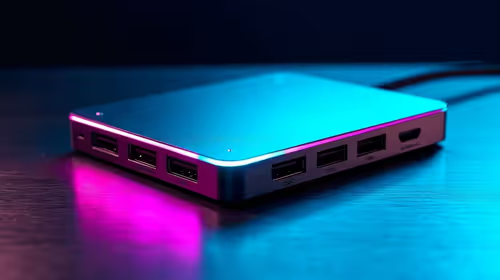
Upgrade your setup with the best USB-C hubs for creators. Discover why high-capacity card readers and dual 4K output are essential for professional South African content production. 🚀💻

B850 motherboard FPS drops needs a methodical troubleshooting pass. Review drivers, thermals, power settings, background apps, cables and game settings before replacing parts in an SA gaming setup.
NVIDIA lists 550W required system power for the RTX 5060 reference specification, based on a high-end test system. A quality 550W unit can be enough, but CPU draw, transient load, connectors and ageing decide real headroom.

OpenRGB's master branch now carries changes labelled for 1.0 final, including translation and platform work, but the official tags page still lists 1.0rc3.1 as the newest packaged release. Stable users should wait for the signed release channel.

A motherboard can remain useful for many years when power, cooling and connectors stay healthy. Replace it for confirmed faults, damaged power delivery or a blocked platform need, not simply because the calendar reaches a fixed age.
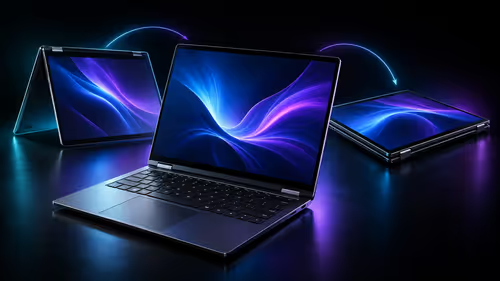
The VAIO T combines a 13.3-inch display with a multi-flip mechanism for laptop, tablet and outward-facing viewing modes. Orders begin in Japan on 18 September; South African availability is unconfirmed.
NVIDIA lists 550W required system power for the RTX 5060 reference specification, based on a high-end test system. A quality 550W unit can be enough, but CPU draw, transient load, connectors and ageing decide real headroom.
The VAIO T combines a 13.3-inch display with a multi-flip mechanism for laptop, tablet and outward-facing viewing modes. Orders begin in Japan on 18 September; South African availability is unconfirmed.
OpenRGB's master branch now carries changes labelled for 1.0 final, including translation and platform work, but the official tags page still lists 1.0rc3.1 as the newest packaged release. Stable users should wait for the signed release channel.
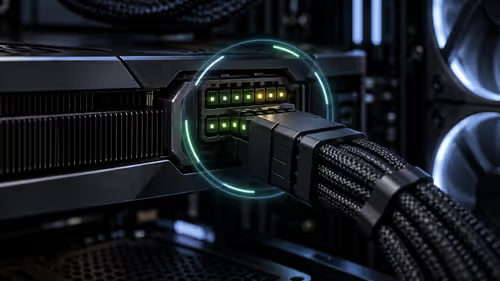
The Cooler Master GPU Shield Adapter monitors current on individual 12+4-pin contacts, adds visual and audible warnings, and can reduce system power during a severe abnormality. Local availability is unconfirmed.