Quick Answer
For most South African high-end gaming builds, a standard ATX mid-tower is the better choice unless you specifically need an EATX motherboard's extra PCIe lanes or M.2 slots. EATX mid-towers exist in a narrow product category and cost R1,500 to R3,000 more than equivalent ATX mid-towers for limited real-world benefit in a single-GPU gaming context.
What Defines an EATX Mid-Tower Case 📐
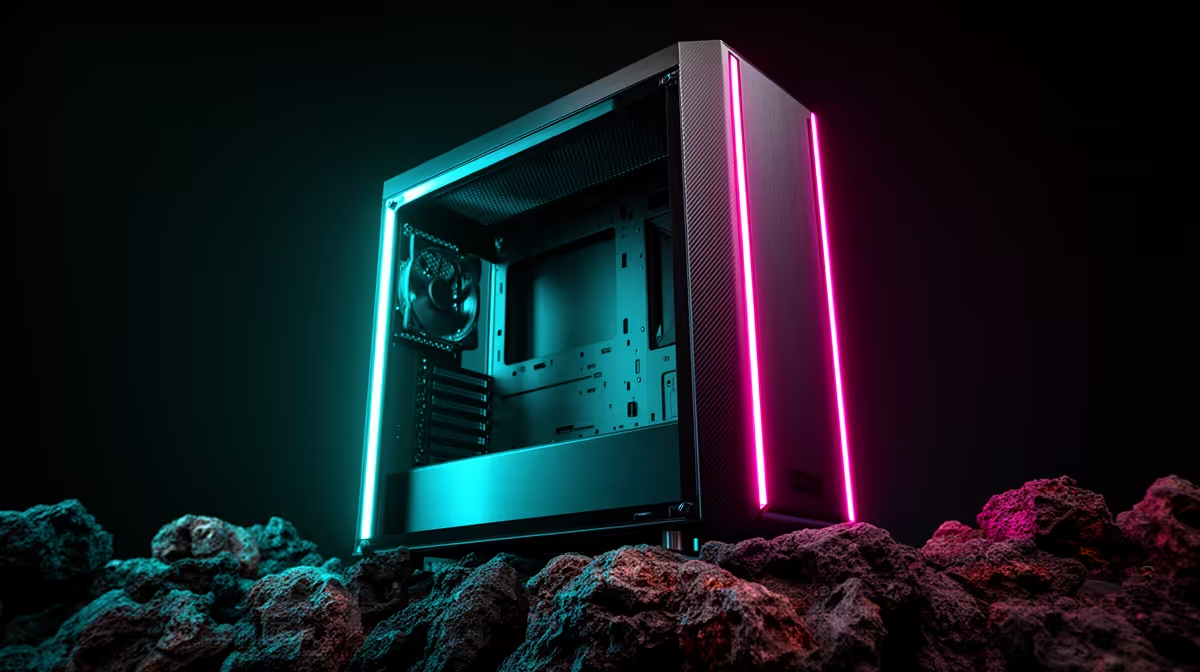
An EATX mid-tower is a mid-tower chassis sized to accommodate a 305 mm wide EATX motherboard, which requires a wider-than-standard internal cavity. These cases typically measure 260 mm to 280 mm in external width compared to 220 mm to 240 mm for ATX mid-towers, and they sit in a price band of R4,500 to R8,000 for quality examples locally. They exist primarily for workstation and enthusiast builds where an EATX board provides eight DIMM slots, additional PCIe lanes for multi-GPU workstation setups, or a dual 10 GbE NIC. For pure gaming with an RTX 5080 and Ryzen 9 9950X, the EATX platform advantages are mostly irrelevant since modern ATX Z890 and X870E boards already offer four M.2 slots and full PCIe 5.0 lane allocation for a single GPU.
When EATX Mid-Tower Makes Genuine Sense 🔧
An EATX mid-tower earns its cost premium in specific scenarios. If you are building a streaming rig that needs a capture card, additional NVMe expansion, and a 10 GbE card all simultaneously populated alongside a flagship GPU, an EATX board's slot count becomes necessary. Streamers covering SA esports tournaments like VS Gaming or DGL events who need zero-latency capture alongside CPU-intensive encoding genuinely benefit from the extra PCIe slots. Photogrammetry and 3D rendering professionals who also game similarly need the RAM capacity of an EATX board's eight DIMM slots, which allow up to 256 GB of DDR5. For these users, an EATX mid-tower at R6,000 to R7,500 is justified.
Thermal and Build Considerations in the SA Context 🌡️
Mid-tower EATX cases face a specific challenge: fitting a wide board into a relatively compact chassis leaves less room for front radiator mounting. Most EATX mid-towers max out at 360 mm radiator support, whereas full-tower alternatives support 420 mm. In South African summers, the extra 15 percent to 20 percent thermal headroom of a 420 mm radiator is tangible for overclocked builds in hot rooms. If you are considering an EATX mid-tower, verify that GPU clearance exceeds 360 mm and that at least three 140 mm fan positions exist at the front and top combined, because the constrained internal volume of a mid-tower chassis makes airflow management more critical than in a full-tower.
ATX vs EATX Decision Shortcut ⚡
Check your motherboard's specification sheet for the form factor label before purchasing a case. A board labelled "ATX" is 305 mm tall by 244 mm wide. A board labelled "E-ATX" or "EATX" is 305 mm by 305 mm. If your board is ATX, you do not need an EATX case and can save R1,500 to R3,000 by choosing a standard ATX mid-tower with equivalent features.
FAQ
Can an ATX board fit in an EATX mid-tower case?
Yes, all EATX cases accommodate ATX boards using the same standard standoff pattern. You will have empty space in the chassis, but it still builds and operates correctly. This makes an EATX case future-proof if you plan to upgrade to an EATX board later.
Are EATX mid-towers harder to find locally in South Africa?
The EATX mid-tower category is smaller than ATX mid-towers, so local stock is more limited. Full-tower EATX cases are generally easier to source locally with full warranty support.
Does an EATX mid-tower cost more to cool?
Not inherently, but the tighter internal proportions require careful fan placement. Budget for three high-static-pressure 140 mm fans in addition to any AIO cooler, which adds R600 to R1,200 to the cooling budget.
Sizing up your next high-end gaming build?
Evetech stocks ATX and EATX mid-tower cases alongside flagship motherboards, letting you configure the right form factor for your exact requirements.