Quick Answer
Yes, HomeKit compatible modular lighting is worth it for SA smart home setups, provided you already own Apple devices and a stable Wi-Fi router. Entry kits start around R1,200 to R2,500 locally, and the automation payoff across multiple rooms justifies the spend over time.
What HomeKit Modular Lighting Actually Offers 🏠
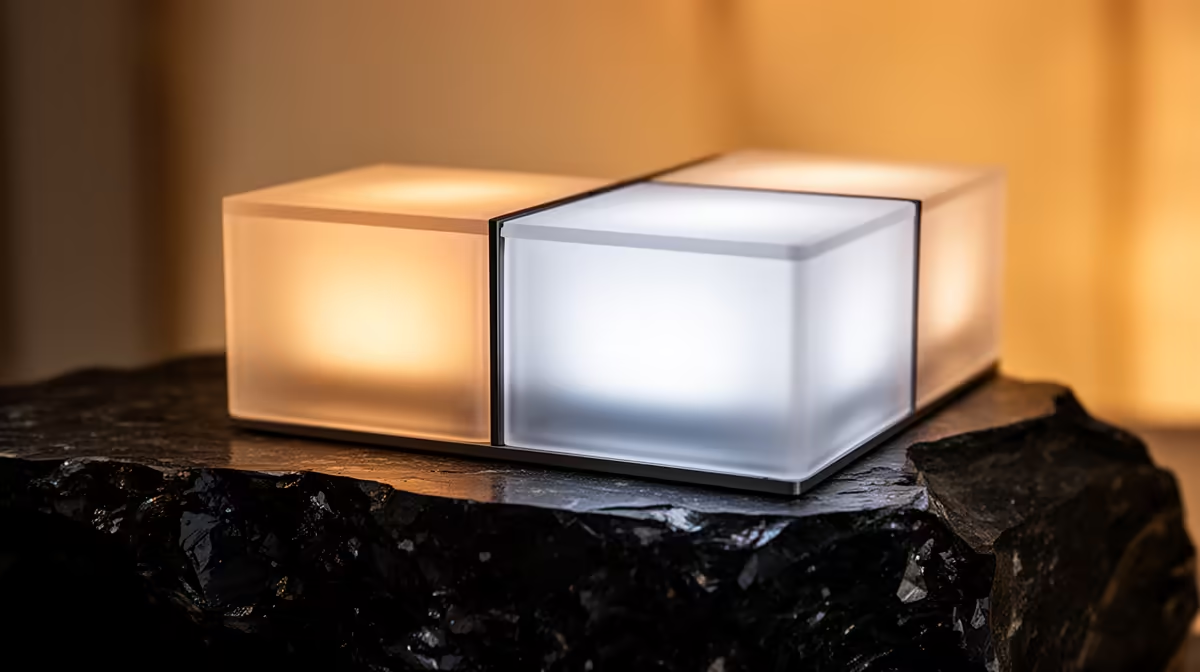
HomeKit gives you tight, local-network-first control over your lights without relying entirely on cloud servers. Modular panel systems like Nanoleaf Shapes or similar hexagonal tiles connect as a single HomeKit accessory, so you can group them with other smart devices and trigger scenes through the Home app or Siri. For SA users, that local-processing advantage matters because commands execute even when your internet drops briefly. Most kits ship with a controller panel, power adapter, and mounting tape, with expansion packs sold separately in 1-pack or 3-pack bundles.
SA-Specific Considerations Before You Buy 💡
South African homes typically run 230V AC, so check that any kit explicitly supports 220-240V input before purchasing. Most internationally designed modular systems do include a universal power supply, but it is worth confirming in the spec sheet. Wi-Fi band compatibility is another local quirk: older SA routers that only broadcast 2.4GHz work fine with most HomeKit lighting (Nanoleaf panels all use 2.4GHz), but if your ISP-supplied router from Vumatel or Openserve is dual-band, keep the lights on 2.4GHz for stability. Thread-enabled panels (which use the Matter-over-Thread standard) need a HomePod mini or Apple TV 4K as a home hub, adding roughly R1,500 to R2,200 to your budget if you do not already own one.
Modular Expansion Costs and Long-Term Value 📐
The real cost of modular lighting is not the starter kit but the expansions. A 1-pack expansion typically adds one extra tile and costs around R400 to R700 depending on shape. Building a full feature wall with 20-plus panels can push your total spend past R8,000. That said, the system genuinely grows with you: panels bought years apart remain compatible within the same ecosystem. For gaming rooms in Johannesburg or Cape Town where content creation and streaming are common, having programmable, scene-linked lighting that reacts to your Mac or iPhone triggers is a legitimate workflow upgrade, not just aesthetics.
HomeKit Hub Tip ⚡
If you do not have an Apple TV or HomePod mini, your HomeKit lights will not respond to automations when your iPhone leaves home. A second-hand Apple TV HD (4th gen) bought locally for around R800 to R1,200 works as a basic hub and unlocks all away-from-home automations without the full HomePod mini cost.
FAQ
Do I need a hub for HomeKit lighting to work in South Africa?
For basic on/off and scene control while you are at home, no hub is required. For automations that trigger when you leave or arrive, you need an Apple TV (4K or HD) or HomePod mini connected to your home network. These are available locally and stocked at Evetech.
Will my SA Wi-Fi router work with HomeKit panels?
Most modular LED panels use 2.4GHz Wi-Fi, which every SA router supports. The only setup requirement is a standard WPA2 or WPA3 password-protected network. ISP routers from Openserve or Frogfoot work without any special configuration.
Can I mix HomeKit panels from different brands?
HomeKit is a protocol standard, so multiple brands show up in the same Home app. However, multi-brand grouping for simultaneous scene changes can be inconsistent. For the best sync, stick to one panel ecosystem and use HomeKit purely for broader room-level automations.
Ready to upgrade your smart home lighting?
Browse HomeKit-compatible LED panels and smart home accessories stocked at Evetech, with local stock available online.