Quick Answer
Yes. Thunderbolt 2 ports are fully compatible with modern Mini DisplayPort bi-directional cables because they share the same physical connector and electrical DisplayPort protocol. A current DP 1.4 bi-directional cable plugged into a Thunderbolt 2 port activates the DisplayPort function and supports up to 4K 60Hz output.
The Thunderbolt 2 and mDP Relationship 🔌
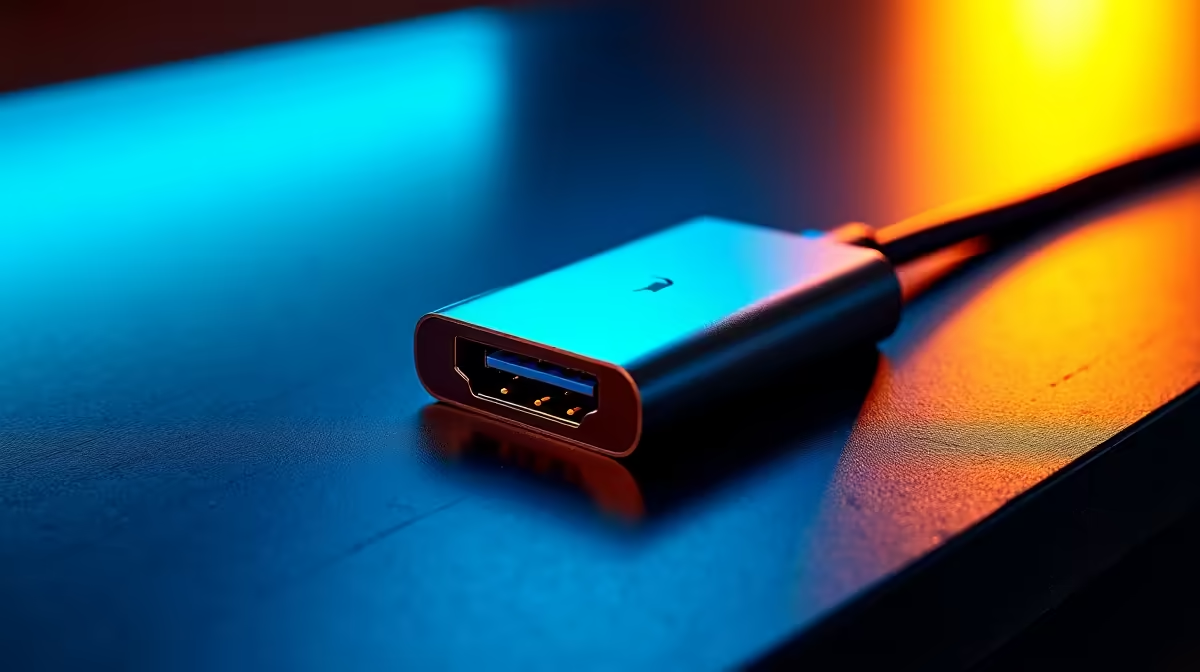
Thunderbolt 2 was designed by Intel and Apple specifically around the Mini DisplayPort physical form factor. The port carries two separate protocols on the same pins: Thunderbolt PCIe lanes for high-speed peripherals, and DisplayPort signalling for video output. When a passive DisplayPort cable is connected, the system activates the DP protocol and the port behaves identically to a standard Mini DisplayPort output. Thunderbolt 2 routes DisplayPort 1.2 signalling, supporting 4K UHD at 60Hz with 8-bit colour over any cable that meets DP 1.2 spec. Modern bi-directional mDP cables rated for DP 1.4 are backward compatible with DP 1.2 sources, so the cable itself is not a limitation.
What Bi-Directional Means in This Context 🔄
For a passive mDP-to-DP cable, bi-directional means either end can connect to either the source or the display without affecting signal quality, since DisplayPort 1.4 specifies automatic role negotiation. In practical terms for Thunderbolt 2 users: you can connect the full-size DP end to the MacBook or PC and the mDP end to a rare mDP-input monitor, or the conventional mDP-to-source and DP-to-monitor orientation, and both work identically. The bi-directional property is most relevant for Thunderbolt 3 and 4 USB-C cables where role negotiation handles much more complex multi-protocol handshaking. For mDP passive cables, it is a minor convenience rather than a critical feature.
Compatibility Boundaries to Know 🔧
Thunderbolt 2 does not support the Thunderbolt-specific features of modern cables such as PCIe tunnelling at Thunderbolt 3 speeds (40 Gbps) or USB4 protocols. The video output compatibility is complete, but if you connect a Thunderbolt 3 or 4 peripheral to a Thunderbolt 2 port via an adapter, data throughput is limited to Thunderbolt 2 speeds (20 Gbps). For South African users with a Thunderbolt 2 MacBook or Mac Pro connecting to a 4K monitor via mDP-to-DP, the compatibility is seamless. For connecting Thunderbolt 3 or 4 external storage or docks, an active Apple Thunderbolt 2 to Thunderbolt 3 adapter is required at a cost of around R800 to R1,200 locally.
4K 60Hz Needs DP 1.2 Cable Minimum ⚡
A modern bi-directional mDP cable rated for DP 1.4 backwards-negotiates to DP 1.2 with a Thunderbolt 2 source, so 4K 60Hz works correctly. An old DP 1.1 cable does not provide enough bandwidth for 4K 60Hz from any source; always check the DP version rating on cable packaging before purchasing.
FAQ
Can a Thunderbolt 2 port support two 4K monitors simultaneously?
No. A single Thunderbolt 2 port provides one DisplayPort signal path. Driving two 4K monitors requires two separate ports or a daisy-chain via Thunderbolt displays (not available on passive DP monitors).
Does bi-directional cable support improve data transfer over Thunderbolt 2?
Not for passive display cables. Bi-directional data transfer at Thunderbolt speeds requires Thunderbolt-certified active cables, not passive mDP video cables.
What is the maximum resolution Thunderbolt 2 can drive over a bi-directional mDP cable?
The maximum is 4K UHD (3840x2160) at 60Hz via DisplayPort 1.2 routing. The bi-directional property of the cable does not change this ceiling; it is set by the Thunderbolt 2 controller's DP 1.2 implementation.
Connecting a Thunderbolt 2 Mac or PC to a modern 4K display?
Evetech stocks Mini DisplayPort cables compatible with Thunderbolt 2 ports for 4K 60Hz video output. Browse the display accessories section for available lengths.