Quick Answer
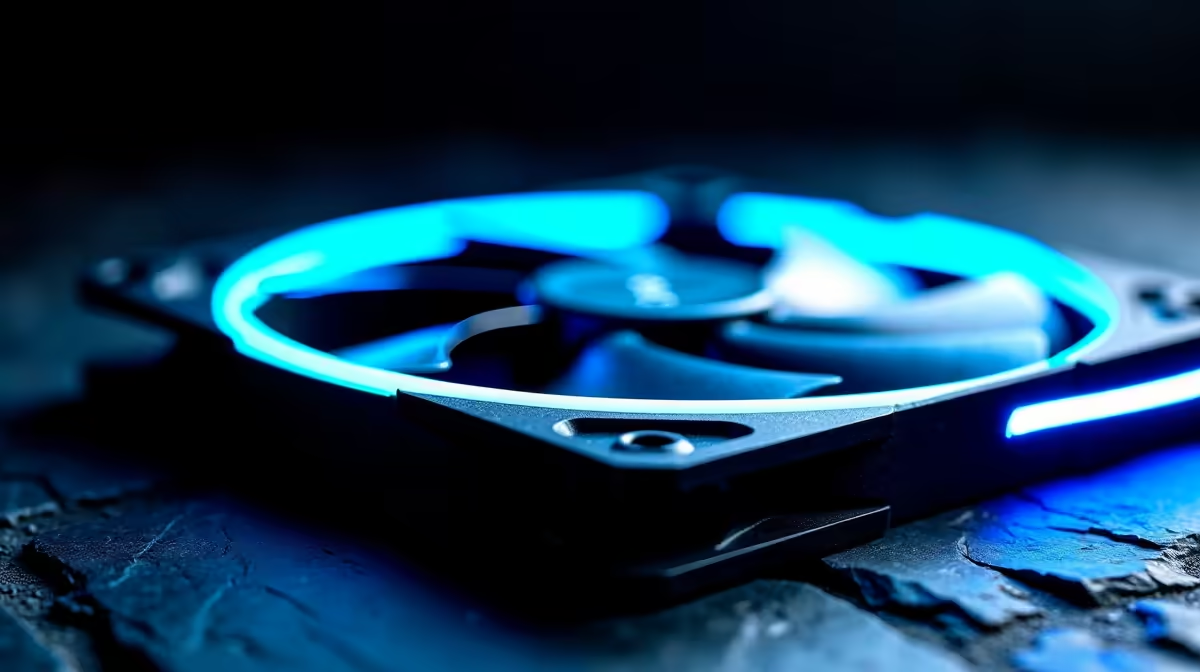
LCP (Liquid Crystal Polymer) fan blades are stiffer and more dimensionally stable than standard ABS plastic blades, reducing flex-induced vibration at high RPM and improving durability in warm operating environments. For high-RPM fans in gaming PCs, LCP is the superior blade material.
What Makes LCP Different From Standard ABS Plastic 🔬
Standard PC fan blades are injection-moulded from ABS or polypropylene. These materials are adequate for fans running at 1,000 to 1,200 RPM. At higher speeds (1,500 to 2,500 RPM), centrifugal forces flex the blade tips outward, increasing the gap to the fan frame, reducing pressure efficiency and creating flutter noise. LCP is a high-performance thermoplastic with very high stiffness and low density. It maintains moulded geometry under centrifugal stress and resists heat deformation when SA summer case temperatures reach 40 degrees Celsius. Several fan brands use LCP specifically for high-RPM low-noise designs.
Durability Comparison in Warm SA Environments 🌡️
SA gaming PCs in Gauteng and the Western Cape face summer ambient temperatures of 28 to 38 degrees Celsius. Inside a case under load, ambient can reach 35 to 45 degrees Celsius. Thermal cycling (cooling overnight, heating during gaming) over years causes micro-fatigue in ABS blades. LCP's thermal stability is rated to 180 to 250 degrees Celsius depending on formulation, showing no degradation from typical case thermal cycling over a five-to-eight-year lifespan. LCP blades are a meaningful investment for SA builders who seldom replace components.
Does Blade Material Affect Noise and Airflow Performance? 🔇
At the same RPM, an LCP fan typically produces 1 to 3 dBA less noise than an equivalent ABS fan, primarily because the stiffer blade maintains its designed aerodynamic profile more precisely, reducing turbulence at the blade tips. The airflow and static pressure figures are also slightly improved: a rigid blade that does not flex under load delivers closer to its rated CFM and mmH2O specs than a blade that deforms under centrifugal stress. For gaming builds where fans push air through radiators, dense heatsinks, or restrictive front mesh panels, these small efficiency gains translate to marginally lower temperatures at equivalent fan speeds.
Check the Material Spec Sheet for High-RPM Fans ⚡
Fan product listings do not always highlight blade material in the headline specs. If you are buying a high-RPM fan (above 1,500 RPM max) for a performance build, check the manufacturer's full spec sheet or product detail page for the blade material designation. LCP, liquid crystal polymer, or 'stiffened polymer frame' in the spec indicates the superior material. This detail is usually buried in the third or fourth paragraph of a product description.
FAQ
Are LCP fans significantly more expensive than standard ABS fans?
Usually R50 to R150 more per fan for a 120mm unit. A quality ABS fan costs R120 to R200; an equivalent LCP fan costs R180 to R350 from reputable brands. For a three-fan setup, the premium totals R150 to R450, which is modest relative to the build cost.
Can I tell if a fan uses LCP blades just by looking at it?
Not reliably by eye. LCP blades are often slightly more translucent or have a different sheen compared to opaque ABS, but the most reliable method is checking the manufacturer's spec sheet. Handling the fan and flexing the blade tip gently gives a tactile sense of stiffness, but this risks stressing the blade.
Does LCP blade material matter for low-RPM, silent fans?
Less so. At below 1,000 RPM, the centrifugal forces are insufficient to flex even standard ABS blades meaningfully. LCP's advantages become pronounced above 1,200 to 1,500 RPM where flex-induced noise and efficiency loss in ABS fans become measurable.
Looking for high-performance fans for your SA gaming build?
Evetech stocks case fans from leading brands including LCP-blade options suited to high-RPM cooling setups, available for delivery across South Africa.