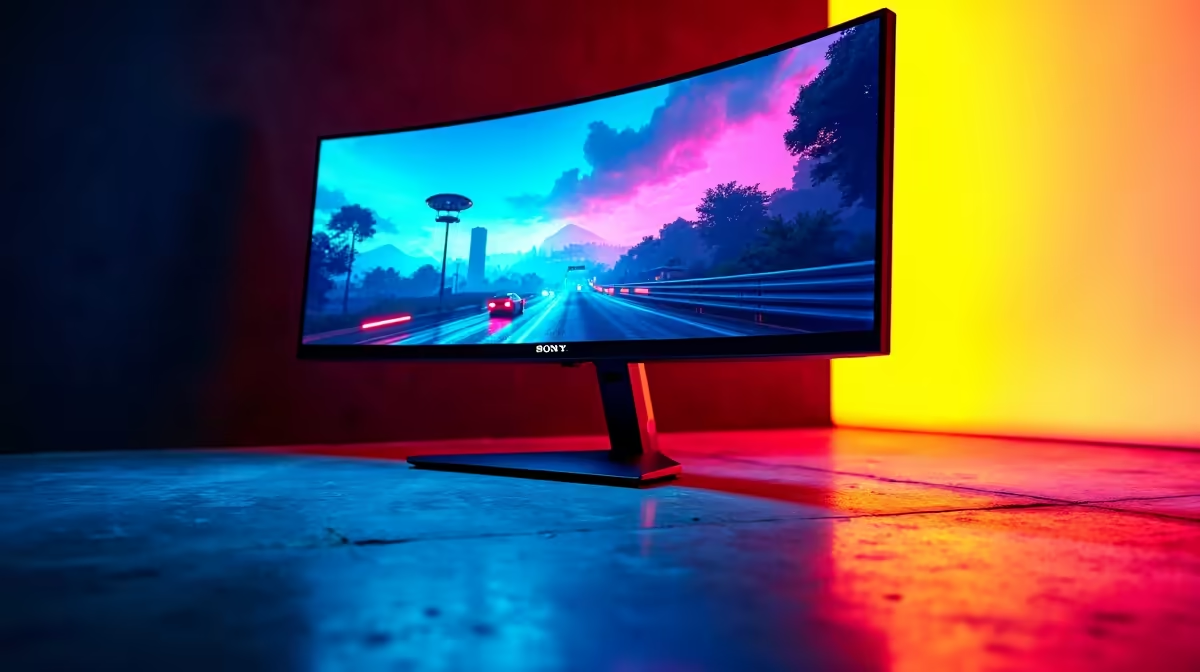
A 27-inch QHD gaming monitor is one of the few display purchases where the middle of the market is genuinely the right place to spend. Go smaller and 1440p loses its sharpness advantage. Go bigger and 1440p needs 4K to stay crisp. Spend on premium extras and you often pay for HDR tiers that add nothing to how a game actually plays. The skill in this buy is identifying which specs deliver tangible performance gains and which ones are marketing padding dressed up as features. Maximising your budget when buying a 27-inch QHD gaming monitor means knowing which column each spec sits in.
Quick Answer
Prioritise a fast IPS panel, 144Hz or higher, and adaptive sync. These three specs shape the day-to-day gaming experience directly. Skip DisplayHDR 400 panels -- the tier adds little visible impact. Capable 27-inch QHD IPS models with those features start near R4,500, leaving room to allocate budget wisely.
💰 Where the Money Should Go First
The features that change how a game feels share a common trait: they affect every session, every genre, every hour of use. A fast response time does not matter only in shooters; it shapes the clarity of any on-screen movement. A high refresh rate does not only help in competitive play; it improves the desktop, scrolling, and every animated transition you encounter. Adaptive sync does not only apply during intensive sequences; it smooths frame delivery across the full range of system load.
These three -- panel speed, refresh rate, and variable sync -- are the core budget targets. A 27-inch QHD IPS panel with 144Hz, 1ms to 2ms GtG, and FreeSync or G-Sync Compatible certification covers everything the majority of South African gamers will ever genuinely need from a monitor. Expect to pay R4,500 to R6,000 for a panel meeting this specification, with the exact price varying by brand and stock availability.
The question to ask about every additional feature beyond those three is this: will I notice this in actual sessions? If the honest answer is uncertain, it is very likely budget padding.
The VA Alternative at the Budget Floor
VA panels at 27 inches QHD can bring the starting price down further, sometimes into the R3,800 to R4,500 range, because they carry deeper contrast ratios as their headline feature rather than the response time engineering that pushes IPS costs up. For primarily single-player and casual gamers who do not need sub-2ms dark transitions, a VA panel at this price point is a legitimate spend. Check the specific model's dark-scene response benchmarks -- not just the GtG spec rating -- before buying.
🔆 HDR Tiers: Where Budget Goes to Underperform
HDR is the feature most likely to cost disproportionately for the improvement it delivers at the monitor level. The entry HDR tier, DisplayHDR 400, requires only 400 nits of peak brightness and permits edge-lit local dimming or no local dimming at all. Most HDR 400 monitors deliver a visibly dim, flat image in HDR mode compared to a well-calibrated SDR image on the same panel. The HDR badge is present; the HDR experience is largely absent.
For HDR to register as meaningfully better than a good SDR panel in gaming, you need a minimum of DisplayHDR 600 with real local dimming zones, ideally mini-LED with 100 or more zones. Panels meeting that standard in a 27-inch QHD form factor push past R9,000 and often beyond R12,000. Unless HDR quality is the explicit goal and the GPU is capable of feeding HDR content consistently, that spend is difficult to justify as a gaming performance investment.
The practical advice: buy the fastest IPS panel your budget allows and skip the HDR badge at the R5,000 to R7,000 price tier entirely. The SDR image on a quality IPS panel looks excellent in this range, and a well-set brightness and contrast calibration will look better than mediocre HDR implementation.
Pro Tip ⚡
Before purchase, look for monitors that publish their factory Delta E score or include a calibration report in the box. A factory-calibrated 27-inch QHD IPS panel at R5,500 to R6,500 will often produce more accurate colours out of the box than a cheaper panel that claims HDR but ships with a poorly tuned colour profile. Calibration quality is an under-discussed budget multiplier.
🔌 Connection Specs That Matter at QHD
One area where spending slightly more does pay off is in connection bandwidth. QHD at 144Hz requires the right cable specification to deliver the full signal without compression. DisplayPort 1.4 handles 1440p at 165Hz comfortably and is the preferred choice. HDMI 2.0 covers QHD at 144Hz; HDMI 2.1 is not required unless you are planning a console input at 4K 120Hz.
Budget monitors at QHD occasionally ship with only HDMI 2.0 and no DisplayPort. This is workable for 144Hz but limits future flexibility. Panels that include at least one DisplayPort 1.4 input preserve the option to upgrade the GPU without encountering a cable bottleneck.
USB hubs integrated into the monitor are a convenience feature rather than a performance one. If you use the desk for work as well as gaming, a monitor with two USB-A ports and a hub saves cable clutter. If the setup is gaming-only, this is not worth a price premium.
✨ Choosing Between Competing Models at the Same Price
At the R5,000 to R6,500 point there are typically several 27-inch QHD IPS options available. Distinguishing between them comes down to three secondary factors: overdrive tuning, stand adjustability, and the warranty terms of the panel manufacturer in South Africa.
Overdrive tuning affects the real-world response experience more than the rated GtG spec. Read owner reviews and look for testing data that measures overshoot at each overdrive level -- a panel with a well-tuned medium setting will behave better in daily use than one with a lower rated GtG but aggressive overshoot artefacts.
Stand adjustability matters over months of use. A monitor that tilts, swivels, and adjusts height reduces ergonomic strain across long sessions. This is genuinely worth a few hundred rand over a fixed-tilt stand, and it is the kind of feature that improves the experience every day rather than only during intense sequences.
Frequently Asked Questions
What does a capable 27-inch QHD gaming monitor cost in South Africa?
Entry-level QHD IPS panels with 144Hz and adaptive sync start near R4,500, with premium versions delivering broader sync ranges, better factory calibration, and improved stand adjustability pushing to R7,000 and beyond. Most value-per-rand concentration lands between R5,000 and R6,500.
Is DisplayHDR 400 worth paying extra for?
Rarely. The HDR 400 specification permits implementations that look nearly identical to a well-tuned SDR panel in practice. The tier requires only 400 nits peak brightness and does not mandate local dimming, which means dark scenes remain flat. Budget is better allocated to a faster panel response or a higher refresh rate.
Can a 144Hz QHD panel be had without overspending?
Yes. Multiple 27-inch IPS panels pair 144Hz with adaptive sync certification near the R5,000 mark. These panels cover the core gaming performance requirements without the premium charged for HDR tiers, OLED panels, or oversized stands with RGB lighting.
Is it worth choosing a VA over an IPS panel to save budget?
It can be. VA panels at 27-inch QHD sit below the entry IPS price point and offer superior native contrast for darker game environments. The trade-off is slower pixel response in dark-tone transitions. For casual and single-player gamers who are not chasing sub-2ms performance, a well-reviewed VA model can be excellent value.
Why does 27 inches suit QHD better than 32 inches at the same budget?
At 27 inches QHD delivers 109 pixels per inch, sharp enough for text and detailed game assets without Windows display scaling. At 32 inches the same resolution drops to 92 PPI, where pixels become individually visible at close viewing distances. Matching QHD to the 27-inch form factor maximises the resolution investment within a tighter budget.
Ready to find the QHD panel that fits your budget and your playstyle?
Browse the 27-inch gaming monitor range at Evetech and compare IPS and VA options across the R4,500 to R7,000 range.