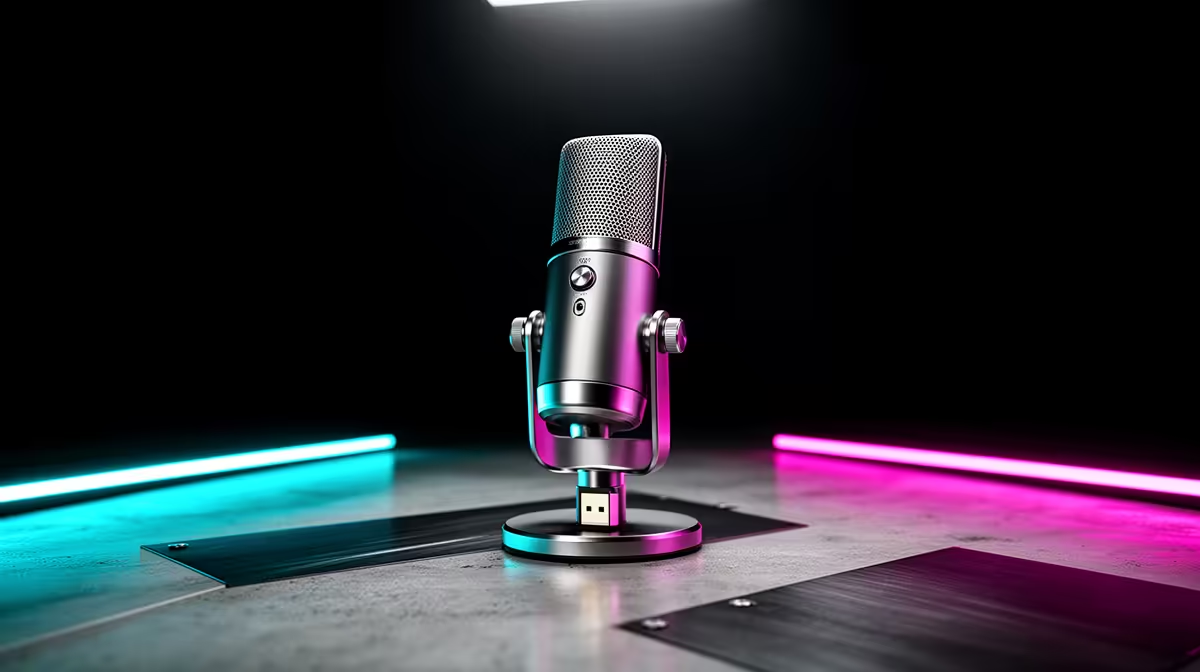
Two thousand rand is a real streaming audio budget. It is tight but not desperate, and the difference between spending it well and spending it poorly is whether you know which specs actually matter at this price bracket. Maximising a R2,000 streaming audio budget means resisting the things the packaging makes sound important and putting the money where the capsule and the build quality sit. Get that right and a sub-R2,000 USB condenser can sound genuinely broadcast-ready.
Quick Answer
Spend around R1,400 on a cardioid USB condenser with a high SNR, a tap-mute button and a headphone jack for zero-latency monitoring. Set aside the remaining R600 for a steel scissor arm to hold the capsule clear of your desk. Skip multiple polar patterns and RGB. A quiet capsule with a clean noise floor is what the Rand is actually buying.
🔧 The Spec That Matters Most at This Budget
The signal-to-noise ratio is the number to find first. It tells you how much clean signal the mic produces relative to its own internal noise floor. At R2,000 you want a spec of 70 dB or higher. Anything below that will produce a faint hiss under quiet passages, which becomes the defining sound of an amateur recording no matter how good the room treatment is.
Large manufacturers include SNR in their published specs. Smaller brands often do not, which is itself a warning sign. If the spec sheet does not list it, the noise floor is probably not something they are proud of.
Sensitivity matters alongside SNR. A sensitivity rating around -35 to -40 dBV per Pascal suits close-mic streaming well. Too sensitive and the mic picks up every fan, keypress and background conversation in your room. Too low and you push the gain into distortion territory to get a full signal. The middle range gives you a capsule that hears your voice clearly from 15 to 20 centimetres while shrugging at the quiet background noise behind you.
Cardioid is the only polar pattern you need. Multi-pattern mics that add omnidirectional or bidirectional modes cost R200 to R400 more at this price point. That extra money is buying modes you will use once to test and never again. A tight cardioid pattern rejects roughly 20 dB of noise from behind the capsule, which is exactly what you want pointed at the back of a semi-treated home setup.
⚡ Features That Earn Their Place Under R2,000
Three functional features are worth paying for, even if they push the mic a little higher in the range.
A tap-mute button is not a convenience feature. It is a safety one. A physical tap cuts the signal at the mic before it ever reaches your streaming software. When your phone rings mid-stream, your delivery driver buzzes the intercom or a cough happens without warning, one tap silences the channel in under a frame. Software hotkeys depend on the app being in focus and responsive. Hardware mute does not.
An onboard headphone jack for zero-latency monitoring is the feature most sub-R1,500 USB mics skip to hit their price point, and its absence costs you more than the saving. Zero-latency monitoring means you hear your own voice directly from the mic capsule with no processing delay. The instant you go live or start recording, you know whether your level is right, whether the room sounds clean and whether the mic is even pointed correctly. Without it, you are guessing. With it, you spend 10 seconds checking and then record with confidence.
A physical gain dial on the body of the mic is the third feature worth having. Opening your audio control panel mid-stream to adjust an input level is slow and disruptive. A knob on the mic body takes two seconds and stays precisely where you set it.
What to skip entirely
RGB lighting on a microphone serves one purpose: it looks good on camera. That is a legitimate use. But a mic with RGB and a mediocre capsule is a prop. At R2,000 you do not have room for both. If two otherwise similar mics are in front of you and one has RGB at an R300 premium, put that R300 toward a better arm.
Multiple polar patterns, as noted above, are not a streaming need. Omnidirectional pickup is for conference rooms and group recordings. Figure-eight is for interview setups with two people on opposite sides of the mic. Neither of those applies to a solo streaming setup, and paying for those modes leaves you with less money for capsule quality.
Pro Tip ⚡
Before committing to a mic, search for the exact model name followed by "noise floor test" or "SNR review" on YouTube. A 90-second clip of someone speaking quietly at normal gain reveals more about the capsule's cleanliness than any spec sheet. This check takes five minutes and has prevented countless poor purchases.
💰 Splitting the R2,000 Budget
The most practical split is approximately R1,300 to R1,500 on the microphone and R500 to R700 on a steel scissor arm. This order of priorities is intentional. A great mic on a bad mount sounds degraded every time the desk vibrates. A good mic on a stable metal arm sounds consistently excellent.
Desktop stands are typically bundled with budget mics or sold separately for under R300. They are worth using while you save for an arm, but the arm should not be skipped permanently. Every keyboard tap, desk knock and chair adjustment that transfers up through a desk stand and into the recording is time you spend in editing removing thumps instead of improving content.
A metal scissor arm rated to at least 1 kilogram, with cable routing channels, sets the mic in place, keeps vibration out and clears the desk surface. The R600 it costs at the mid-range is one of the most efficient audio quality investments available.
Headphones do not need to be purchased immediately if you already own a closed-back pair. The mic's headphone jack will accept any standard 3.5mm plug. If your current headphones are open-back, the audio bleed into the capsule while monitoring will cause feedback. Closed-back is the requirement, but the pair you already own is fine if it qualifies.
Frequently Asked Questions
Which microphone spec should I prioritise if I can only focus on one at R2,000?
The noise floor, expressed as the signal-to-noise ratio in decibels. A mic with an SNR of 70 dB or higher delivers a clean, quiet recording even in a lightly treated room. Everything else, polar pattern, sample rate, diaphragm size, matters less than the baseline noise the capsule generates on its own. A hissy capsule cannot be fixed by any other feature on the mic.
Can R2,000 realistically cover both a microphone and a boom arm?
Yes, with the right allocation. A cardioid USB condenser with tap-mute and a headphone jack sits in the R1,300 to R1,500 range from reputable brands. That leaves R500 to R700 for a metal scissor arm, which is enough to get a solid, cable-routing arm that will last several years. The pairing performs well above its combined price if the mic capsule spec is sound.
Is onboard noise reduction realistic at sub-R2,000?
Yes. Many USB condensers in the R1,200 to R1,800 range now include hardware-level noise reduction, applying a gentle high-pass filter and background noise gate at the chip level before the signal reaches USB. This is not a substitute for a quiet room, but it does reduce the cost of a secondary noise reduction plugin and delivers a cleaner signal from the start.
Should I pay extra for multiple polar patterns on a streaming mic?
No. For solo streaming, a cardioid pattern is all you need. It captures voice from the front and rejects roughly 20 dB of ambient noise from behind. Omnidirectional and bidirectional modes serve specific use cases, neither of which applies to a single-host stream or gaming session. The cost difference between a single-pattern and multi-pattern mic in this range is better directed at capsule quality.
Where is the worst place to spend money in a R2,000 audio budget?
On RGB lighting and brand aesthetic premium. A mic with flashy illumination but a mediocre noise floor sounds exactly as mediocre as its capsule. Paying R300 to R400 over a similar-spec competitor purely for the light ring is money that does not reach the recording. Spend it on a better arm or pocket it toward a future upgrade. The audience hears your audio. They do not see your desk setup.
Ready to record clean audio from the first take?
Explore the USB condenser microphone range at Evetech and pair one with a metal boom arm to make every Rand of your streaming budget count.