Hand a complete beginner an Arduino and they spend the first hour wiring a breadboard before a single LED blinks. Hand them a micro:bit and a light pattern scrolls across its face in minutes with no wiring at all. That difference is the whole decision. The micro:bit vs Arduino question is really about whether a learner needs an instant first win or is ready to build real circuits from the start.
Quick Answer
The BBC micro:bit is the better first board for most beginners and younger learners, because its built-in 5x5 LED display and buttons show results with zero wiring. Choose Arduino when the learner is older or specifically wants to build circuits, since it needs a breadboard and external parts before anything happens.
The Core Difference: Built-In Versus Build-It-Yourself
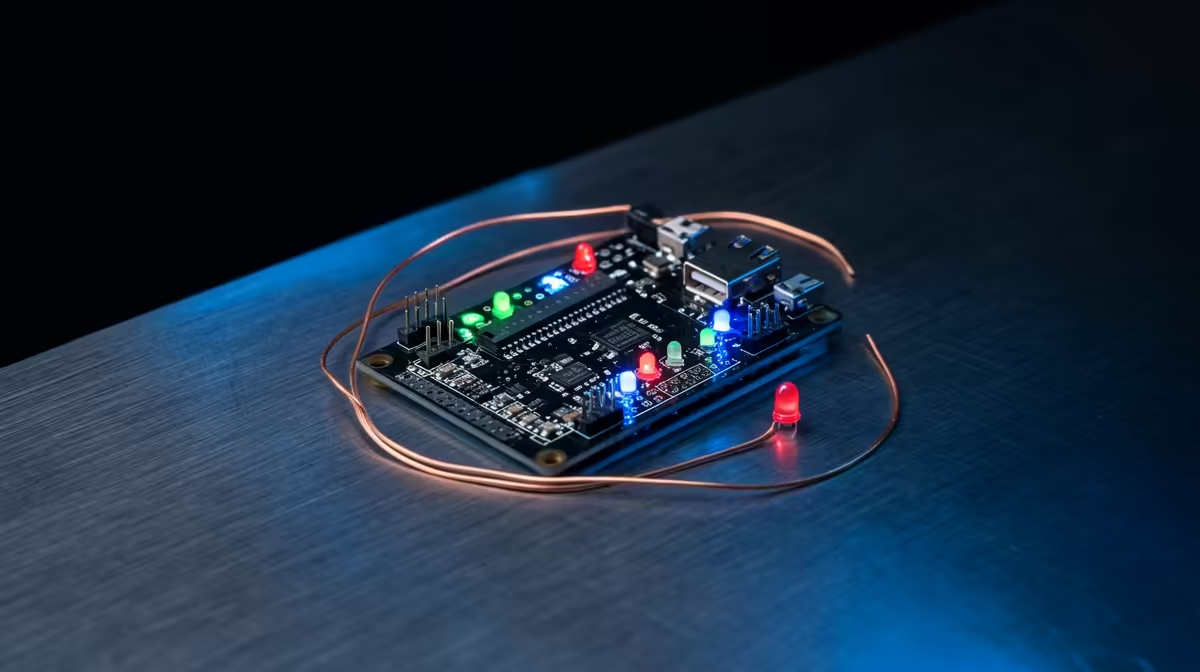
The micro:bit is a complete little computer on one board. It has a 5x5 grid of programmable LEDs, two push buttons, a USB port, and onboard sensors including an accelerometer and magnetometer. A beginner can write their first program, scroll their name across the LEDs, and see it work without connecting anything else. That instant feedback is what keeps a new learner engaged.
The Arduino, typically the Uno, is a bare microcontroller board. It has no built-in display, no buttons for projects, and no sensors. To do anything visible you add a breadboard, jumper wires, resistors, and components. That is more setup, but it is also the point: with Arduino, the wiring and circuits are part of what you are learning.
How They Teach Coding
The two boards approach programming differently, and that shapes who each one suits.
micro:bit: Blocks First, Text Later
The micro:bit is programmed in MakeCode, a drag-and-drop block editor that needs no typing to get started. A child can light the LEDs, read the buttons, or respond to a shake by snapping blocks together. When they are ready, the same board moves on to text-based MicroPython, so the skills grow without changing hardware. This gentle ramp is why the micro:bit suits first-time coders, roughly ages eight to twelve.
Arduino: Straight to Real Code
Arduino is programmed in the Arduino IDE using C and C++, the languages of professional embedded electronics. There is no block mode in the standard workflow, so a learner is writing real code from the first sketch. That is more demanding up front but more powerful long term, which is why Arduino suits older beginners, around thirteen and up, who want depth rather than quick wins.
Which One Should a Beginner Buy First?
Match the board to the learner, not the other way around. If the goal is to spark interest fast in a younger child, the micro:bit's no-wiring start is hard to beat, and it keeps enthusiasm up because something works immediately. If the learner is a teenager or an adult who actively wants to understand circuits and write proper code, Arduino rewards that ambition.
There is also a middle path: many start on the micro:bit, build confidence, then move to Arduino once the wiring and text coding feel approachable. Buying the micro:bit first rarely wastes money, because the concepts transfer directly. You can see beginner boards and starter kits in the STEM and smart home range at Evetech, which is the easiest place to compare what is in stock locally.
What Each One Costs to Get Going
The micro:bit's hidden saving is that the board is the whole project; you can start with just the board and a USB cable. Arduino's true entry cost includes the board plus a breadboard, wires, resistors, and a few components, so budget for a starter kit rather than the board alone. Factor that in when comparing prices, and add extra electronics and maker accessories only as projects demand them rather than all at once.
What Each Board Lets You Build
The boards also point toward different kinds of projects, and that can settle the choice. The micro:bit's onboard accelerometer, compass, buttons, and LED grid make it ideal for self-contained gadgets: a step counter, a digital dice, a reaction-time game, or a simple wearable. Because the inputs and outputs are built in, a learner can prototype a complete idea in an afternoon without sourcing parts. Add-on boards extend it to robotics and sensors when the learner is ready.
Arduino's strength is the opposite: it is a blank canvas wired to the physical world. With the right components a learner can drive motors, read environmental sensors, control LED strips, or build a custom controller. Nothing is built in, so every project teaches a little circuit design, which is exactly what makes Arduino the better choice for someone who wants to understand how electronics actually work rather than just code behaviour.
Community and Learning Resources
Both boards have large, beginner-friendly communities, which matters more than it sounds. The micro:bit is backed by a wealth of school-oriented lessons and the MakeCode editor's built-in examples, so a stuck learner rarely stays stuck. Arduino has one of the largest hobbyist communities anywhere, with countless tutorials, forum threads, and ready-made project guides. Whichever you pick, a beginner who hits a wall will find an answer quickly, and that steady stream of small wins is what keeps a new maker going.
Frequently Asked Questions
Is the micro:bit easier than Arduino for a complete beginner?
Yes. The micro:bit's built-in LED display, buttons, and sensors let a beginner see a working result with no wiring, and its block-based MakeCode editor needs no typing. Arduino requires a breadboard and external parts before anything works.
What age is each board best for?
The micro:bit suits first-time coders roughly aged eight to twelve thanks to its quick wins. Arduino is better for learners around thirteen and up who want to build circuits and write C and C++ from the start.
Does the micro:bit need a breadboard?
Not to begin with. The board has its own LEDs, buttons, and sensors, so early projects need only the board and a USB cable. Breadboards and external parts come later if you choose to expand.
Can I move from micro:bit to Arduino later?
Yes, and many learners do. The micro:bit teaches coding logic and then text-based MicroPython, so the concepts carry over when you step up to Arduino's C and C++ and hands-on wiring.
Which board is cheaper to start with?
The micro:bit usually has the lower true starting cost because the board itself is the whole project. Arduino needs a breadboard, wires, and components on top of the board, so a starter kit is the realistic comparison.
Pick the board that matches the learner in front of you. Browse beginner coding kits in the STEM range at Evetech and start them on a board that keeps them coming back.