Quick Answer
Mini DisplayPort and standard DisplayPort carry identical signals and support the same resolutions and refresh rates: the only difference is the physical connector size. A passive adapter converts between them without signal loss, and both support 4K at 60Hz (DisplayPort 1.2) through to 4K at 120Hz (DisplayPort 1.4) depending on the hardware's protocol version.
Physical Connector Differences and Backward Compatibility 🔧
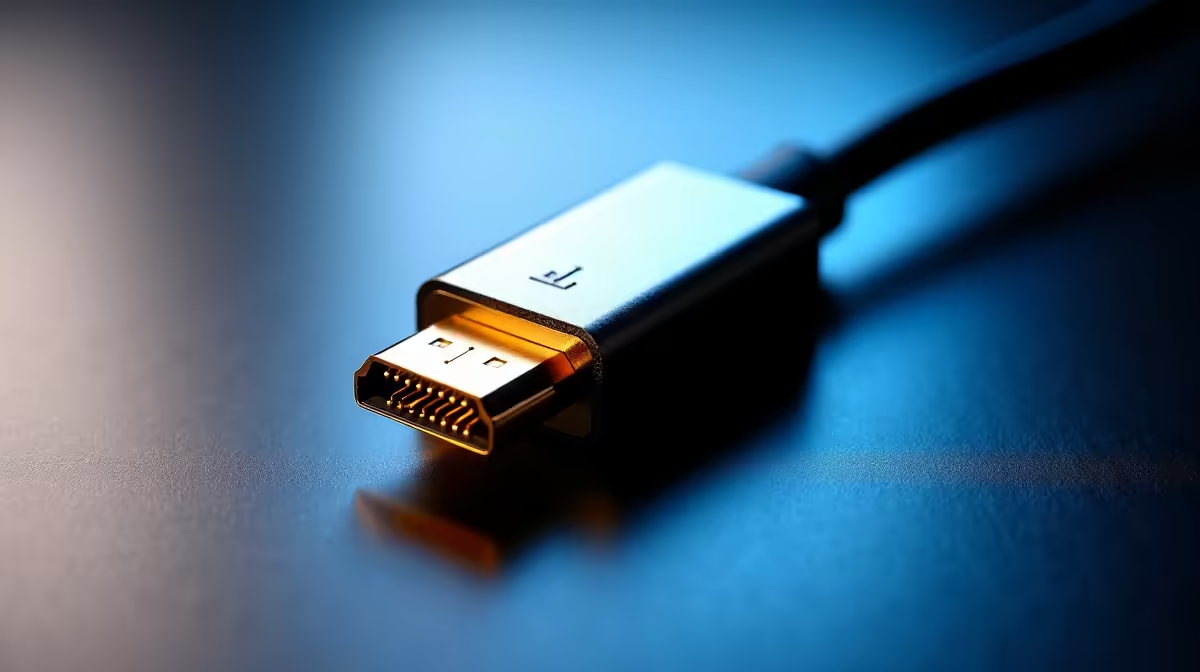
Standard DisplayPort uses a 20-pin trapezoid connector approximately 16mm wide. Mini DisplayPort uses the same 20-pin arrangement in a connector approximately 7.5mm wide, identical in shape to the Thunderbolt 2 port on older Mac hardware. The signal pins map directly between the two form factors, so a passive Mini DP to DP cable is a purely mechanical conversion with no active electronics required. This means compatibility is universal: any Mini DP source connects to any standard DP display through a passive cable without any driver or software configuration. For SA professionals using older Mac workstations alongside Windows PCs at a mixed desk, a single Mini DP to DP cable connects the Mac output to a standard DP monitor that also serves the Windows machine via manual cable swap.
Bandwidth and Version Compatibility for 4K Workstations 📡
The resolution and refresh rate limit is determined by the DisplayPort version supported by the hardware, not by whether the connector is Mini or standard. A MacBook Pro with Thunderbolt 2 supports DisplayPort 1.2 (21.6Gbps, HBR2), handling 4K at 60Hz. A MacBook Pro with Thunderbolt 3 or 4 supports DisplayPort 1.4 over USB-C, handling 4K at 120Hz via a USB-C to DP adapter. A Windows workstation GPU with a standard DP 1.4 output supports HBR3 directly. In all cases, the passive cable between Mini DP and standard DP does not reduce the available bandwidth. For SA architects or engineers running CAD software at 4K at 60Hz, a Mini DP to standard DP cable rated for HBR2 at R150 to R350 connects the workstation to any DP monitor without limitations.
Choosing Between Connector Types for a 4K Workstation 💰
For new workstation builds in 2026, standard DP is the practical choice: all current discrete GPUs from Nvidia and AMD use full-size DisplayPort outputs, and standard DP monitors are the norm at every price point. Mini DP is relevant primarily for laptops and older Mac hardware. If a workstation setup involves both a Mini DP laptop and a standard DP desktop sharing one monitor, a Mini DP to DP cable for the laptop and a native DP cable for the desktop is the cleanest solution.
Lock Mechanism Prevents Accidental Disconnects ⚡
Standard DisplayPort connectors have a small latch mechanism that clicks into the port's retention groove. If the cable comes loose during desk use, press the latch button on the connector while reseating it to engage the lock. Mini DisplayPort connectors do not have this lock, which is one practical reason full-size DP is preferred for fixed workstation monitor connections.
FAQ
Do I lose any signal quality converting between Mini DP and standard DP?
No. The conversion is purely mechanical. Signal integrity depends on the cable's conductor quality and shielding, not on whether the connector is Mini or standard size.
Can I use a Mini DP to DP cable for a 144Hz gaming monitor from a Windows laptop?
Yes, if the laptop's Mini DP port supports DisplayPort 1.2 (for 1440p at 144Hz) or DisplayPort 1.4 (for 1440p at 240Hz). Check the laptop's display output specification before buying.
Is Mini DisplayPort being phased out?
Yes. USB-C with DisplayPort Alt Mode has replaced Mini DP on most modern laptops. However, the installed base of Thunderbolt 2 and Mini DP hardware remains large enough that cables and adapters will be available and relevant for years.
Mixing Mini DP and standard DP sources on one monitor?
Evetech stocks passive Mini DP to DisplayPort cables for 4K workstation setups across South Africa.