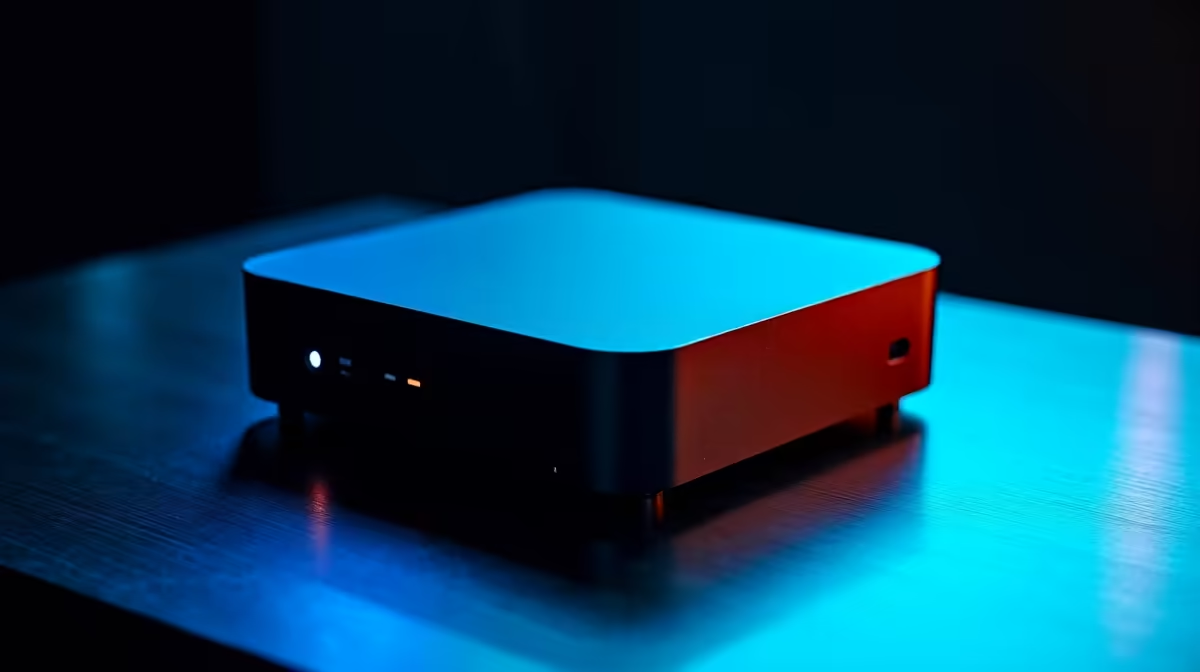
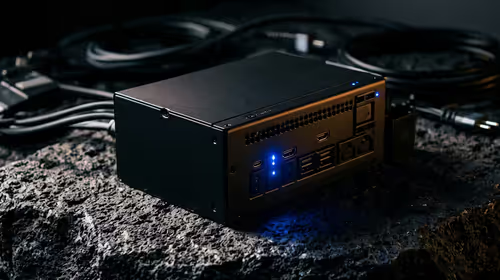
The hardware you run Home Assistant on decides what your smart home can actually do, and the choice usually comes down to two camps: a purpose-built box like the Home Assistant Green, or a small mini PC doing the same job with room to spare. For a simple setup the dedicated hub is hard to fault, but the moment you add camera analysis or local voice, the mini PC starts to earn its keep.
Quick Answer
Choose a dedicated hub like HA Green if you want a fanless, plug-and-play box drawing around 5 to 12 watts for lights, sensors and automations. Choose a mini PC (an Intel N100 box is the popular pick) if you plan to run Frigate camera detection, local voice, or other add-ons that need real processing power and NVMe storage.
What each approach is built for
The HA Green is a small, fanless appliance designed to run Home Assistant and nothing heavier. It boots straight into the software, sips power, and disappears onto a shelf. For someone automating lights, controlling sensors, and running a few integrations, it is genuinely all the hardware needed, and its silence and low draw are real advantages in a bedroom or lounge.
A mini PC is a general-purpose computer. An Intel N100 model is the common choice: it idles at roughly 6 watts and peaks around 14 watts even under a heavy camera workload, while offering far more processing headroom and fast NVMe storage. That extra capacity is wasted on a basic setup but becomes essential as soon as you ask Home Assistant to do real work.
Where the mini PC pulls ahead
Two add-ons separate the camps. Frigate, the camera object-detection add-on, is processor-hungry: an N100 mini PC can run several cameras at once, with people reporting comfortable CPU headroom on six to eight cameras, and adding a small AI accelerator drops detection times to a few milliseconds. On a dedicated hub like HA Green, Frigate manages one or two cameras at lower resolution before it runs out of breath.
Local voice pipelines tell the same story. Processing speech on-device rather than in the cloud is demanding, and the mini PC's spare power makes it usable where a lightweight hub struggles. If your smart home plans include camera analysis or voice control, the mini PC is not a luxury, it is the right tool. The mini PC range at Evetech covers the N100-class boxes that suit this role well.
The Intel QuickSync advantage for Frigate
One technical detail that genuinely matters for camera setups is Intel QuickSync. The N100 chip includes hardware-accelerated video decode, which Frigate uses to offload the work of analysing camera streams from the CPU entirely. The result is that four or five 1080p streams can be decoded and analysed with CPU load staying well under 20 percent, leaving the rest of the processor free for Home Assistant's automations, history recording and dashboard.
A dedicated Home Assistant hub has no equivalent hardware acceleration. Its ARM processor handles everything in software, which is why resolution and camera count ceiling is so much lower. If cameras are on the roadmap, this single difference makes the choice straightforward.
Storage: why it matters for both
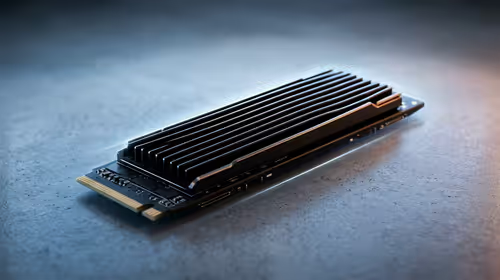
Home Assistant writes constantly to disk: event logs, state histories, recorder data, add-on files. The dedicated hub stores everything on eMMC, which is more durable than a microSD card but still a slower medium overall. A mid-range NVMe SSD in a mini PC pushes past 400 megabytes per second where the hub's eMMC sits around 80, which keeps dashboards loading quickly and history queries snappy on a large install.
For a home with fifty devices and basic automations, the difference is invisible. For a setup logging detailed energy data, running multiple integrations and querying history across months, the storage speed is noticeable.
Power and running cost in SA terms
A common worry is that a mini PC will cost a fortune to leave running. It will not. The gap between a dedicated hub at around 5 to 12 watts and an N100 mini PC at roughly 6 to 14 watts is small, and both add only a modest amount to a monthly electricity bill running continuously. The deciding factor is capability, not power draw. The dedicated hub's lower idle draw is a genuine but minor edge; it should not push you toward a box that cannot do what you need.
Which one fits your smart home
Be honest about your roadmap. If Home Assistant will manage lights, plugs, climate and sensors, the HA Green is the simpler, quieter, set-and-forget choice. If you want camera detection, local voice, or to run other services alongside Home Assistant on one machine, the mini PC is worth the extra outlay because it grows with you instead of forcing a replacement later. A mini PC also doubles as a small home server, so it can host other tools beyond Home Assistant. For smart plugs, Zigbee dongles and the sensors that connect to either platform, the smart home and appliances range at Evetech stocks the compatible hardware. To gauge what local builders are pairing into these setups, the most popular accessories at Evetech show which add-ons are most in demand.
Frequently Asked Questions
Is a mini PC overkill for basic Home Assistant use?
For lights, sensors and simple automations, yes. A dedicated hub like HA Green handles that workload comfortably while staying fanless and low-power. The mini PC only pays off once you add demanding add-ons.
Can HA Green run Frigate camera detection?
It can run Frigate with one or two cameras at lower resolution, but it lacks the processing power for a larger camera setup. For multiple cameras or higher resolution, a mini PC is the better base.
Does a mini PC use a lot more electricity?
No. An N100 mini PC draws roughly 6 to 14 watts, close to a dedicated hub's 5 to 12 watts. Running continuously, the difference in monthly cost is small, so capability should drive the decision.
What makes a mini PC better for local voice?
Local voice processing is demanding, and the mini PC's spare CPU power and faster storage handle it smoothly where a lightweight hub struggles. If voice control matters to you, the mini PC is the safer base.
Can a mini PC do more than just Home Assistant?
Yes. Because it is a full computer, a mini PC can host other home-server services alongside Home Assistant, such as media tools or network utilities, making it a flexible single box for a growing smart home.
Planning a smart home that goes beyond basic automations? If cameras and local voice are on the cards, start with the right base. Browse capable, low-power options in the mini PC range at Evetech and build a Home Assistant server that grows with you.