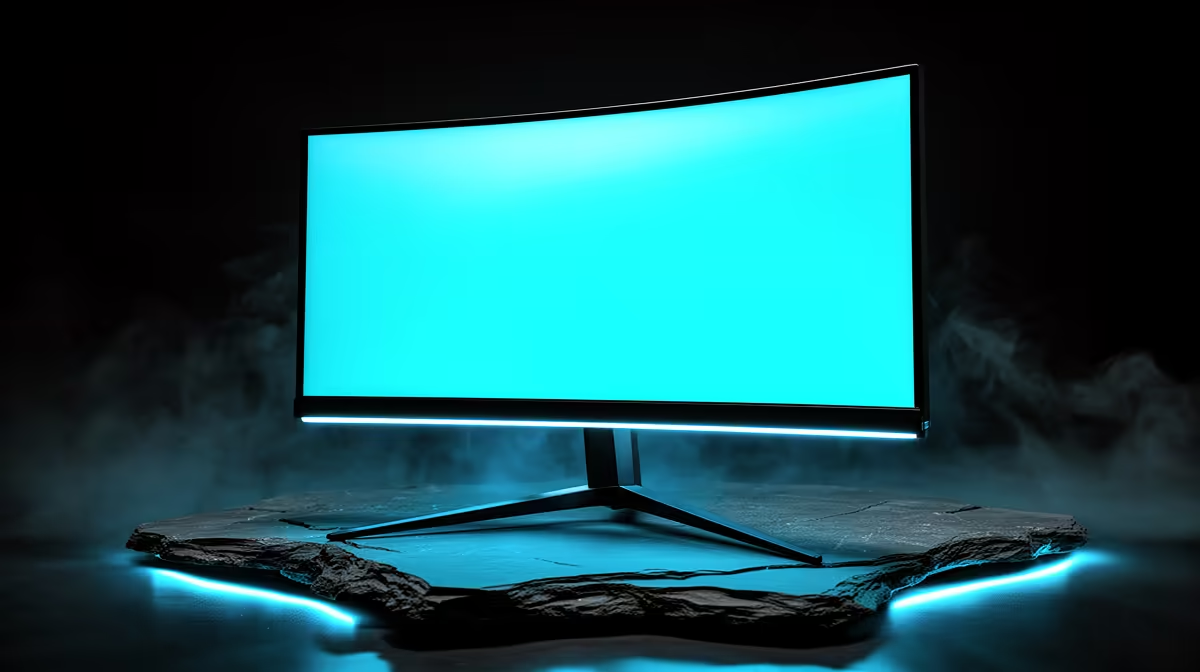
A strict budget does not mean accepting a bad screen. It means knowing which monitor specifications actually improve your experience and which ones are easier to skip. Spend the limited rand on the wrong spec and the savings feel hollow. Spend it on the right one and the setup punches well above its price. Working out which monitor specs to prioritise on a tight ZAR budget is a question worth answering precisely, because the answer is not what most spec sheets lead you to believe.
Quick Answer
On a tight ZAR budget, prioritise refresh rate first: the step from 60Hz to 144Hz is the single most noticeable improvement per rand. Follow it with an IPS panel for honest colour. Stay at 1080p for now and skip HDR entirely. A 24-inch 1080p 144Hz IPS runs from around R3,000 in SA.
⚡ Refresh Rate: The Upgrade That Lands Immediately
The improvement from 60Hz to 144Hz is not a number on a chart. It is something you feel in the first five minutes of moving the mouse. At 60Hz the screen updates sixty times per second, which at normal desktop speeds gives a faint but constant sense of lag between your input and the image catching up. At 144Hz that lag is more than halved, and the motion clarity that comes with it makes everything from cursor movement to in-game panning feel more responsive.
This is the first specification to secure on a budget build, and fortunately it is also one where pricing has come down significantly in South Africa. A 24-inch 1080p 144Hz panel starts near R3,000. A 27-inch variant is achievable from around R3,500 to R4,000. The premium over a 60Hz equivalent is modest enough that there is almost no situation where choosing 60Hz over 144Hz at a similar price makes sense.
The competitive benefit is real but secondary to the comfort benefit. Games feel smoother, windows drag without tearing, and scrolling through long pages no longer produces that subtle visual smear. Budget or not, 144Hz is the floor worth targeting.
🖥️ Panel Type: IPS Over TN at the Same Price
Until recently, choosing IPS on a budget meant paying meaningfully more than for a TN equivalent. That gap has closed. At the R3,000 to R4,500 price range, IPS panels are available at 144Hz with only a small premium over TN alternatives, and in many cases at the same price.
The reason to prefer IPS is colour accuracy and viewing consistency. TN panels cover around 70 to 75 percent of the sRGB colour space, which means colours that should be vivid appear somewhat dull, and images shift in hue as you move even slightly off-centre. IPS covers 95 to 99 percent sRGB and holds that accuracy across a wide viewing arc. For a student in a res room sharing a screen with a friend, for a professional checking design files from a chair that does not face the display straight on, and for anyone who simply wants the image to look correct, IPS is the better investment.
There is no longer a strong technical argument for choosing TN at a budget price point. The speed advantage TN once held, measured in sub-1ms response times, has been matched by modern IPS variants. The colour and angle limitations remain.
Pro Tip ⚡
When shopping budget IPS panels, check whether the listing specifies an IPS sub-type. Some manufacturers label screens as IPS that use a lower-cost IPS variant with narrower gamut. Look for 95 percent sRGB or above in the spec sheet rather than trusting the panel type label alone. It takes 30 seconds and ensures you are getting the colour benefit you are paying for.
🔧 Resolution: Why 1080p Is the Right Call for Now
At a tight budget, staying at 1080p is the correct decision and it does not need to feel like a compromise. On a 24-inch screen at 1080p the pixel density is 92 pixels per inch, which at a normal viewing distance of 60 to 70cm produces a sharp image. Most people cannot resolve individual pixels at that density unless they sit unusually close.
The cost of moving to 1440p at budget is not just the panel price. The GPU needs to drive 77 percent more pixels, and a card that handles 1080p at 144Hz may struggle to sustain that frame rate at 1440p in your current games. Spending R2,000 more on a QHD panel and then dialling back settings or frame rate to compensate produces a result that is not clearly better than a sharp 1080p experience at maximum settings.
The practical path is 1080p now at 144Hz, IPS quality, and a resolution upgrade when both the display budget and the GPU budget are ready to move together. That sequencing ensures neither component bottlenecks the other.
🌗 What to Skip Entirely: HDR on a Budget Build
Budget HDR is worth naming plainly as a feature to deprioritise. The DisplayHDR 400 certification that appears on many panels in the R3,000 to R5,000 range describes a minimum brightness of 400 nits with no requirement for local dimming. Without local dimming, the monitor cannot selectively dim parts of the image to produce deep blacks, which is the mechanism that makes HDR content look genuinely different from SDR.
In practice, a DisplayHDR 400 monitor playing an HDR-flagged game looks nearly identical to the same panel in SDR mode. The bright highlights gain a small amount of extra headroom but the dark content stays at the panel's native black level, which at 800 to 1,200 to 1 contrast is modest.
Skipping HDR 400 and redirecting those funds toward a higher refresh rate or a better panel quality level produces a more visible improvement. HDR becomes meaningful at DisplayHDR 600 with genuine local dimming, which begins at a price point well above the tight-budget bracket.
Frequently Asked Questions
Which single monitor feature deserves the most budget on a tight build?
Refresh rate, specifically the step to 144Hz. It is the improvement that registers the moment you sit down and affects every minute of use, from desktop navigation to competitive gaming. It is also well within reach at the budget level, starting near R3,000 for a 24-inch 1080p 144Hz IPS in South Africa.
Is an IPS panel at 144Hz actually worth the small premium over TN?
Yes, and the gap has largely closed. At current local pricing the IPS option at 144Hz costs only slightly more than TN in many cases. The wider colour coverage and accurate viewing angles IPS provides are permanent benefits, while the speed advantage TN once held at budget prices no longer exists in practical terms.
Why should resolution wait on a restricted budget?
Because 1440p requires the GPU to process 77 percent more pixels per frame, meaning a card sized for a 1080p build will need to reduce settings or frame rate to keep up at QHD. The resolution upgrade only makes sense when the graphics hardware can actually sustain the frame rate the display is capable of delivering.
Does FreeSync cost extra on affordable 144Hz monitors?
No. The vast majority of budget 144Hz panels in South Africa include FreeSync support as standard across their full variable refresh range, typically 48 to 144Hz. It adds nothing to the price and removes screen tearing completely, making a 70 FPS session look cleaner than a torn 90 FPS one.
Is a 24-inch screen the right choice for a 1080p budget build?
For most desk setups, yes. A 24-inch 1080p panel gives 92 pixels per inch, which is sharp enough at normal viewing distances. A 27-inch 1080p screen drops to around 82 PPI, which produces a noticeably softer image at close range. If the budget allows a 27-inch, moving to QHD resolution is worth the extra, but 24 inches at 1080p is the cleaner pairing.
Ready to get the most out of every rand in your monitor budget?
Browse the 144Hz IPS gaming monitor range and find a screen that delivers the specifications that actually matter for your build.