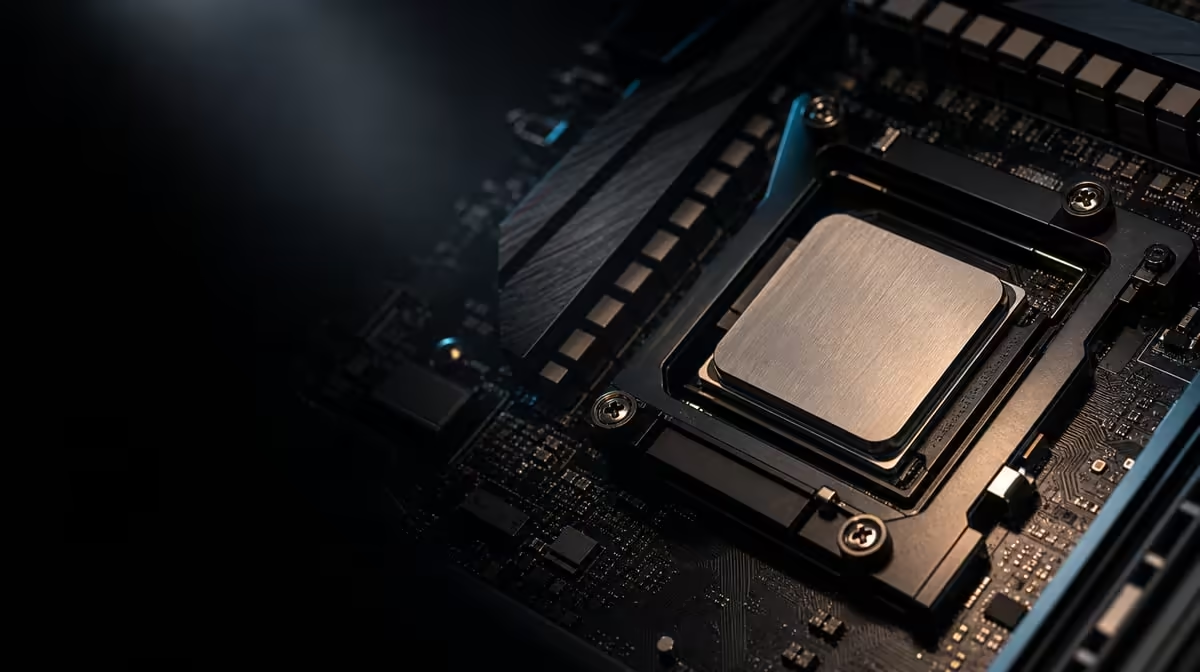
A processor tier should describe the problem a buyer is paying to solve, not simply divide a page into increasingly expensive labels. AM4 gaming CPU price tiers in South Africa make more sense when processor cost, cooling and reusable platform parts are viewed together. At R7,199, the Ryzen 7 5800X3D sits below R8,000 with eight Zen 3 cores, 16 threads and 100MB cache.
Quick Answer
Set AM4 tiers by the complete upgrade outcome: an entry choice should meet the intended games, a middle tier should remove a demonstrated CPU limit, and a higher tier must justify its premium in CPU-sensitive work. The R7,199 Ryzen 7 5800X3D belongs in the under-R8,000 discussion, but its separate cooler and discrete graphics requirement increase the finished-system cost.
🪙 Define tiers by need before price
A useful first tier covers the processor capability required to run the intended software on a supported board. It does not need to imitate a more expensive model when the graphics card or display target is already the main constraint. Paying less for an adequate CPU can leave more of the South African build budget for graphics, storage or memory that creates a larger practical change.
The middle of a shortlist should address a clear gap. That may be poor frame consistency in processor-sensitive games, insufficient resources for concurrent work or an older CPU that cannot prepare frames quickly enough for the graphics card. The buyer needs before-and-after evidence, because an attractive processor feature cannot remove a bottleneck located somewhere else.
A higher AM4 tier earns its place through workloads that use its resources. The Ryzen 7 5800X3D offers eight cores and 16 threads, while its 100MB cache can assist games with suitable data-reuse patterns. Neither the tier nor the cache capacity promises the same FPS uplift across every engine.
The AMD CPU category is a practical place to create a current shortlist without inventing price points for unexamined models.
💰 Place R7,199 inside the real budget
R7,199 puts this processor R801 below an R8,000 CPU ceiling. That arithmetic does not mean the remaining R801 will buy an adequate cooler. A 105W specification guides the thermal plan, and the empty cooler position in the box means the solution must be selected and priced on its own merits.
Use Evetech's CPU cooler range to compare options after confirming AM4 mounting, case dimensions, nearby clearance and airflow. Add any necessary installation or chassis work to the same budget rather than hiding it outside the CPU tier.
Discrete graphics are another separate requirement. This processor cannot create display output, which means a working build must have a GPU. Existing AM4 owners may already possess a suitable card, strengthening the value of reuse. Someone assembling a complete PC must add the graphics card, adequate power and physical space to the total.
The motherboard itself can turn reuse into savings only when the exact model and BIOS support the 5800X3D. A socket match is not enough. If support is absent, buying a new board solely to preserve AM4 may change the comparison with other processor platforms.
🎮 Match each tier to a measured constraint
Use a repeatable game route to determine whether the current system is processor-limited. Keep the resolution, settings, game version and background conditions stable. Observe frame consistency and the interaction between CPU work and GPU load. A lower graphics setting can help reveal a processor ceiling, but it should be treated as a test rather than an automatic play recommendation.
A graphics-limited machine can pair well with a less expensive CPU if that choice already keeps the GPU busy at the intended settings. In that case, a premium processor may improve little that the player can see. A CPU-sensitive title or high-frame-rate target can shift the balance and make the large-cache Ryzen 7 more relevant.
Core count alone does not create a tier verdict. Eight cores and 16 threads provide a useful resource pool, but software decides how it is used. The Zen 3 architecture, 100MB cache, 3.5GHz base frequency and boost ceiling of 4.5GHz all contribute different information. Review them together with real workload results.
The complete processor selection helps compare the under-R8,000 AM4 option against other CPU routes. Keep the configuration and total platform cost consistent when reading benchmarks.
🧾 Know when a platform comparison is required
Staying on AM4 can be efficient when the board has documented support, memory remains serviceable and the rest of the system fits the desired outcome. Reusing those components focuses the R7,199 spend on the processor and may avoid replacement purchases that add little to the target games.
A wider platform move deserves consideration when the motherboard cannot support the CPU, several old components need replacement, or the intended workload calls for a different set of capabilities. Do not assign automatic superiority to either route. Compare every part that must be bought and every serviceable part that can remain.
Price tiers are snapshots rather than longevity guarantees. Availability and current pricing should be checked at the time of purchase. The stable comparison method is to define the performance goal, prove platform support, price the complete installation and test the expected constraint.
For the 5800X3D, the known facts are specific: R7,199, AM4, eight Zen 3 cores, 16 threads, 100MB cache, 105W, no cooler and a need for discrete graphics. That makes it a clear under-R8,000 CPU candidate, while the buyer still decides whether it is the right completed upgrade.
One final check is opportunity cost. Compare the expected CPU improvement with what the same money could do for the limiting graphics card, insufficient memory or constrained storage. The highest sensible processor tier is the one that leaves the whole system balanced for its intended use, not the one that consumes the largest possible share of the budget.
Frequently Asked Questions
Which price tier contains the R7,199 Ryzen 7 5800X3D?
It falls below an R8,000 processor ceiling by R801. The completed upgrade may exceed that ceiling once the separate cooler and other required hardware are included.
What should a budget AM4 tier cover first?
It should meet the intended games and workload on a supported motherboard. The cheapest option is poor value if it cannot solve the actual processor constraint.
Why should cooler cost appear beside the CPU price?
No cooler is included with this 105W processor. Cooling is required to operate the CPU, so it belongs in the installed total rather than an optional extras column.
How can existing AM4 parts improve the value tier?
A supported motherboard, serviceable memory, suitable case and adequate discrete GPU can be retained. Reuse has value only after each component passes the relevant checks.
Does a high CPU tier guarantee higher gaming FPS?
It does not. A graphics limit, frame cap, game engine or settings can reduce the visible difference. Compare repeatable tests that resemble the intended system.
When should buyers compare a full platform replacement?
Make that comparison when board support is missing, several parts already need replacement or the required capabilities justify moving beyond the existing platform.
What role does the discrete GPU requirement play?
It means the processor cannot complete a display-capable system alone. Existing GPU reuse can improve value, while a new build must add graphics and supporting power costs.
Ready to build an AM4 CPU tier around value that reaches the screen?
Compare Evetech's processor choices, then add compatible cooling and graphics to the R7,199 option before deciding.