Quick Answer
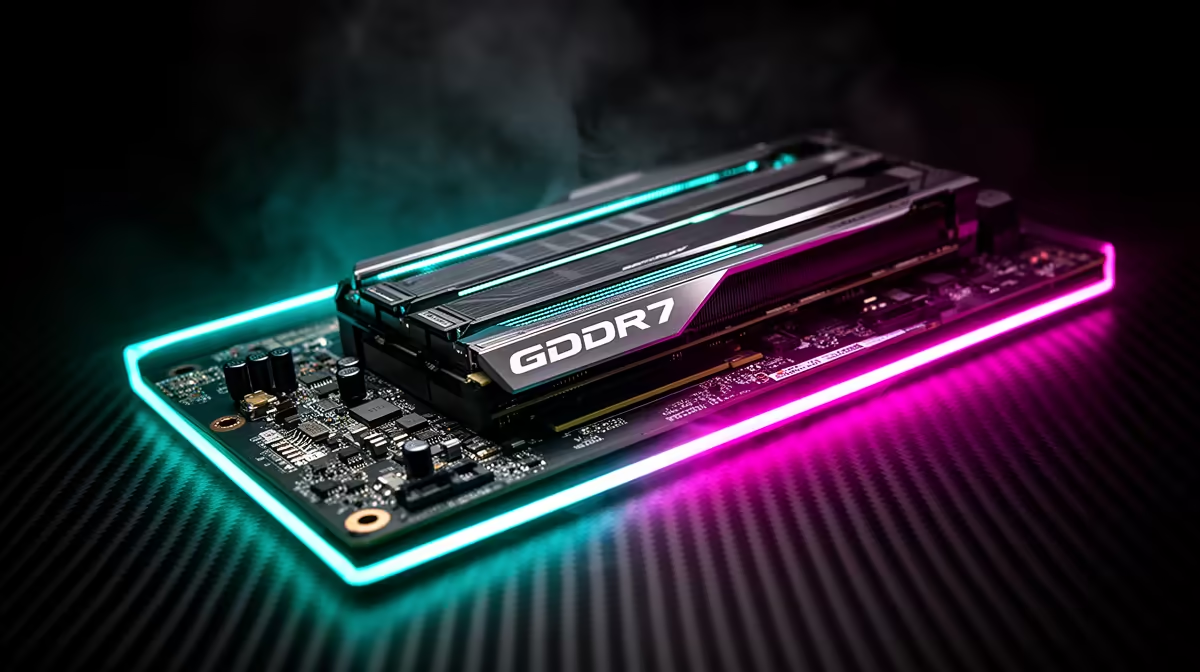
A 32GB GDDR7 graphics card performs best across gaming, content creation, and AI workloads when driver settings, VRAM allocation, and software configurations are tuned per use case rather than left at defaults. For gaming, enable DLSS 4 or FSR 4 with Frame Generation for maximum fps at 4K. For creation, allocate GPU memory priority in DaVinci Resolve and Blender. For AI, use CUDA or ROCm runtime builds matched to your GPU architecture.
Gaming Optimisation on 32GB GDDR7 🎮
The RTX 5090, the flagship 32GB GDDR7 card in 2026, delivers 4K gaming above 100 fps in Cyberpunk 2077 with path tracing enabled when DLSS 4 Quality mode is active. Enable Resizable BAR in the BIOS and update to the latest Game Ready driver. In Nvidia's control panel, set Power Management Mode to Prefer Maximum Performance for sustained boost clocks during long sessions where South African summer ambient temperatures push case internals above 35 degrees Celsius. An RTX 5090 currently retails in South Africa from around R55,000 to R70,000.
Content Creation Settings for 32GB VRAM 🎨
In DaVinci Resolve 19, navigate to Preferences and set GPU processing mode to CUDA (Nvidia) or OpenCL (AMD). With 32GB VRAM, enable caching of decoded media to GPU RAM: this eliminates CPU bottlenecks on complex timelines with 4K ProRes or RAW footage. In Blender 4.x with Cycles, select OptiX as the render device and enable the GPU under Render Properties. For complex scenes, 32GB VRAM allows loading complete high-resolution texture sets without compression, reducing render-to-disk times significantly compared to 16GB or 24GB cards that must page texture data. Premiere Pro users should enable GPU Acceleration in File > Project Settings > General.
AI Workload Configuration 🤖
Local AI inference on a 32GB GDDR7 GPU enables running 70B-parameter language models quantised to 4-bit precision, which fit within the VRAM with headroom. Install CUDA Toolkit 12.6 or later from Nvidia's developer portal, then use llama.cpp or Ollama for model serving, directing both to GPU offload mode to keep all model layers in VRAM. For image generation with Stable Diffusion or Flux, set VRAM to unrestricted mode in ComfyUI or Automatic1111 settings to prevent VRAM splitting with system RAM. South African AI researchers and developers at universities like Wits, UCT, and Stellenbosch are increasingly using local 32GB GPU inference to avoid cloud API costs, saving R2,000 to R8,000 per month in API fees.
Use DDU Between Driver Updates for Clean Installs ⚡
When updating GPU drivers on a system that switches between gaming and AI workloads, use Display Driver Uninstaller in Safe Mode to perform a clean driver removal before installing the new version. Residual driver files from mixed workload sessions can cause CUDA errors, game crashes, or incorrect VRAM allocation that a standard over-install does not resolve.
FAQ
Does 32GB GDDR7 make a noticeable difference over 24GB GDDR6X for gaming alone?
At 4K with maximum texture settings in current titles, the difference is minimal because most games still fit within 16 to 20GB VRAM. The advantage of 32GB shows in future-proofing, multi-monitor gaming, and workloads that combine gaming with simultaneous AI inference or background rendering.
Can 32GB GDDR7 run local LLMs and games simultaneously?
Yes, if the combined VRAM requirement of both workloads fits within 32GB. A 13B-parameter 4-bit quantised model uses around 8GB VRAM, leaving 24GB for a game running in parallel, which is feasible for most current titles at 1440p settings.
Is a 32GB GDDR7 GPU worth the price for a South African content creator?
For 4K video editing, 3D rendering, and AI-assisted production workflows, yes. For 1080p to 1440p editing without AI inference, a 16GB card at roughly half the price covers all creative tasks adequately.
Ready to unlock the full potential of a 32GB GDDR7 GPU?
Evetech stocks high-end graphics cards with local warranty and nationwide delivery. Browse the latest GPU range at Evetech to find the right card for your workload.