Quick Answer
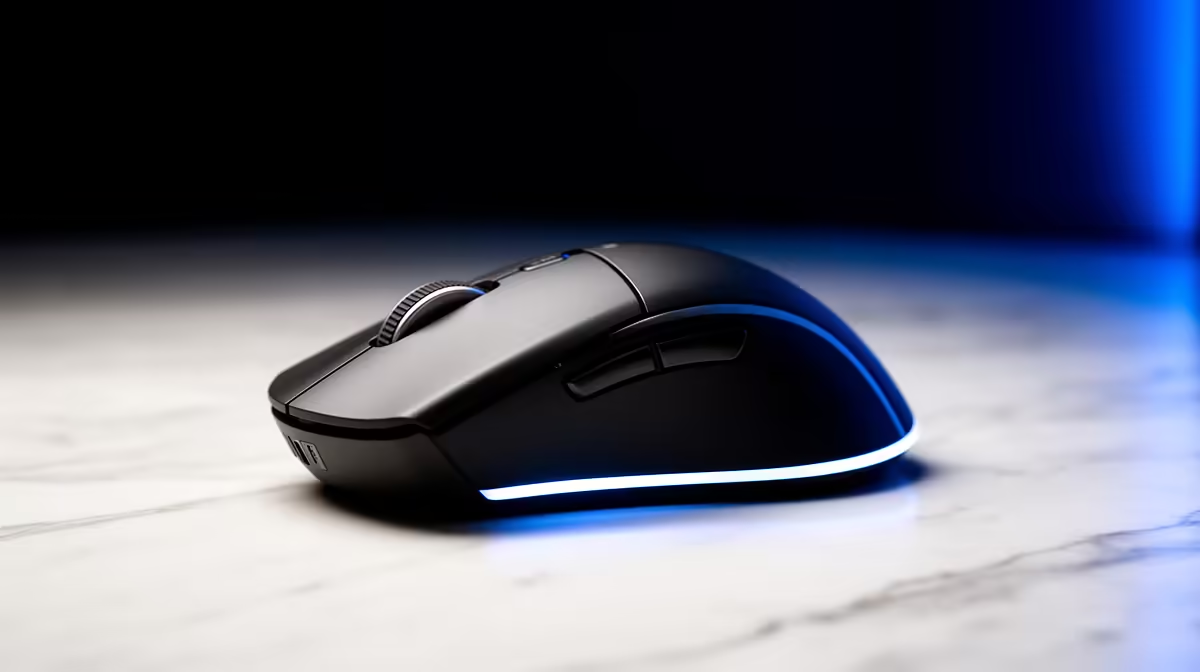
For South African home office environments, signal stability is optimised by placing the dongle within 30 cm of the mouse on a USB extension cable, connecting to a USB 2.0 port to avoid USB 3.0 interference, switching your router to 5 GHz where possible, and choosing a proprietary 2.4 GHz mouse over Bluetooth for any latency-sensitive work.
The SA Home Office RF Landscape 📡
South African home offices present specific wireless challenges. In dense urban areas of Johannesburg, Cape Town, and Pretoria, apartment buildings and townhouse complexes pack many 2.4 GHz Wi-Fi networks into a small area. A Vumatel, Frogfoot, or Openserve fibre-connected home in a residential complex may have 15 to 30 neighbouring routers visible on channel scan, raising the noise floor for your wireless mouse.
The 2.4 GHz spectrum is divided into 13 channels in South Africa, but only channels 1, 6, and 11 are non-overlapping. If your router auto-selects channel 3, 8, or 9, it partially overlaps with channels on both sides, amplifying the interference your mouse experiences. Setting the 2.4 GHz band to channel 1, 6, or 11 in your router admin panel reduces mouse signal interference significantly.
Practical Placement and Hardware Steps 🔧
Dongle placement is the highest-impact change you can make at zero cost. Halving the distance quadruples received signal power. Position the included extension cable on your desk within 20 to 30 cm of where your mouse travels, and avoid PC chassis drawers or behind monitor stands where the signal passes through metal.
For the USB port itself, use a port connected to a USB 2.0 header, not a USB 3.0 or 3.2 port. USB 3.0 hardware generates significant 2.4 GHz electrical noise, documented in Intel interference white papers as one of the most common overlooked causes of wireless mouse micro-stutters.
Beyond RF: Software Stability Fixes 🖥️
Disable USB selective suspend in Windows Power Options. This feature powers down USB devices after inactivity, which can cause the dongle to momentarily lose connection state when you resume mouse movement, producing a brief lag spike at the first movement after a pause. Disabling it in advanced power settings under USB Settings eliminates this. Also set your PC's power plan to Balanced or High Performance rather than Power Saver, which can throttle USB controller clocking on some laptops.
For standing desks with a wireless charger pad built in, note that wireless chargers emit interference across multiple frequencies. Position your dongle and mouse away from the charging area.
Router Band Segregation Helps ⚡
Give your 5 GHz network a different SSID from your 2.4 GHz network and connect all your PCs, phones, and smart devices to 5 GHz. This leaves the 2.4 GHz band nearly empty for your wireless mouse, one of the few devices that genuinely needs 2.4 GHz for range.
FAQ
Does Bluetooth 5.0 work as well as 2.4 GHz proprietary for home office use?
For productivity tasks like document editing and email, Bluetooth 5.0 is adequate. For video calls where precise cursor control matters, or creative work requiring pixel-level accuracy, proprietary 2.4 GHz wireless delivers more consistent positioning with lower variable latency.
How do I test if my wireless mouse is dropping packets?
Move your mouse in slow, perfectly straight lines on screen. If the cursor drifts or shows micro-jitter, the sensor is receiving inconsistent signal. Software like MouseTester plots polling intervals over time and shows gaps where packets were dropped.
Can thick walls affect my wireless mouse signal?
At the distances involved in a home office (typically under 2 metres between mouse and dongle), walls have negligible effect on a properly placed dongle. Interference comes from electrical devices and RF congestion, not physical barriers.
Build a stable wireless home office setup.
Evetech stocks a wide range of wireless mice designed for both home office productivity and gaming precision. Visit Evetech to compare 2.4 GHz and Bluetooth options across all price points.