Host-interface bandwidth is most valuable when a game or creator tool repeatedly needs it. PCI Express 5.0 benefits for games and creator work should be measured through data movement, active lane configuration and complete-job behaviour rather than generation labels.
Quick Answer
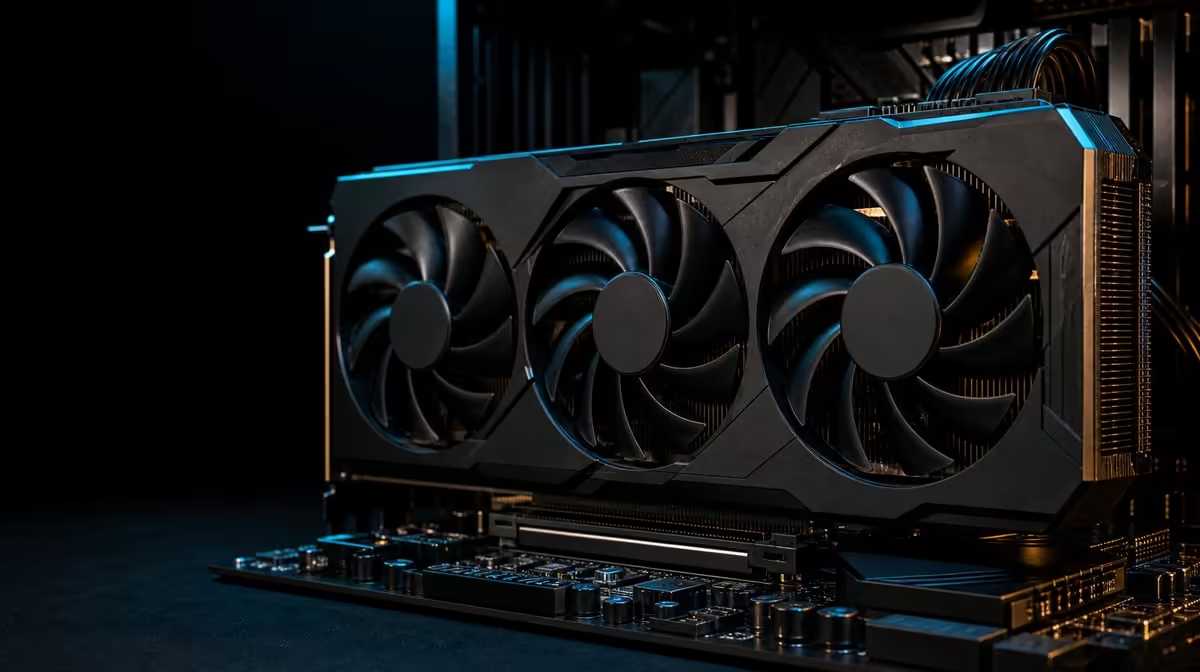
The R73,599 ASUS TUF RTX 5090 supports PCIe 5.0. Games may show little change when the link is not limiting, while creator tasks moving substantial data between host and GPU can have a clearer case; each workload needs controlled testing.
🛣️ Define what the newer interface changes
PCI Express links the graphics card and host system. A newer generation increases potential capability for moving commands and data, provided the motherboard and active connection support it.
That is not the same as increasing all processing inside the GPU. Rendering, AI operations and work performed on data already in VRAM can remain limited elsewhere.
Lane width contributes to total link capability. Record both generation and active lanes, because "PCIe 5.0" alone is an incomplete description of the negotiated connection.
The RTX 5090's 32GB GDDR7 can keep substantial working data local. A project that fits and reuses that data may rely less on repeated host transfers than one that constantly moves information.
Data movement can arrive in bursts. Average link use across a long job may hide a short saturated stage, so inspect the period around the actual delay.
Latency and bandwidth are not interchangeable ideas. More transfer capability can help sustained data movement, while the application's sequencing and wait states still shape how quickly a small exchange completes.
Avoid assigning every loading screen to PCIe. Storage access, decompression, CPU preparation and engine logic can occupy the same interval. Resource timelines help distinguish them.
Compare interface details in Evetech's ASUS GPU category alongside memory and workload results.
🎮 Test games where players notice
Choose the actual titles, not a generic GPU score. Preserve resolution, visual settings, frame cap, software version and the host processor.
Use a repeatable route that includes asset transitions and a steady rendering section. These can create different transfer patterns and should not be averaged into one unexplained number.
Record frame times as well as mean performance. A player may notice a loading-related spike even when the average barely changes.
Repeat the route. A first pass can include compilation, caching or asset preparation that behaves differently later. Separate one-time activity from a persistent interface constraint.
Run the comparison after a clean restart and then across several passes. Report the median and variation rather than selecting the result that best supports an upgrade.
Observe CPU, GPU and PCIe use together. A processor-limited game can leave both the graphics engine and host link below full demand, making a platform-generation comparison irrelevant to that scene.
Try a deliberately lower rendering load as a diagnostic. If frame delivery barely changes, the constraint may sit outside GPU rendering. Restore the original settings before evaluating the link.
The card's 3352 AI TOPs may support game features built to use AI processing, but it is not derived from PCIe 5.0. Evaluate those features within the title and selected image quality.
Use Evetech's NVIDIA graphics-card range for like-for-like game evidence.
🎬 Measure creator transfers stage by stage
A creator job may load a scene, prepare assets, send work to the GPU, process it and write output. Time these stages separately where possible.
Storage can delay loading, system memory can constrain host data and the CPU may prepare work. A slow complete job does not automatically identify PCIe as the cause.
Choose one production-sized file and preserve application version, output dimensions, quality controls and project data. Compare equivalent usable results.
Watch whether the working set fits inside 32GB. If the task repeatedly exceeds available VRAM or exchanges data with the host, interface behaviour may deserve more attention.
Capture the application's memory state before loading the project and at its busiest stage. Reserved space should be distinguished from the increase created by the actual working file.
For AI creation, hold model and precision constant. The 3352 AI TOPs figure describes supported compute, while PCIe carries data and memory provides room. The three resources have different jobs.
Test interactive response and batch throughput separately. A user adjusting a scene can value quick transfers during iteration, while a long export may spend most time processing locally.
Include output verification and project-open time. A configuration that renders faster but loads slowly or produces an altered result may not improve the creator's complete day.
Keep failed runs and note thermal state. ASUS's patented chamber plus axial-tech airflow need chassis airflow during sustained work, and heat-related changes should not be mistaken for link effects.
Schedule identical runs at similar room conditions where practical. If not, record the difference and avoid making a narrow interface claim from two thermally different systems.
🔎 Verify the platform before upgrading it
Read the motherboard manual for the main graphics slot, supported generation and lane-sharing rules. Other expansion cards or storage connections may alter the active width.
Inspect the negotiated link while the GPU is busy. Idle power saving can show a reduced state, so include the workload in the evidence.
If the card operates through PCIe 4.0, measure the target before replacing the platform. A compatible earlier link may still meet the job when it is not exhausted.
Check active lane width before comparing generations. A lane-sharing configuration can have a larger effect than the generation change being discussed, and it needs to be held constant where possible.
Calculate the complete cost of a motherboard change, including any related processor, memory, setup and downtime implications. Compare that with the measured gain and other bottleneck fixes.
For a new build, PCIe 5.0 can provide sensible platform capability when the rest of the motherboard suits the plan. Do not treat that planning benefit as proof of faster results everywhere.
Rank motherboard features as a package: slot layout, storage arrangement, processor support and expansion plan. Choosing for one interface label can create trade-offs elsewhere.
Save the slot map for future additions. Mark connectors that share lanes so a later storage upgrade does not silently change the GPU link.
At R73,599, the RTX 5090 should be justified by the complete gaming or production result. PCIe 5.0 is one enabling feature, not the entire reason for a flagship purchase.
Review Evetech's GPU best sellers once the interface-sensitive stage is found, then check current availability.
Frequently Asked Questions
What changes with PCI Express 5.0 at the interface level?
It raises the potential capability of the host link when the platform and active lane arrangement support it.
Why may a game show little difference from more link bandwidth?
Its data transfers may already fit comfortably while the processor, GPU rendering or engine controls performance.
Which creator tasks could care about host transfers?
Jobs that repeatedly move substantial working data between the system and GPU can be more sensitive.
How does 32GB of GDDR7 relate to PCIe traffic?
It can keep a large working set on the card, potentially reducing repeated transfers for compatible tasks.
What platform checks establish the active PCIe link?
Review motherboard slot and lane rules, then inspect negotiated generation and width while the GPU is under load.
Does PCIe 5.0 guarantee future application performance?
No. Later software behaviour, processing needs and wider system limits cannot be guaranteed by the interface.
How should a buyer test an interface-sensitive workload?
Preserve one real project or game route, measure transfer-related stages and change only the link configuration where possible.
Deciding whether PCIe 5.0 earns platform budget?
Find the transfer-bound stage in a real game or creator job, then compare Evetech graphics cards with the active link documented.