Quick Answer
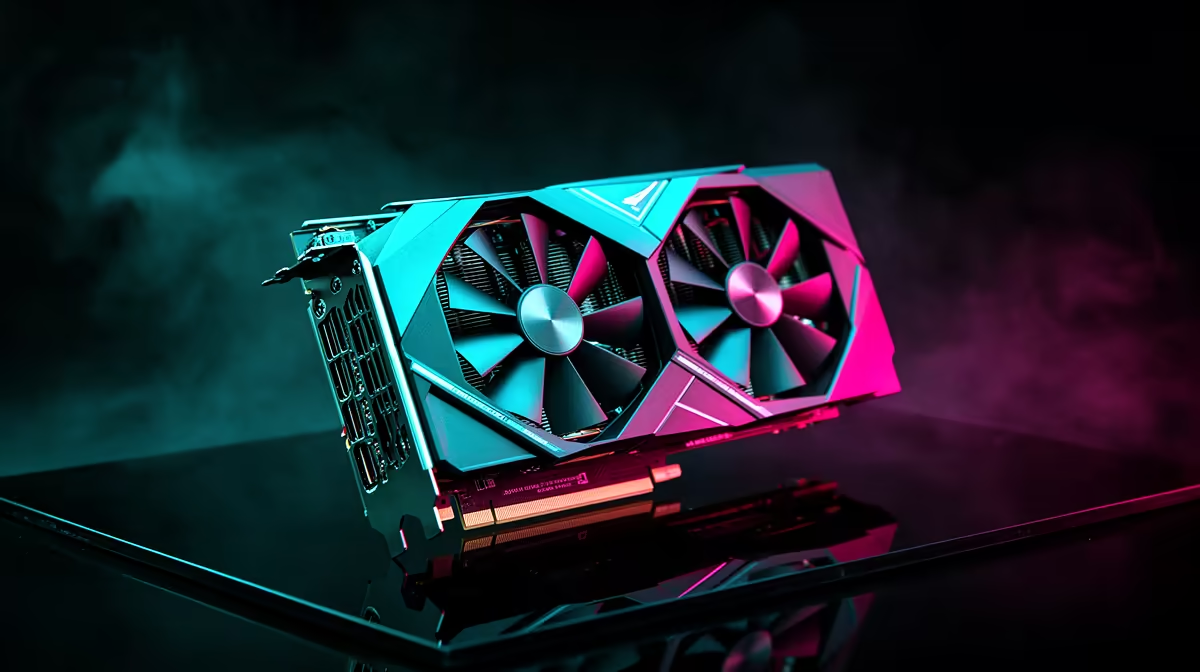
Before installing a 32GB GDDR7 graphics card, check your CPU generation, RAM speed, PCIe slot version, PSU capacity, and physical case clearance. A flagship GPU paired with an outdated CPU or a PCIe 3.0 slot will not deliver anywhere near its rated performance, making the R45,000-plus investment difficult to justify.
CPU Compatibility and Bottleneck Risk 🖥️
A 32GB GDDR7 card like the RTX 5090 has a 512-bit memory bus capable of over 1.7TB/s of memory bandwidth. Your CPU must be able to feed this GPU with draw calls and game logic fast enough to keep it busy. Older processors, particularly quad-core CPUs from before 2020, create a significant CPU-side bottleneck in modern titles, where the GPU sits idle waiting for instructions. For a card at this performance tier, a minimum of a Ryzen 7 7800X3D or Intel Core i7-13700K class processor is recommended to avoid losing more than 5 to 10 percent of the GPU's capability to CPU stalls. If your processor predates the Ryzen 5000 or 12th-gen Intel era, budget for a CPU and motherboard upgrade as part of the same build.
PCIe Slot Version and RAM Speed 🔧
The RTX 5090 uses a PCIe 5.0 x16 interface. Installed in a PCIe 4.0 x16 slot, real-world gaming performance drops by roughly 3 to 5 percent at 4K, which is manageable. Installed in a PCIe 3.0 slot, losses of 10 to 15 percent in bandwidth-sensitive workloads are possible, and some AI or compute tasks see larger reductions. Check your motherboard specification before committing. RAM speed also matters more with a fast GPU: DDR5-6000 paired with a Ryzen 9 9900X feeds the CPU's cache and prefetch pipeline more efficiently than DDR4-3200, which can translate into 5 to 8 percent higher frame rates in CPU-limited scenarios at high resolutions.
PSU Capacity and Physical Clearance 🔩
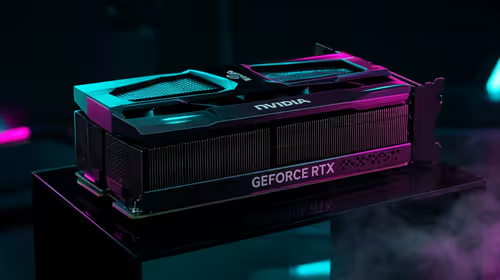
The RTX 5090 carries a 575W TDP. Add your CPU at 125 to 170W, case fans, storage, and RAM, and a full high-end system can draw 800 to 900W under sustained gaming load. A 1000W PSU from a reputable brand is the practical minimum, with 1200W recommended for any overclocking headroom. The physical size of a 32GB GDDR7 card is also substantial: the Palit GameRock RTX 5090 is a three-slot card exceeding 340mm in length, which will not fit in many mid-tower cases without removing a drive cage. Measure your case's stated maximum GPU length before ordering, and verify that your CPU cooler does not encroach on the first PCIe slot.
Run a Pre-Install Power Budget Check ⚡
Add up the TDP of every component in your system including the CPU, all storage drives, RAM, and fans, then add 10 percent headroom. If the total exceeds 85 percent of your PSU's rated wattage, your supply is undersized for long-term sustained loads. PSU degradation over time means a 750W unit running at 90 percent capacity is a reliability risk after 18 to 24 months.
FAQ
Will a 32GB GDDR7 GPU work in an older Z490 or B550 motherboard?
Physically yes via the PCIe x16 slot, but at PCIe 3.0 or 4.0 bandwidth. You will see a modest performance penalty in some workloads and will miss the full PCIe 5.0 bandwidth the card is designed for. For a GPU at this price point, pairing it with a current-gen AM5 or LGA1851 motherboard is strongly advised.
Does system RAM affect GPU VRAM performance?
Not directly, but system RAM speed and capacity affect how quickly the CPU can prepare asset data before it is streamed to the GPU. In open-world games with large texture and geometry budgets, slow or insufficient system RAM can cause CPU-side stalls that manifest as frame pacing issues even when GPU VRAM is plentiful.
Is 32GB of GDDR7 VRAM useful today or is it future-proofing?
For 4K gaming at maximum texture quality in current AAA titles, 16GB VRAM is the practical minimum and 24GB is comfortable. 32GB provides genuine current-day benefit for GPU-accelerated AI inference, 3D rendering with large scene files, and video production at 4K or 8K.
Ready for a high-VRAM GPU?
Compare graphics cards and supporting components stocked at Evetech before you upgrade.