The Dell SE2426H 23.8in FHD at R1,532 suits a data science student who needs more spreadsheet, notebook, and browser space without paying for a portable screen. A second monitor is not overkill when your work involves code on one side and results, documentation, or a dataset preview on the other. For most student desks, a normal desktop display gives better value than chasing portability.
Better value than a tiny travel screen
The Dell SE2426H 23.8in FHD at R1,532 is the sensible starting point because 23.8 inches is big enough for two working panes, but still compact for a shared room or residence desk. Full HD is practical for lecture slides, Python notebooks, PDFs, and admin portals, especially when the laptop screen can stay open beside it.
The Dahua LM27 at R1,500 gives you a larger 27-inch canvas with a 100Hz refresh rate. That makes it useful if you want more visible rows in a sheet or a wider view of charts without spending much. The 100Hz spec is also comfortable for everyday scrolling after long study sessions.
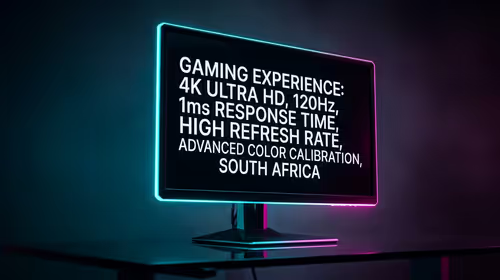
The Dell SE2726H 27in FHD 144Hz at R1,797 is the stronger pick if the same desk also handles gaming or fast-moving video. You still get 27 inches for study work, while the 144Hz refresh rate makes the setup feel more responsive than a basic display.
Student desk reality in South Africa
For a student moving between home, campus, and res, a portable screen only makes sense if you truly carry it daily. If the main work happens at one desk, the MSI PRO MP275W at R1,850 gives a fixed 27-inch workspace that feels more useful for assignments, dashboards, and research notes than a smaller travel panel.
Ready to choose the right monitor?
Use Dell SE2726H 27in FHD 144Hz at R1,797 as the student desk benchmark, then check whether its listed spec matches the space, workload, and upgrade path.