


Using GitHub Copilot: Complete Beginner's Guide for SA Developers
Using GitHub Copilot: Complete Beginner's Guide for SA Developers. Everything you need to know with SA-specific pricing and recommendations.
Read morePower bank charges slowly — Checklist: diagnose causes; recommend fixes; optimize cables, ports, and power modes ⚡🔧 Learn 9 common reasons and quick steps to speed charging.
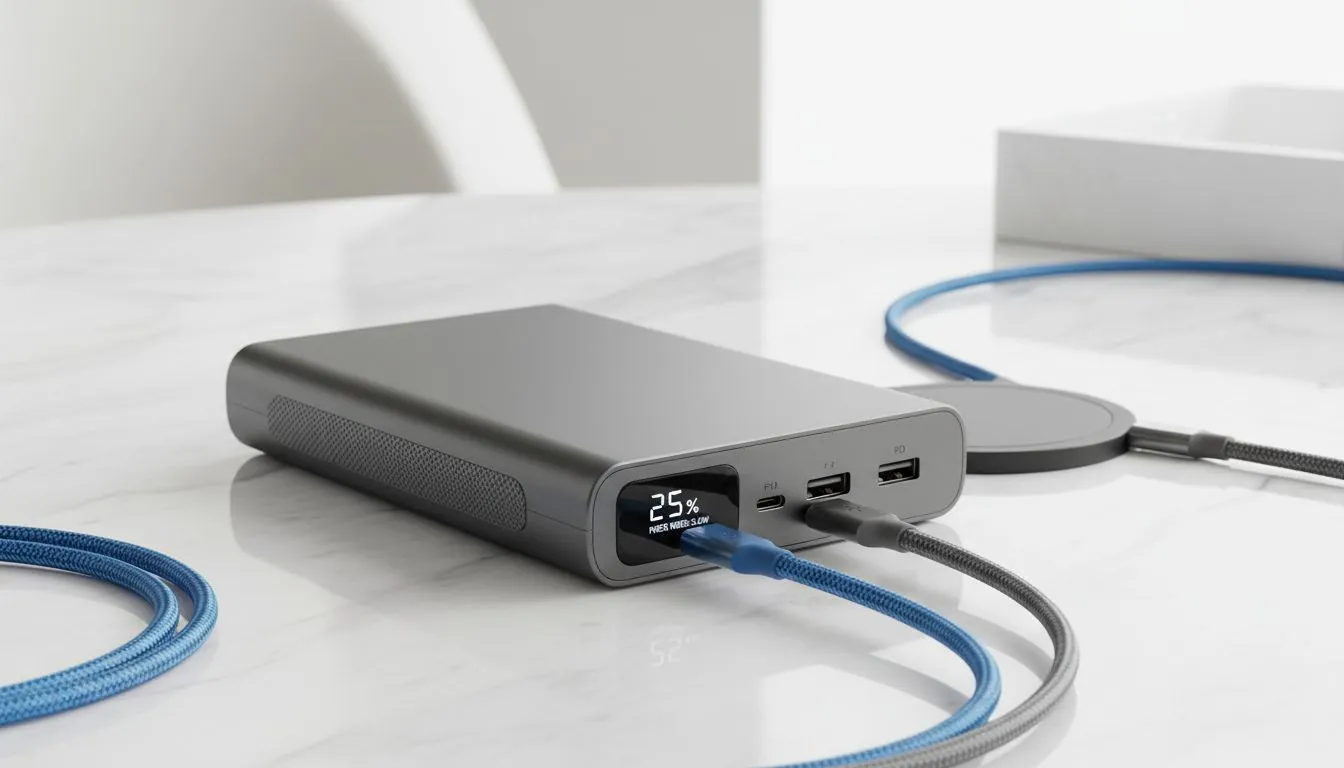
Load shedding kicks in... you reach for your backup... but the percentage barely moves. If your power bank charges slowly, it can feel like a race against a dying battery. In South Africa, staying powered up is a necessity, not a luxury. We have identified the top reasons your portable charger is lagging and how to fix it fast. ⚡
The cable is the most common bottleneck. Many generic cables cannot handle high current. If you use a thin, old cable, the resistance is too high... slowing down the flow of electricity. Switching to high-quality Promate power banks and their certified cables often solves this immediately.
Are you plugging your power bank into a standard 5W phone brick? A high-capacity bank needs more "push" to fill up. If you are looking for better charging solutions, check out these budget power banks under R500 that support faster input wattages.
Laptop USB ports are designed for data transfer... not fast charging. They usually output only 0.5A. This will make your power bank take days rather than hours to charge. Always use a dedicated wall socket.
It is simple physics. A 30,000mAh bank takes three times longer to charge than a 10,000mAh model. If you need a balance between capacity and recharge time, browse the latest power banks to find one with Power Delivery (PD) support.
South African summers can be brutal. If your power bank gets too hot, the internal circuitry will throttle the charging speed to prevent a fire hazard. Keep your gear in a cool, shaded spot while it juices up.
Always check the 'Input' rating on the back of your power bank. If it says 5V 1A, it will charge slowly no matter how fast your wall plug is. Look for units with 18W or 20W USB-C PD input for the fastest possible turnaround times during load shedding stages.
Some banks allow you to charge the bank and a phone at the same time. This generates massive heat and splits the incoming power... significantly slowing down the recharge rate for the bank itself. 🔧
Pocket lint is the enemy of fast charging. Use a toothpick or compressed air to gently clean the USB-C or Micro-USB port. A solid connection is required for maximum amperage.
Lithium-ion batteries degrade over time. After 300 to 500 cycles, the internal resistance increases. If your old bank is suddenly crawling, it might be time to retire it. You can find reliable high-capacity power banks under R1200 that offer modern battery tech and longer lifespans.
Many power banks have multiple ports, but only one is designed for "Fast In." Check the labels. Usually, the USB-C port acts as both an input and output, offering much higher speeds than the older Micro-USB port. 🚀
Ready to Beat the Blackouts? Don't get caught with an empty battery when the lights go out. For maximum power, choice, and value in South Africa, our portable power solutions are hard to beat. Explore our massive range of power bank specials and find the perfect backup to keep your devices running.
Cheap or damaged cables limit current; use a rated USB-C or PD cable. Replacing the cable often fixes slow power bank charging.
Yes. High phone usage draws power while charging, causing slow power bank charging. Turn the device off or use airplane mode.
Yes. Dirty or damaged ports reduce current. Clean ports and use the correct input port labeled for fast charging to fix slow charge port issues.
A low-output adapter limits input current. Use a higher wattage PD or QC adapter to resolve slow power bank charging.
Some power banks throttle charging when in ECO or trickle modes. Switch to normal or fast mode to stop slow charging behavior.
Yes. Battery degradation reduces charge acceptance. If old, battery health could be the reason your power bank charges slowly.
Mismatch between PD profiles or a cable not rated for PD can cause slow charging. Use PD-certified cables for USB-C PD charging.
Using GitHub Copilot: Complete Beginner's Guide for SA Developers. Everything you need to know with SA-specific pricing and recommendations.
Read more
Back-to-School Headset Buying Guide for SA 2026. Everything you need to know with SA-specific pricing and recommendations.
Read more
Mesh Front Panel Setup and Configuration: Complete Tutorial. Comprehensive coverage with SA insights, Rand pricing, and practical recommendations.
Read more
Black Screen: Troubleshooting Guide #1. Everything you need to know with SA-specific pricing and recommendations.
Read more
The Complete 2026 Guide to Storage in South Africa. Everything you need to know with SA-specific pricing and recommendations.
Read more
1000W PSU Not Working After Load Shedding: Recovery Guide. Everything you need to know with SA-specific pricing and recommendations.
Read more
AMD RX 9050 XT: Rumoured Specs, Price & Release. SA-focused analysis with local pricing data, real-world insights & actionable buying advice.
Can RTX 4080 Super Run AI Workloads for SA Developers Detailed answer with SA data, expert analysis & practical recommendations for local buyers.
Can RTX 4090 Run AI Workloads for SA Developers Detailed answer with SA data, expert analysis & practical recommendations for local buyers.
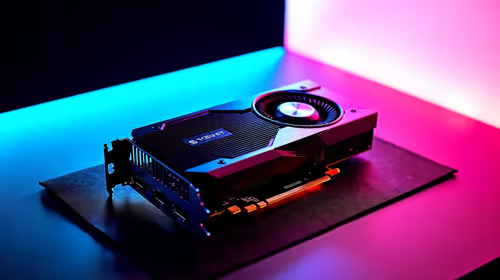
Top Settings for Intel Arc B580 at Ultrawide 1440p picks evaluated on performance, value & SA availability with current Rand pricing from Evetech.

RTX 4060 CS2 Low Settings at 1080p: FPS Results. Real-world benchmark data, FPS numbers & performance analysis. What SA gamers can actually expect.
Visual Artifacts: Possible GPU Issue Issue #1. Diagnosis steps, proven fixes & when to seek professional help. SA-specific support info included.
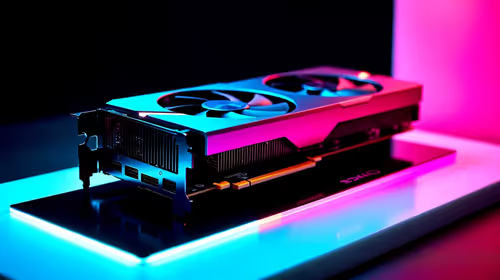
Can the RTX 4090 Handle 1440p 144Hz Gaming. Performance testing verdict with real data & practical recommendations for SA buyers.

Top ASUS GPU Under R15000 picks evaluated on performance, value & SA availability with current Rand pricing from Evetech.
GTA 6 Max Settings on RTX 5070. Tested & verified settings for best FPS and visual quality on SA hardware budgets.
Cyberpunk 2077 Max Settings on RTX 5080. Tested & verified settings for best FPS and visual quality on SA hardware budgets.
Starfield Max Settings on RTX 5070 Ti. Tested & verified settings for best FPS and visual quality on SA hardware budgets.
Top RTX 5090 Under R5000 picks evaluated on performance, value & SA availability with current Rand pricing from Evetech.