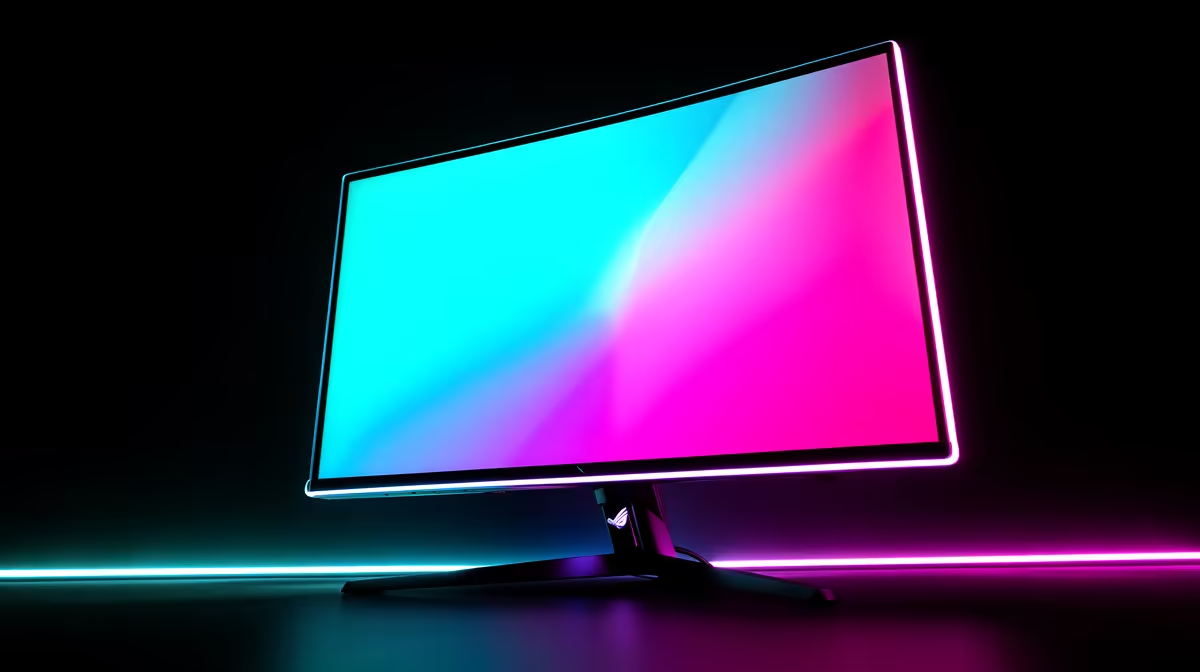
The monitor market in South Africa rewards patience and punishes impulse. Spend too little on a 27-inch 144Hz panel and you get a screen that technically meets the spec sheet but disappoints in every other way. Spend at the right level and the display carries your rig through several GPU upgrades without ever being the weak link. Knowing exactly where that level sits in ZAR pricing for a premium 27-inch 144Hz gaming display is the difference between a satisfying purchase and a regrettable one.
Quick Answer
A premium 27-inch 144Hz gaming monitor in South Africa typically costs between R6,000 and R9,000. That range buys QHD resolution, a quality IPS panel, and a credible HDR rating. Entry 144Hz screens start closer to R4,500 but trade away resolution and panel quality to get there.
💰 What the Entry Band Buys and Where It Falls Short
The cheapest 27-inch 144Hz panels in SA land near R4,000 to R4,500. At that price the trade-offs are predictable and worth naming plainly. Nearly all of them run at 1080p, which on a 27-inch screen gives a pixel density of around 82 pixels per inch. Text and fine detail look noticeably softer than on a 27-inch QHD panel at 109 pixels per inch. If you sit close to the screen, as most desk gamers do, the softness is not subtle.
Panel type at this price is almost always TN. The speed is there but the colour coverage is limited, typically around 70 to 75 percent sRGB, and viewing angles are narrow enough that a second person watching alongside you sees a noticeably different image. Stands at this price bracket commonly offer only tilt adjustment, which makes ergonomic positioning a compromise.
For a secondary display, a bedroom setup, or someone stepping up from a 60Hz screen on a very tight budget, the entry band is defensible. As the primary monitor on any serious gaming rig, it underdelivers.
🎯 The Premium Band: R6,000 to R9,000
Spending between R6,000 and R9,000 is where the specification makes a genuine leap. Three things change at once and they compound each other.
Resolution moves to QHD, meaning 2,560 by 1,440 pixels on a 27-inch screen. That 109 PPI density makes text genuinely crisp and gives games a noticeably cleaner edge to geometry, shadows, and foliage. If you have only ever gamed at 1080p on a large panel, the difference at QHD is visible immediately.
Panel type shifts predominantly to IPS. The wider colour coverage and stable off-angle viewing that IPS delivers are not features you tend to notice in isolation but are things you miss when you go back. At 99 percent sRGB, photo editing, design review, and colour-rich gaming environments all look more accurate.
HDR support enters the picture in this band. A DisplayHDR 400 certification is the floor level for genuine HDR content, though its effect is modest. Moving up toward R8,000 to R9,000 starts to bring DisplayHDR 600 panels into view, where local dimming and higher peak brightness produce a visibly richer high-contrast image in supported content.
Pro Tip ⚡
At R6,500 a 27-inch QHD 144Hz IPS panel represents the strongest value position in the local market. Paying above that mostly buys higher refresh rates like 165Hz or 240Hz, or a step up to HDR 600. Unless you are chasing peak competitive frame rates, the jump from R6,500 to R9,000 has diminishing returns for most gaming scenarios.
🔧 What Drives the Price Within the Band
Not every R8,000 monitor is more capable than every R6,000 monitor. Understanding the specific factors that move the needle helps you avoid paying for specs that do not affect your use case.
Refresh rate is the most common premium driver. Going from 144Hz to 165Hz is nearly imperceptible. Going from 144Hz to 240Hz is real but requires a GPU that can actually deliver 240 frames per second in your games, which at QHD resolution is demanding enough to need a high-tier card. If your GPU cannot sustain 200 FPS at 1440p in the titles you play, paying extra for a 240Hz panel returns very little.
HDR tier is the second driver. DisplayHDR 400 is the baseline and is largely a marketing designation at this point, since most monitors at that level use full-array backlights without local dimming, limiting real HDR performance. DisplayHDR 600 with genuine local dimming zones does produce a visible improvement and commands a genuine price premium.
Build quality and stand adjustability add cost that is easy to dismiss until you spend a day sitting at a fixed position. A monitor with height adjustment, tilt, and pivot over a range of positions takes roughly five minutes to set up correctly once and then stays comfortable indefinitely.
🖥️ Beyond R9,000: When the Premium Band Ends
Past R9,000 the market shifts toward 240Hz QHD panels, high-tier HDR implementations, OLED screens, and 4K. These are real upgrades for specific use cases but represent a different purchase decision. An OLED 27-inch at R12,000 to R15,000 offers contrast that no IPS panel can approach, but the price is nearly double the premium IPS band for a jump most users will find meaningful only in the darkest cinematic content.
For the bulk of South African gaming setups a well-chosen R6,000 to R9,000 monitor represents the point where additional spending starts returning less per rand than the purchase itself.
Frequently Asked Questions
What does R6,000 to R9,000 actually get you over a R4,500 monitor?
The jump buys three things at once: QHD resolution at 1440p rather than 1080p, an IPS panel with proper colour coverage instead of a TN screen, and a credible HDR rating. Each is a noticeable improvement in isolation; together they represent a display that matches modern gaming hardware rather than bottlenecking it.
Why does moving to QHD raise the price so much compared to 1080p?
A 1440p panel drives 77 percent more pixels than a 1080p equivalent, which increases the cost of the panel itself and the electronics that process the signal. The manufacturing yield requirements are also higher, since panel defects that might be acceptable at lower pixel densities become more visible on a denser screen.
Is HDR 400 worth paying for on a gaming monitor?
In most cases, no. DisplayHDR 400 is the entry HDR certification and does not require local dimming, so the real-world HDR effect is limited. If HDR is a genuine priority for your viewing, look for DisplayHDR 600 with local dimming, which begins to appear near the upper end of the R6,000 to R9,000 range.
Does a premium stand justify the extra cost in ZAR?
For a primary monitor used more than four hours a day, yes. A stand with full height, tilt, and pivot adjustment lets you place the screen at the exact position your neck and eyes need, which matters over long gaming or work sessions. The ergonomic benefit does not wear off, while the visual difference between two monitors at similar specs often does.
Which single spec delivers the best return in this price band?
For the majority of South African gamers, QHD resolution on a 27-inch IPS panel around R6,500 gives the clearest and most consistent improvement over a typical current setup. Chasing 240Hz at QHD or top-tier HDR produces real benefits only for users whose GPU and game library can actually exploit both, which narrows the field considerably.
Ready to match your rig with a monitor that earns its place on the desk?
Browse the 27-inch gaming monitor range and find the QHD 144Hz panel that fits your budget band without compromise.