Quick Answer
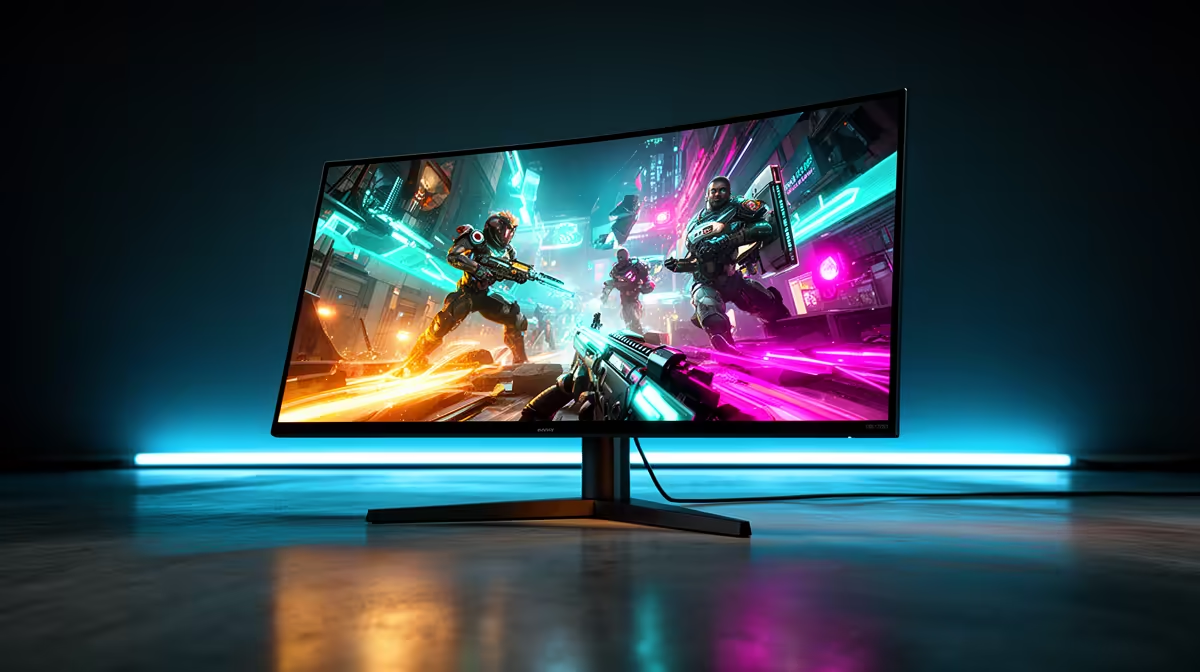
For South African buyers, the premium monitor decision comes down to three variables: QD-OLED versus WOLED panel technology, 144Hz versus 240Hz refresh rate ceiling, and whether the long-term value calculation (resale, warranty, and feature longevity) justifies spending R18,000 to R30,000 locally versus grey-market risk.
Understanding the Two OLED Panel Types Available in SA 🖥️
QD-OLED and WOLED are both self-emissive display technologies, but they generate colour differently. QD-OLED panels use a blue OLED backplane with quantum dot colour conversion to produce red, green, and blue subpixels, achieving peak brightness in small highlight zones of up to 1,000 nits. WOLED panels use a white OLED emitter filtered through a colour layer, producing slightly lower peak brightness (typically 250 to 450 nits full-screen) but better uniformity across the whole image.
In a South African home or office context, QD-OLED tends to perform better in rooms with significant ambient light because its brighter highlights remain visible even in sunlight.
Refresh Rate: Matching the Panel to Your SA Gaming Reality 💰
South Africa's premium gaming monitor market splits between 144Hz and 240Hz panels at 4K. The 144Hz tier typically falls in the R18,000 to R24,000 range, while 240Hz 4K OLED panels push R26,000 to R35,000. The additional cost for 240Hz is only recovered in value if your GPU can consistently deliver above 144 fps at 4K resolution.
With DLSS 4 and Frame Generation, an RTX 5080 can breach 200 fps at 4K in esports titles. In single-player AAA games, native framerates at 4K on even the RTX 5080 rarely exceed 120 fps without upscaling. This means for mixed-use gamers, 144Hz at 4K is genuinely the better ZAR allocation, freeing budget for a higher-quality panel brand or a larger screen size.
Long-Term Value in the South African Market 📈
OLED monitors depreciate more slowly than LCD counterparts because the technology gap remains wide. A 4K OLED purchased today will be competitive with most new IPS and VA launches for the next three to four years.
Buying from a local stockist like Evetech provides CPA-backed consumer protection, local warranty claim processing, and the certainty that you are not receiving a display intended for a different regional market with different voltage or power adapter tolerances. For a R20,000-plus purchase, that warranty certainty has tangible rand value.
Factor the Five-Year Cost Per Year ⚡
Divide your monitor's purchase price by five to get a cost-per-year figure. A R24,000 OLED works out to R4,800 per year, which compares favourably to replacing a R8,000 IPS panel every two years. OLED's slower depreciation and longer technological relevance often make it the better long-run financial decision for serious users.
FAQ
Which OLED panel type holds resale value better in South Africa?
QD-OLED panels from established brands tend to hold resale value slightly better due to their higher peak brightness specifications, which remain a headline comparison point when buyers upgrade. WOLED models from LG-sourced panels are also strong resellers due to brand recognition in the SA market.
Is extended warranty worth buying for an OLED monitor in SA?
For panels costing R20,000 or more, a two or three-year extended warranty covering pixel defects is worth the typical R800 to R1,500 premium. Pixel defects and panel uniformity issues, while rare, are expensive to resolve without warranty coverage at this price tier.
Can I use a premium OLED monitor for both console and PC gaming?
Yes. HDMI 2.1 ports support 4K at 120Hz for current-generation consoles, while DisplayPort 2.1a handles PC gaming at up to 240Hz. A dual-input setup works well for households with both a gaming PC and a console.
Comparing OLED panel types and refresh rates for your next monitor upgrade?
Evetech's premium monitor range includes QD-OLED and WOLED options at multiple refresh rates, all with local warranty and knowledgeable staff ready to help you match the right display to your setup.