Quick Answer
For a premium build in South Africa, prioritise a case with at least 360mm radiator support, three or more pre-installed fans, and a minimum 380mm GPU clearance. Expect to spend between R2,500 and R5,500 for a chassis that ticks all three boxes and leaves room to grow.
What Airflow Specs Actually Matter 🌬️
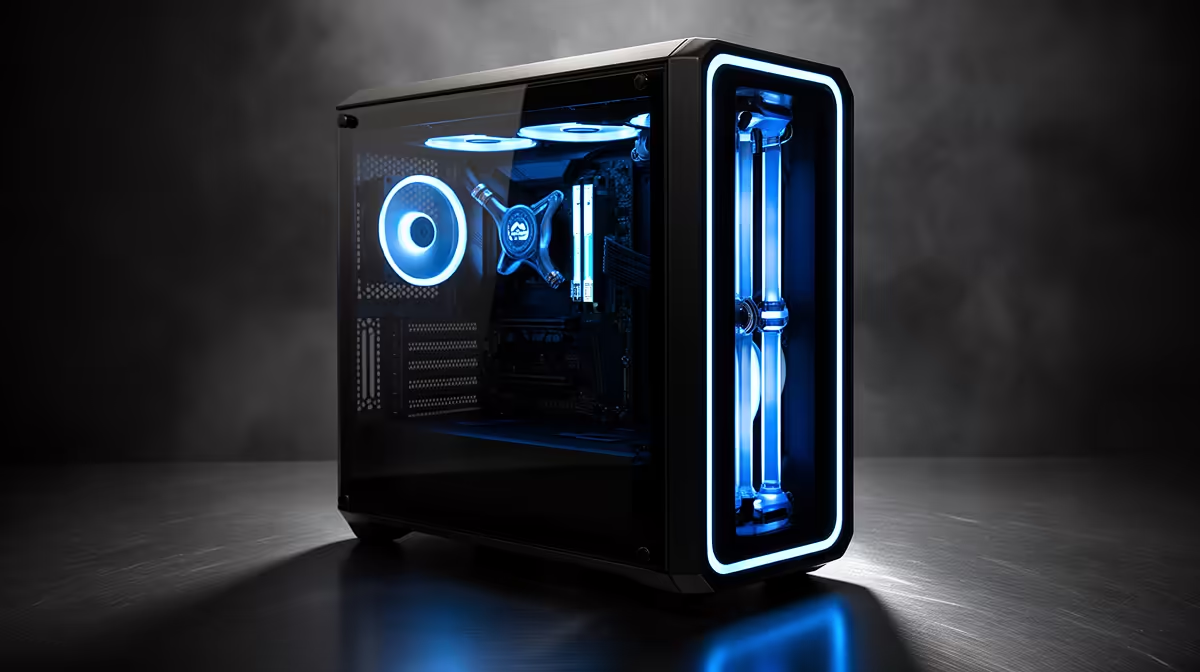
Airflow quality comes down to fan count, fan size, and whether the case front panel is perforated mesh or solid. A mesh front lets cool air reach the GPU and CPU cooler without restriction, while a solid or tempered glass front forces air to enter through narrow gaps and raises temperatures under full gaming load. For high-end builds pairing an RTX 5080 or RX 9070 XT with a Ryzen 9 9900X, sustained GPU temperatures above 85 degrees Celsius are a sign the case is choking your hardware. Three 120mm fans provide adequate baseline flow, but four 140mm fans move significantly more air at lower RPM and noise levels.
Radiator Support and Future Cooling Plans 💧
If you plan to run an all-in-one liquid cooler now or later, radiator clearance is non-negotiable. A 360mm radiator covers three 120mm fans and keeps a high-TDP CPU comfortably below 80 degrees Celsius under full load. Premium cases increasingly support 420mm radiators, which use three 140mm fans for even lower noise at the same cooling performance. Check the top and front mount positions separately as some cases support 360mm in the front but only 240mm on top, which limits future AIO upgrades. Verify that the radiator mounting position does not conflict with tall RAM modules or VRM heatsinks before purchasing.
Upgrade Space and Cable Management 🔧
South African builders tend to hold hardware longer between upgrades compared to markets with lower import costs, so buying a case with room to grow makes financial sense. Look for at least four drive bays, a PSU shroud that conceals cabling, and vertical GPU mounting brackets if you want to show off a flagship card. Cases with removable drive cages give you flexibility to add storage without sacrificing airflow. Tool-free side panel access also saves time during the iterative upgrades typical of a multi-year build cycle. A case in the R3,000 to R4,500 range from a reputable brand will generally outlast two or three hardware generations without feeling cramped.
Check Case Dimensions Before Buying ⚡
Before ordering, measure your desk or tower alcove and compare it against the case's external dimensions. South African shipping from online retailers can take several days, and returning an oversized case is more hassle than checking the specs sheet first. Pay attention to height and depth, not just width.
FAQ
How much should I spend on a PC case for a high-end South African build?
For a build using current-gen components like an RTX 5080 and Ryzen 9 9900X, a case budget of R3,000 to R5,500 is reasonable. Cheaper cases often compromise on fan quality, radiator support, or cable routing space, which affects both thermals and the build experience.
Does a tempered glass panel hurt airflow?
A tempered glass side panel has minimal impact on airflow if the front and top panels are open mesh. The problem arises with a solid glass front panel, which blocks intake air. Many cases solve this with a glass side panel and a perforated front, giving you visibility and good airflow simultaneously.
Is more fan support always better?
Not necessarily. More fan headers and mounting points give you options, but adding eight fans to a case designed for six can create turbulence and noise without a meaningful temperature drop. Focus on strategic fan placement: front intake, top exhaust, and rear exhaust form the most effective triangle for standard ATX builds.
Ready to choose your next case?
Browse Evetech's range of PC cases, from mid-tower mesh builds to full-tower E-ATX chassis with premium radiator support and upgrade room built in.