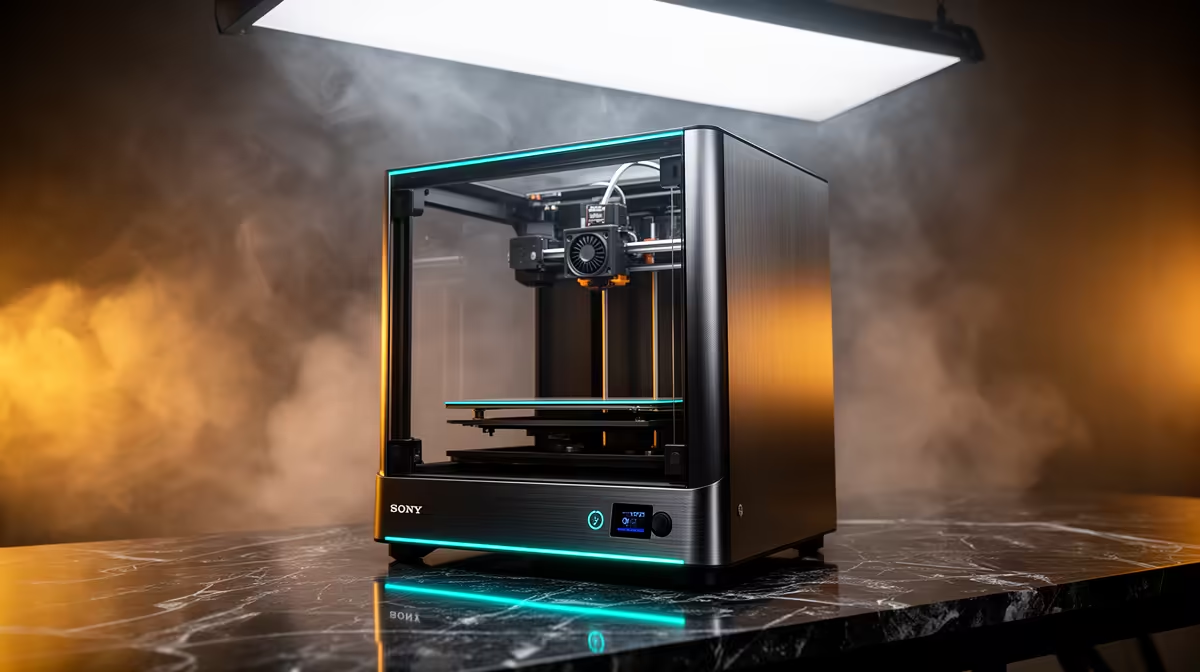
Two enclosed CoreXY machines keep showing up on serious South African maker benches, and the Prusa Core One vs Bambu P1S decision usually comes down to one thing: do you want a polished, locally stocked ecosystem, or an open, endlessly hackable platform you are willing to import for? Both sit around a 250mm cubed build volume, both run heated, enclosed chambers for ABS and ASA, and both target the same maker who has outgrown an open-frame bedslinger.
Quick Answer
The Bambu P1S wins on convenience and price in South Africa, currently around R12,495 with local stock, support, and a refined app workflow. The Prusa Core One is open-source and deeply serviceable but importer-only here, which adds cost and lead time. For most SA makers the P1S is the practical pick; the Core One rewards those who value repairability and tinkering over plug-and-play.
The two machines, side by side
The P1S is the enclosed sibling of Bambu's P1 line. It pairs a stiff CoreXY motion system with an enclosure, runs fast, and leans on the Bambu Handy app and cloud slicing for a near appliance-like experience. Multi-colour printing through the optional AMS unit is its party trick, and the whole platform is tuned so a first print succeeds without fuss.
The Core One is Prusa's answer to the CoreXY era. It moves the company away from its famous open-frame i3 lineage into an enclosed, faster format while keeping the Prusa philosophy intact: documented parts, replaceable everything, and firmware you actually control. It is built to be opened, fixed, and upgraded for years rather than replaced.
Print quality and speed
On raw output the two are closer than the price gap suggests. Both use CoreXY kinematics, which keeps the heavy components off the moving bed and allows high acceleration without the ghosting an open bedslinger shows at speed. Expect clean walls, tidy overhangs inside the enclosure, and reliable ABS and ASA results once the chamber warms.
Where the P1S pulls ahead
Tuning is the P1S advantage. Bambu ships sensible profiles, the slicer is mature, and input shaping is dialled in from the factory. You spend less time chasing calibration and more time printing. For a maker who wants parts, not a hobby in calibration, that matters.
Where the Core One pulls ahead
The Core One is the machine you can understand top to bottom. When a part wears, Prusa publishes the spare and the procedure. Firmware is open, the community is large, and modifications are encouraged rather than locked out. Over a multi-year ownership window that serviceability can outweigh a slicker app.
Chamber heating: a real technical difference
One spec that distinguishes the Core One clearly is its active chamber heating. The Core One heats the enclosure to up to 55 degrees Celsius, compared to the P1S's passive enclosure that traps heat from the heated bed and hotend but does not actively maintain chamber temperature. For most ABS and ASA prints at medium sizes that difference is minor. For large ABS prints that grow tall over many hours, an actively heated chamber maintains consistent layer bonding all the way up the part, which reduces warping and layer splits near the top that passive enclosures can struggle with as the print grows away from the bed heat. If you print large single-colour ABS structural parts, that is a genuine advantage on the Prusa side.
The South African reality
This is where the contest is decided for most local buyers. The P1S has confirmed SA pricing and availability, so you order it, it arrives, and warranty support is reachable. The Core One is importer-only, meaning you pay the unit cost plus shipping, duties, and a longer wait, and spares follow the same import path. If you want to see how the enclosed CoreXY category is shaping up locally, the 3D printers section at Evetech is a useful gauge of what is genuinely in stock versus what needs importing.
Filament and consumables tip the maths further. ABS, ASA, and PETG are easy to source here, and an enclosed chamber finally makes those higher-temperature materials practical without warping. Either printer handles them, so factor ongoing filament cost into the decision rather than just the sticker price.
Multi-colour and the AMS versus MMU question
If multi-material printing matters to you, Bambu's AMS ecosystem is more polished and more widely adopted. The AMS supports up to 16 colours across paired units, and the purging workflow is handled automatically with the poop chute positioned away from the build plate so you keep the full 256 x 256mm print area. The Prusa MMU3 is Prusa's multi-material solution, and it works, but it prints a prime tower on the bed during colour changes, consuming some of the build area and adding some manual calibration. For a maker who wants multicolour prints with the least friction, the Bambu ecosystem has the cleaner workflow.
Ecosystem and accessories
The P1S ecosystem is broad and tightly integrated: the AMS for multi-material, a strong slicer, and a deep accessory catalogue. The Core One leans on the open RepRap world, so third-party mods, nozzles, and community fixes are plentiful if you enjoy that path. For nozzles, adhesion sheets, spare PTFE, and the small consumables that keep either machine running, it is worth scanning what is on the accessories best sellers list before you commit, since downtime waiting on a R150 part is the real cost.
Who should buy which
Choose the P1S if you want local stock, fast support, multi-colour capability, and a machine that prints well out of the box with minimal calibration. It suits makers who treat the printer as a tool.
Choose the Core One if open-source matters to you, if you intend to service and upgrade the machine yourself for years, and if you accept the import cost and wait as the price of that freedom. It suits makers who treat the printer as a platform.
Frequently Asked Questions
Is the Bambu P1S actually available in South Africa?
Yes. The P1S has confirmed local pricing, currently around R12,495, with in-country stock and support, which is its biggest advantage over the import-only Core One.
Can the Prusa Core One be bought locally?
It is importer-only in South Africa at present, so you should budget for shipping, duties, and a longer lead time on both the unit and its spare parts.
Do both printers handle ABS and ASA?
Yes. Both are enclosed CoreXY machines with heated chambers, which is exactly what ABS and ASA need to print without warping or layer splitting.
Which is better for multi-colour printing?
The P1S, paired with Bambu's AMS unit, has the more mature multi-material workflow. The Core One can do multi-material too, but the P1S ecosystem is more turnkey for it.
Which one is easier for a first-time enclosed-printer owner?
The P1S. Its factory tuning, mature slicer, and app workflow get you to a successful print faster, while the Core One rewards owners who enjoy hands-on setup and servicing.