The headline gives you a PS5 Pro-sized budget and asks what a gaming PC can do with it. Treat that number as the scenario, not a live console quote from this guide. In the same spending band, a well-balanced desktop can reach a discrete mid-tier graphics card, capable CPU, 16GB or more of memory and fast storage. The precise parts and performance depend on the local configuration available when you buy.
Quick Answer
A gaming PC around the headline budget can target strong 1080p and useful 1440p play with a mid-tier discrete GPU. It also gives you a broader PC game library, component upgrades and general desktop use. A PS5 Pro gives you a fixed console target, controller-led living-room setup and less component research. Choose the experience before comparing specifications.
Use the gaming PC deals page and PC best sellers to capture an exact local build and dated price. Do not infer the current configuration from the budget alone.
What the PC Budget Needs to Cover
Decide whether the amount covers only the tower. A monitor, keyboard, mouse, controller, headset and Windows setup can change the basket. If you already own suitable peripherals, the tower can take the whole budget.
The console side needs the same treatment. Count a second controller or storage only when you will buy it. Use the television you already own on both sides when it can serve both.
This removes the usual comparison trick where one platform receives a complete setup and the other gets a bare device.
Put the Graphics Card First
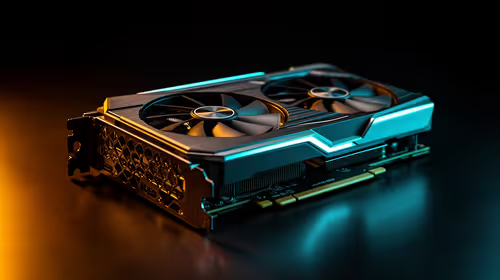
For a gaming desktop, the discrete GPU should receive the largest performance share of this budget. Look for a current mid-tier card with enough memory for the games and settings you target. Then choose a processor that can feed it without consuming money meant for graphics.
A faster CPU can help high-refresh esports and simulation games. A larger GPU matters more when you raise resolution, image quality or ray-traced effects. Name your games before choosing which side receives the extra spend.
Check benchmark results for the exact GPU and game. "Mid-tier" covers a range, and model names alone cannot promise a frame rate.
Memory, Storage and the Parts You Cannot See
Sixteen gigabytes of system memory is a practical starting point, with 32GB attractive for newer games, creation and heavy multitasking. Use a matched kit supported by the motherboard.
Fast NVMe storage keeps the PC responsive, but capacity controls how many large games remain installed. Choose enough space for your real library and leave an upgrade slot where possible.
Do not sacrifice the PSU, motherboard or case airflow to force a higher GPU name into the budget. A proven power supply with the correct cable and a case with clear intake protect the whole build. These parts rarely appear in a simple console-versus-GPU headline.
What Console Simplicity Buys
A fixed console platform gives developers one known target. Setup is controller-led, updates follow the platform path and game settings require fewer decisions. This has value when you want to sit down and play from the sofa.
The PC asks you to handle drivers, graphics menus, launchers and occasional troubleshooting. In return, you can choose input devices, change settings beyond a fixed console mode and use the same machine for work, study or creation.
Time matters. A buyer who dislikes component choices may prefer the console even when the spreadsheet favours desktop flexibility.
Resolution and Frame Rate Need Game-Level Evidence
A console can use dynamic resolution, reconstruction and fixed quality modes to target a frame rate. A PC exposes more settings and lets you trade image quality for speed. "Native" can mean different things once scaling technologies enter the discussion.
Compare the same game, scene and display output where possible. Check whether the PC benchmark includes upscaling or frame generation, and identify the console mode being tested.
Do not promise that one budget holds a fixed resolution and frame rate across every title. A demanding new release and an esports game place different loads on both platforms.
The PC Upgrade Path
A desktop can receive more storage, memory or a new graphics card later. Whether that upgrade is economical depends on the original motherboard, CPU, case and PSU. Choose those foundations with one realistic next step in mind.
You do not have to upgrade. A stable PC can remain unchanged for years, and graphics settings can extend its useful life. The option has value; the spending is still your choice.
When the GPU changes, check power capacity and CPU balance. Component upgrades work best when one part can move without dragging three others with it.
Library and Ongoing Costs
PC offers several storefronts, older games, mods in supported titles and many online multiplayer games without a platform-wide access fee. PlayStation has its own exclusives, account library and subscription catalogue. Availability and terms change, so check the games you care about.
Make a five-year basket of actual titles rather than assuming every PC game is cheaper. Include online subscriptions you would buy and the resale value you expect from physical console games, where applicable.
The initial hardware budget is only the first row. The platform you use more can deliver better value even if it costs more on day one.
Who Should Choose Each Option?
Choose the gaming PC when you want adjustable settings, a broad desktop library, component choice and other computer tasks. You should be comfortable with basic maintenance or willing to learn it.
Choose the PS5 Pro when the living-room console experience, fixed platform and PlayStation library carry more weight than upgrade flexibility. A controller-first household may prefer its lower setup overhead.
The same buyer can value both. This budget comparison helps you identify the trade, not manufacture a universal winner.
FAQ
What tier of GPU does this PC budget reach?
It can reach a discrete mid-tier card in a balanced tower, depending on the exact dated local configuration. Check the named GPU and its game benchmarks.
Does the gaming PC budget include a monitor?
Treat it as a tower budget unless the listed bundle says otherwise. Add a monitor and peripherals when you do not already own suitable ones.
Is a PS5 Pro easier to set up?
For many buyers, yes. The fixed platform and controller-led interface remove much of the component and graphics-setting work.
Can the gaming PC be upgraded later?
Yes. Storage, memory and graphics can often change separately, provided the motherboard, case and PSU support the chosen upgrade.
Use the headline PS5 Pro budget as a scenario, compare a named local gaming PC on the same date and choose between fixed console ease and desktop flexibility.