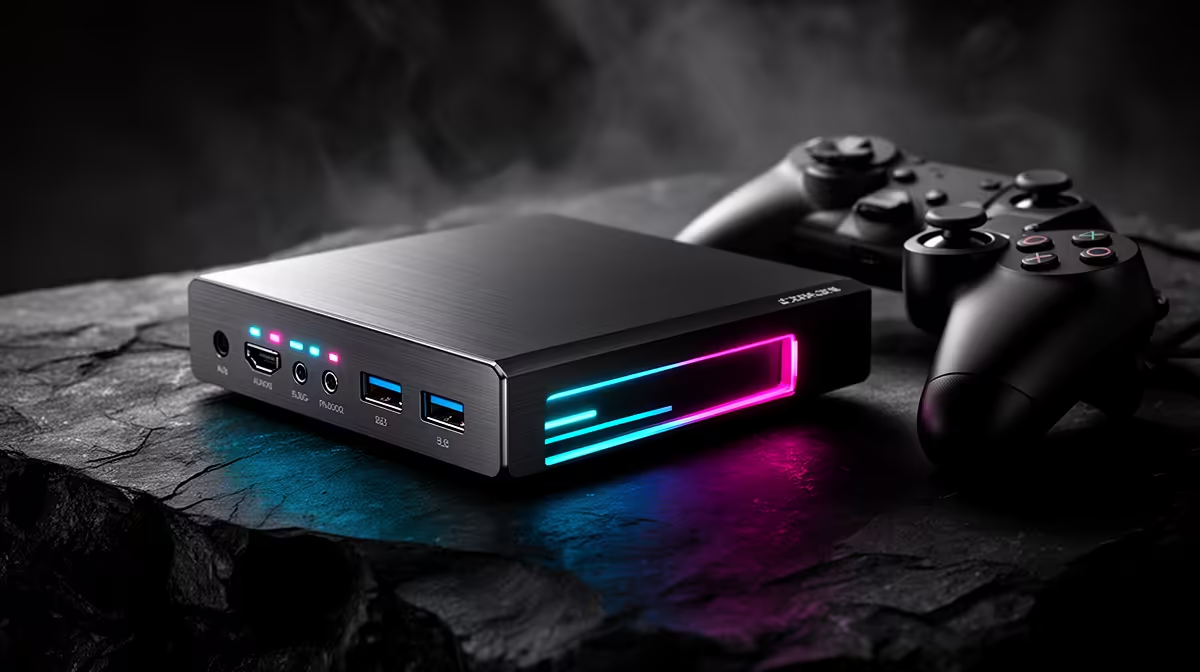
Console gameplay recording is not as simple as plugging a cable between a PS5 or Xbox and a PC and pressing record. The consoles themselves have copy protection, specific HDMI versions, and audio routing quirks that catch out first-time capture buyers. Getting the right accessories the first time means understanding what the console is actually outputting and what each piece of the capture chain needs to receive. PS5 and Xbox recording accessories require a few non-obvious decisions upfront, and making them correctly saves you from blank screens, missing party audio, and wasted resolution.
Quick Answer
Prioritise a capture device with 4K60 passthrough and HDCP handling for the console HDMI output, HDMI 2.1 support for newer consoles, and a chat-link audio adapter for party voice. Quality cables and a direct connection from the console to the capture device prevent the most common blank-screen and dropout issues.
🎮 Capture Cards: What the Numbers Actually Mean
The core piece of hardware is the capture device, and its specifications determine what the console can actually deliver to your recording or stream. There are three figures worth understanding before buying.
Passthrough resolution and frame rate describes what the console sends to your television while the capture card simultaneously records a separate signal. A 4K60 passthrough card routes 4K video at 60 frames per second to your display without any quality reduction, so gameplay feels completely normal. What the card actually captures for recording is typically 1080p60, which is what the majority of console games render to natively even when they output a 4K signal through upscaling.
Capture resolution and frame rate is the quality of what the card writes to storage. Most current cards record at 1080p60, which suits the majority of streaming and YouTube content. Cards that capture at 4K60 cost more and the visible quality difference for most viewing contexts is modest against the higher file size and processing demand.
HDMI input version determines what signals the card can accept. Standard HDMI 2.0 handles 4K at 30 frames per second and 1080p at up to 144Hz. HDMI 2.1 handles 4K at 120Hz and 8K at lower frame rates. For the PS5 and Xbox Series X, which support 4K120 and even 8K output in specific titles, an HDMI 2.1 capture device keeps pace with what the console is sending out.
HDCP and Why It Causes Blank Screens
HDCP is a copy protection protocol built into HDMI that consoles use to prevent their output from being directly captured. When a PS5 has HDCP enabled in its system settings and an active HDCP device is in the signal path, many capture cards receive a blank or black screen instead of footage.
The PS5 has a setting under System to disable HDCP for video output, which must be active during recording sessions. The Xbox Series consoles apply HDCP more selectively, only on protected content rather than all game output. Checking HDCP settings is the first troubleshooting step for any blank-screen capture problem, since it is the cause in the vast majority of cases.
🎙️ Recording Party Chat and Game Audio Correctly
Console party voice is one of the most frustrating aspects of capture setup because it deliberately routes outside the HDMI signal on both Sony and Microsoft platforms by default. Your mic appears in the recording, but your teammates or friends in party chat are silent, which makes co-op recordings and commentary-heavy content unusable.
A chat-link audio adapter addresses this by connecting to the controller's headphone jack and routing party audio into the capture chain. The adapter takes the mixed signal from the controller, which includes both game audio and party voice, and feeds it as an analogue input to the capture device or to a separate audio interface. This gives you the party mix alongside game audio in your recording.
A secondary benefit of this approach is that you can control the game-to-chat balance directly at the controller rather than in post-production. Setting the party volume correctly before recording means the mix in the captured file is usable without additional audio editing.
For streamers using a USB microphone rather than a headset, the USB mic connects to the PC as the voice input and the chat-link adapter handles party audio. Route each to separate tracks in recording software for full independent control.
Pro Tip ⚡
Do a five-minute test capture before any planned session. Play a few minutes of gameplay with a party chat open, then review the recording in your editing software and confirm that game audio, party chat, and your microphone all appear on separate, correctly labelled tracks. Discovering an audio routing error after a three-hour session is far more frustrating than spending five minutes confirming everything before you start.
🔌 Cables, Connections, and Avoiding Capture Dropouts
Console capture setups fail at the cable level more often than most guides acknowledge. The reason is that high-speed HDMI signals, particularly at 4K60 and above, are sensitive to cable quality in a way that standard definition signals were not. A cable that handles 1080p reliably may introduce intermittent dropouts, blank frames, or a refusal to handshake at 4K.
Certified high-speed HDMI cables rated to handle 4K60 or 4K120 transmission are the practical choice. The certification confirms that the cable has been tested at those speeds rather than just marketed at them. Cable length matters too. Longer runs at high speed are harder to sustain reliably, and consumer cables over two metres at 4K60 introduce a degree of risk. If a longer run is needed, an active HDMI cable that regenerates the signal electrically over its length is worth the additional cost.
Standalone capture devices that record directly to an SSD or SD card without a PC in the chain suit console creators who want to record without running a gaming PC simultaneously. They write the recording to attached storage while passing video to the television and a streaming encoder, and dedicated hardware typically handles HDCP and HDMI handshaking more reliably than PC-based capture software.
Frequently Asked Questions
What capture resolution is actually worth aiming for with current consoles?
A 4K60 passthrough card with 1080p60 capture matches what most games genuinely output and what most streaming platforms and YouTube audiences consume. Capturing at 4K is technically possible and useful if you plan to reframe or zoom footage in post-production, but the storage requirement is approximately four times higher and PC editing performance needs to match. For most console creators, 1080p60 capture is the practical ceiling.
How does HDMI version affect Xbox and PS5 performance in practice?
The PS5 and Xbox Series X both support HDMI 2.1 for high-refresh output in compatible titles. If your capture card has only an HDMI 2.0 input, you will need to set the console output to 4K60 or lower to ensure the card accepts the signal. The console will function normally at that setting, and most games run at 60fps or below anyway. HDMI 2.1 in the capture chain only matters if you actively want to record 4K120 gameplay, which is currently a minority use case.
Why is cable quality more important at 4K than at 1080p?
HDMI signals at 4K60 carry roughly four times the data of 1080p60, which requires the cable's conductors and shielding to perform at a substantially higher standard. Budget cables that cut corners on insulation or conductor quality work fine at lower data rates and fail intermittently at higher ones. The failure mode is not always obvious, presenting as periodic frame drops, handshake failures, or a blank screen that clears when the cable is reseated.
What is a standalone capture device and when is it the better option?
A standalone capture unit connects between the console and the television, records to its own storage without a PC, and passes video simultaneously to the display and a streaming encoder. It suits creators without a capable gaming PC or those who want the simplest recording workflow. The trade-off is less real-time audio mixing flexibility than a PC-based setup offers.
Ready to set up a clean PS5 or Xbox recording workflow?
Browse the capture cards, audio adapters, and streaming accessories at Evetech to build a console recording setup that captures every session without the blank screens and missing audio.