Quick Answer
PWM-controlled PSU fans adjust their speed in fine steps based on internal temperature, running near-silent at low loads and spinning up gradually under heavy load. Standard DC fans either run at a fixed speed or switch on abruptly, causing audible noise spikes. For silent gaming PC operation, choose a PSU with a PWM fan controller and semi-passive or zero-fan mode below 40% load.
How PWM Fan Control Works Inside a PSU 🌀
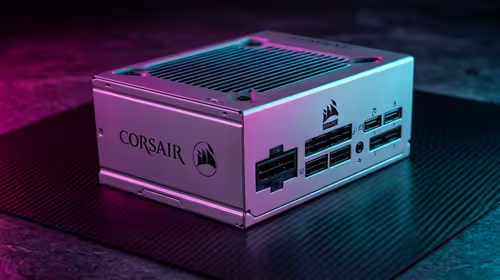
Pulse Width Modulation (PWM) fan control varies the percentage of time power is delivered to the fan motor, changing average voltage without a resistor. At 20% duty cycle the fan spins slowly and quietly. At 100% it reaches maximum RPM. A thermal sensor inside the PSU measures heatsink temperature and the controller adjusts duty cycle in real time. Quality PSUs from Corsair (RM series) and Seasonic (Focus GX) use this approach, and their fans do not become audible until internal temperatures exceed 45 to 50 degrees Celsius. In a 900W unit, that threshold only occurs above about 70% continuous load.
Standard PSU Fans: Noise Profiles and Shortcomings 🔧
Older or budget PSUs use a simple thermistor-and-relay approach: the fan runs at fixed speed from boot or switches on at a temperature threshold with a noticeable spin-up noise. Fixed-speed fans on cheaper units run continuously at 1,200 to 1,500 RPM regardless of load, generating between 22 and 30 dB. For a gamer using open-back headphones or playing without audio in a quiet room, this hum is distracting. In South Africa's warmer indoor climate (ambient temperatures in Johannesburg averaging 22 to 28 degrees Celsius in summer), a fixed-speed fan also provides less cooling margin because it cannot spin faster when the room temperature rises.
Achieving Zero-Noise Operation During Light Gaming 💡
Several premium PSUs include semi-passive or hybrid mode where the fan stops entirely below 30% to 40% load. In a system drawing 400W from a 1000W PSU (40% load), the PSU fan may run at 0 RPM with internal temperatures managed by convection alone. This is achievable because Platinum or Titanium rated PSUs generate so little waste heat at moderate loads that passive cooling is sufficient. Activate hybrid mode via the physical switch on the PSU rear panel next to the IEC socket, or in BIOS on supported units. With PSU fan off, only the CPU cooler and GPU fans remain audible during light gaming.
Pair a PWM PSU Fan with a Well-Ventilated Case ⚡
A PWM PSU fan in a poorly ventilated case is forced to run faster because ambient air inside the case is already warm from component heat. Place the PSU in a case with a direct bottom-mount intake filter and at least one active rear exhaust fan. This reduces PSU heatsink temperature by 5 to 10 degrees and lets the PWM controller keep fan speeds lower throughout your gaming session.
FAQ
Does semi-passive mode reduce PSU lifespan?
No. Components last longer at lower temperatures. Zero-fan periods in semi-passive mode extend capacitor lifespan by reducing thermal cycling, and fan bearings experience less wear. Most quality semi-passive PSUs carry 10-year warranties reflecting this design confidence.
Can I retrofit PWM fan control onto an older PSU?
No, not safely. The fan control circuitry is integrated into the PSU's primary controller PCB. Replacing the fan with a PWM unit and wiring it to a separate controller bypasses the thermal protection loop. Replace the PSU rather than modifying it.
What RPM should a PSU fan run at during heavy gaming?
Under full load, quality PSU fans spin to between 1,200 and 2,000 RPM. Below 1,400 RPM most 135mm fans are inaudible with side panels closed. If your PSU fan frequently exceeds 1,800 RPM during gaming, case airflow is insufficient and the PSU is relying on its own fan rather than case exhaust to cool itself.
Want a quieter PC without sacrificing cooling performance?
Browse Evetech's range of semi-passive and PWM-controlled power supplies stocked in South Africa, from 650W to 1600W across Gold, Platinum, and Titanium efficiency ratings.