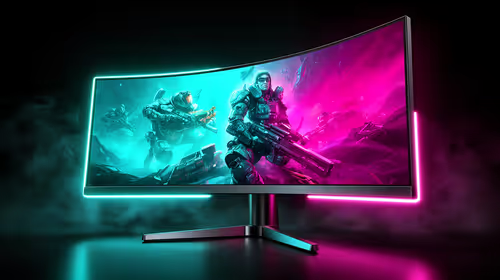
QHD is the gaming sweet spot for many PCs because it looks sharper than 1080p without asking the graphics card to shade a full 4K frame. A 4K monitor earns the extra load when you sit close to a larger screen, value fine desktop detail and own a GPU that can hold your game target. Choose from the card backwards.
Quick Answer
Pick QHD at 27 inches for a strong mix of sharpness, high refresh and manageable GPU demand. Consider 4K at 27 to 32 inches when text clarity, creation work and detailed games matter, and your graphics card can sustain the frame rate you want. Competitive players often gain more from QHD 165Hz or 240Hz than from 4K at a lower refresh.
The pixel difference is large
QHD, or 2560 x 1440, contains about 3.7 million pixels. 4K UHD, or 3840 x 2160, contains about 8.3 million. The 4K panel gives the GPU more than twice as many output pixels to manage.
That extra density makes text, interface edges and fine game detail look clean at a suitable viewing distance. It also reduces frame rate when settings stay the same. The size of that hit varies with the game and graphics card.
At 27 inches, QHD offers a comfortable pixel density for gaming and ordinary Windows use. At 32 inches, 4K looks crisp and provides useful workspace, though you may enable display scaling to keep text readable.
Match refresh rate to the games
Refresh rate describes how often the panel can show a new image. A 165Hz monitor can display a fresh frame every 6.1 milliseconds, while 240Hz cuts that to about 4.2 milliseconds. The game and PC must still produce frames at a useful pace.
For competitive shooters, QHD makes high refresh easier to feed and preserves more sharpness than 1080p. For slower single-player games, 4K detail can carry more value than the jump from 144Hz to 240Hz.
Adaptive sync helps when frame rate moves through the monitor's supported range. Check the exact range, connection and GPU compatibility. A good variable-refresh experience can make a fluctuating 90 to 120 fps feel cleaner than an uncapped output with tearing.
Use real GPU headroom
Run your five demanding games at QHD and 4K using reputable benchmarks for the same GPU. Compare average frame rate and one-percent lows. Decide the minimum base frame rate you accept before frame generation.
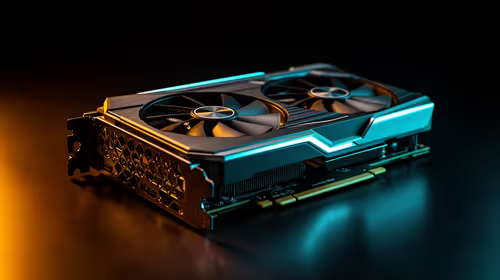
A mid-range graphics card may deliver excellent QHD results and require compromises at 4K. A high-end card has more 4K headroom, but ray tracing can absorb it fast. New games also grow more demanding, so leave margin rather than buying for one launch benchmark.
Upscaling changes the equation. A quality mode can create a 4K output from a lower internal resolution, improving performance while keeping a sharp interface. Inspect motion, fine detail and ghosting in the games you use. QHD upscaling begins from fewer source pixels and can expose reconstruction artefacts sooner.
Screen size and viewing distance
Sit too far from a small 4K monitor and the extra detail becomes hard to see. Sit close to a large QHD panel and individual pixels become easier to notice. Your eyes, desk depth and display scaling decide the useful point.
For a normal desktop distance, 27-inch QHD is a safe starting size. A 32-inch 4K monitor gives a larger canvas without coarse text. Ultrawide resolutions need their own calculation because 3440 x 1440 sits between standard QHD and 4K in pixel load.
Browse the monitor catalogue by size, resolution and refresh, then compare which combinations appear on the monitor best-seller page. Open the exact product specification because one family can include several panels.
Panel quality can outweigh resolution
Resolution does not tell you response time, contrast, colour, HDR performance or viewing angles. A strong QHD OLED or fast IPS panel can look better in motion than a basic 4K screen. A good 4K Mini-LED monitor may provide bright HDR that neither ordinary panel can match.
Check measured pixel response across the refresh range. A slow panel can smear moving detail even when its resolution is high. Look for overshoot at the overdrive setting you will use.
For dark-room gaming, native contrast and local dimming matter. For creation work, seek coverage and calibration data for the colour space your software uses. A factory accuracy claim should be backed by measurements.
Desktop work favours 4K in a different way
High pixel density improves text and gives photographs or video a detailed preview. Windows scaling can preserve readable interface size while using the extra pixels for cleaner edges. Check your older applications because some handle scaling better than others.
If you edit 4K video, a 4K monitor can show the frame at full output resolution, though panels and toolbars reduce the available preview area. A second monitor or larger screen may still be useful.
For spreadsheets and coding, physical size and window layout may matter more than raw pixel count. Test the scaling level you expect to use rather than assuming 4K creates twice the practical workspace.
Ports and bandwidth
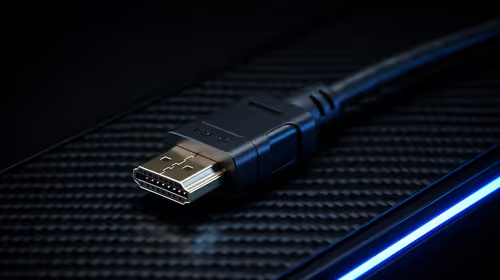
High resolution plus high refresh needs enough connection bandwidth. Confirm which refresh, colour depth and HDR modes the monitor supports over DisplayPort and HDMI. The GPU and cable must support the same standard.
Display Stream Compression can enable demanding combinations with no visible loss in normal use when implemented as intended. Some monitors reserve full refresh for one input or reduce colour format at a certain mode. Read the manual.
Console users should check supported 4K 120Hz input, variable refresh and HDMI features on the exact model. A PC-oriented DisplayPort specification does not prove console behaviour.
A two-option buying test
Build one QHD high-refresh option and one 4K option at the same total budget. Include any GPU upgrade needed to drive the 4K panel. Compare them in the games and work you use each week.
Choose QHD when it keeps frame rates inside your desired refresh range and the screen looks sharp at your desk. Choose 4K when its detail is visible in your work and games, and the system holds a base frame rate you enjoy without stripping away the image settings you bought it for.
Frequently Asked Questions
Is 4K always sharper than QHD?
It has more pixels, but visible sharpness also depends on screen size, viewing distance and scaling.
Is QHD enough for a 32-inch monitor?
It can be comfortable for gaming, though text appears less dense than on 27-inch QHD or 32-inch 4K. View one at your desk distance if possible.
Do I need a flagship GPU for 4K?
Not for every game. Demanding high-setting play benefits from a high-end card, while lighter titles and upscaling can run well on less powerful hardware.
Compare QHD and 4K with your GPU's exact-game one-percent lows, then choose the resolution and refresh combination your desk can use.