Quick Answer
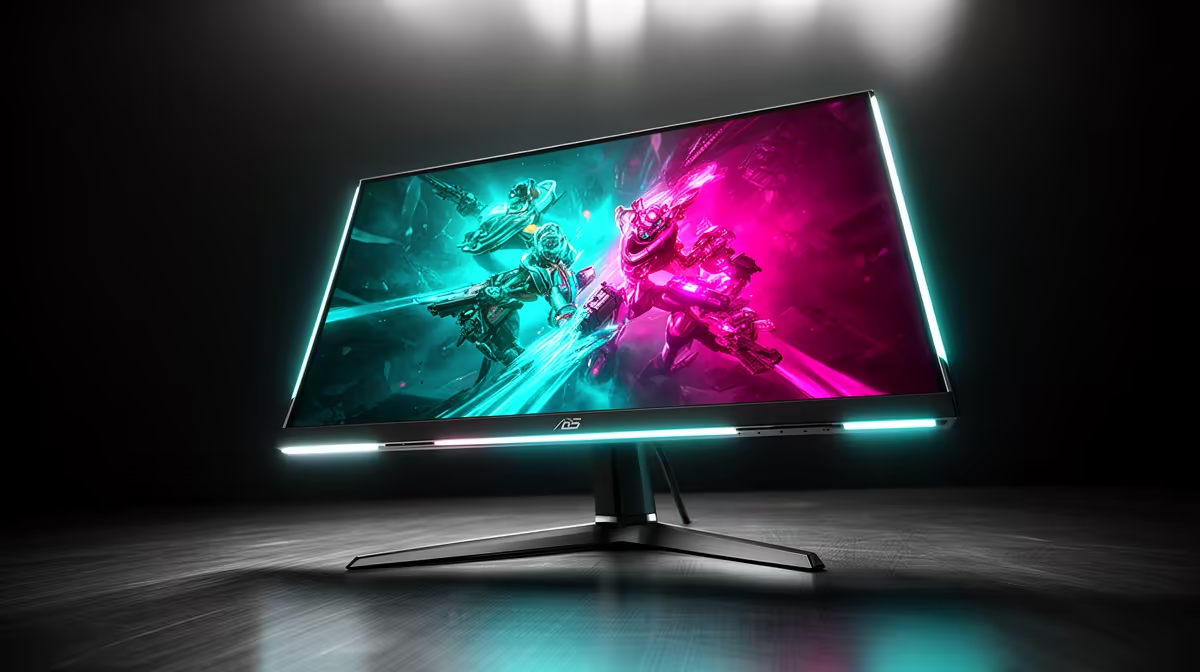
At 27 inches, QHD (2560x1440) is the better choice for most esports players. Full HD (1920x1080) at 27 inches produces a pixel density of 82 PPI, which is noticeably soft at normal viewing distances. QHD at the same size delivers 109 PPI, making the image sharper without the rendering cost of 4K.
Pixel Density and Visual Sharpness at 27 Inches 🖥️
Pixel density determines how sharp text, UI elements, and player models appear. At 1080p on a 27-inch panel, individual pixels are visible to most people sitting 50 cm to 70 cm from the screen, particularly in fine text and the edges of thin UI lines. Professional esports players often sit closer than this (50 cm is common), which makes the softness even more noticeable. QHD on the same 27-inch panel produces pixels that are 25% smaller across each dimension, resulting in sharper player models, cleaner crosshair edges, and finer detail in map textures. In CS2 and Valorant, where distinguishing a pixel-wide sliver of an enemy model from background geometry matters for aiming, the additional sharpness of QHD has a real gameplay argument behind it.
Frame Rate Trade-Offs Between QHD and 1080p 🎮
The cost of QHD over 1080p is GPU load. Rendering at 2560x1440 requires approximately 78% more pixels per frame than 1920x1080. On an RTX 5070 or RX 9070, CS2 produces 400-plus fps at 1080p but around 280 to 350 fps at 1440p on low settings. In Valorant, which is CPU-limited rather than GPU-limited, the difference between 1080p and 1440p frame rates is smaller, typically 10% to 15% lower at QHD. For esports titles specifically, a GPU capable of producing 200-plus fps at 1440p is readily available in the R12,000 to R18,000 price range in SA, making QHD a viable choice for competitive play without compromising frame rates to a level where a 240Hz or 300Hz panel becomes underutilised.
Which Resolution SA Esports Players Should Choose 🏆
For a competitive SA player pairing a 27-inch monitor with a mid-to-high tier GPU: choose QHD. The GPU cost to run esports titles at QHD is modest, the visual sharpness improvement over 1080p is immediately apparent at 27 inches, and QHD monitors at 165Hz to 240Hz are priced from around R4,500 to R8,000 locally, which is a reasonable spend for a setup that will remain relevant through multiple GPU upgrades. The only strong case for 1080p at 27 inches is a budget build where the GPU is below the RTX 4060 level and the focus is purely on maximum frame rates with no budget headroom for a GPU upgrade.
Run 1080p Temporarily While You Wait for the GPU Upgrade ⚡
A QHD monitor purchased now can run at 1080p via the monitor's resolution scaling until you upgrade to a GPU that handles 1440p at your target frame rate. The image will not be as sharp as native 1080p on a 1080p panel, but it is a reasonable transitional setup rather than buying two monitors at different times.
FAQ
Do professional esports players use QHD or 1080p?
Most LAN-event pro players still use 1080p at 240Hz to 360Hz because tournament-provided setups prioritise maximum frame rates on standardised hardware. For home setups with personal GPU choices, many pros use QHD at 165Hz to 240Hz where their GPU supports it.
Is there a visual quality difference between QHD and 1080p for console-style gaming?
Yes, but it is less relevant on a 27-inch panel at typical TV viewing distances above 1 metre. At PC viewing distances of 50 cm to 70 cm, QHD is clearly sharper. At 1.5 metres or more, the difference is much harder to detect.
Can a mid-range SA build run QHD esports titles at 144Hz or higher?
Yes. An RTX 4070 or RX 7800 XT produces 144-plus fps in CS2 and Valorant at 1440p on medium settings without difficulty. These GPUs are priced from approximately R10,000 to R14,000 in the SA market.
Deciding between QHD and 1080p for your 27-inch esports monitor?
Evetech stocks QHD gaming monitors from 144Hz to 300Hz. Browse the monitor section to find a panel that pairs well with your GPU and your competitive game of choice.