Quick Answer
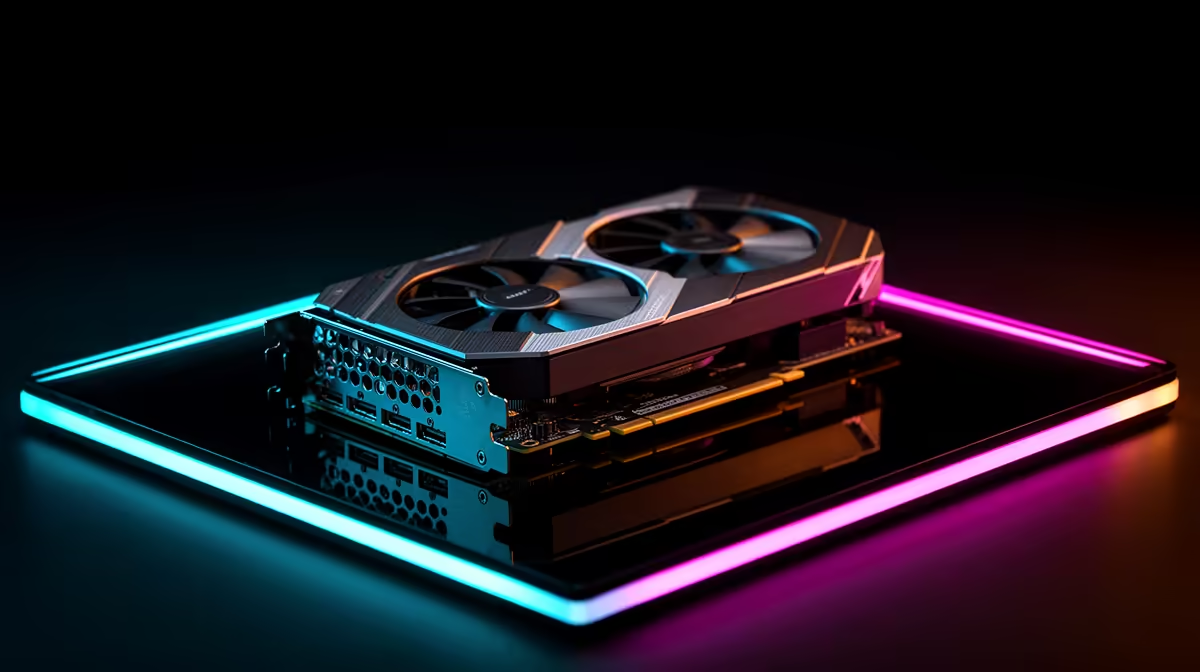
A premium GPU upgrade makes financial sense when your current card bottlenecks your target resolution, when the performance-per-rand gap between tiers is significant, or when your workload genuinely demands more VRAM. Paying a R5,000 to R10,000 premium for a flagship card is justified for 4K gaming or GPU-accelerated creative work, but wasteful for 1080p casual play.
When the Maths Works in Your Favour 💰
The key question is not what a card costs in absolute terms but what it delivers per rand spent. In the current GPU generation, stepping from a mid-range card to an upper-mid card often yields a 30 to 40 percent performance uplift for a 20 to 25 percent price premium. That ratio flips at the very top of the stack, where the RTX 5090 class costs roughly R45,000 to R55,000 and delivers gains that are meaningful only at 4K ultra or in AI-accelerated workloads. If you are gaming at 1440p on a 165Hz monitor, an RTX 5070 Ti class card in the R18,000 to R24,000 range typically hits the sweet spot. Paying double for marginal extra headroom is hard to justify unless your workflow monetises that headroom.
Factors That Shift the Equation 🖥️
Three variables change the calculation dramatically. First, your monitor: if you are still on a 1080p 60Hz panel, even a mid-range RTX 5060 will sit idle most of the time; upgrade the display first. Second, your CPU: a Ryzen 5 7600X paired with an RTX 5090 will bottleneck in CPU-limited titles, wasting half the GPU's capability. Third, your use case outside gaming. South African content creators and 3D artists who render commercially can offset a premium card's cost through faster project turnaround, making a R40,000-plus card a business expense rather than a luxury.
How Rand Depreciation Affects the Long-Term Maths 🔧
Buying a premium GPU in South Africa carries an implicit hedge against rand weakness. GPU prices imported via grey channels shift sharply with the rand/dollar exchange rate, while stock from local authorised retailers like Evetech reflects a more stable landed cost. Buying one generation above your current need means the card remains relevant for four to six years rather than two to three. An RTX 5080 purchased today at around R28,000 to R34,000 will still drive 1440p at high framerates well into the decade, whereas a budget card bought twice in the same period may cost more overall and carry no warranty continuity.
Check Your PSU Before You Buy ⚡
Premium RTX 50-series cards often require an 850W to 1000W PSU with a native 16-pin connector. Before committing to an upgrade, verify your power supply wattage and check whether your case has adequate cable routing for the new connector. A PSU upgrade overlooked at purchase can add R2,000 to R4,000 to the total cost.
FAQ
Is it worth buying a premium GPU if I only game at 1080p?
For pure 1080p gaming, a premium flagship card is overkill in most titles. The RTX 5060 or 5070 class cards handle 1080p at maximum settings with frame rates well above 144fps. Save the premium for a future display upgrade or put the budget difference toward a better monitor now.
How do I know when my GPU is the actual bottleneck?
Monitor GPU utilisation in-game using a free overlay tool. If your GPU sits above 95 percent utilisation while your CPU stays below 70 percent, the GPU is your limiting factor. If both are below 80 percent and you are still dropping frames, the bottleneck is likely elsewhere, such as RAM speed or storage.
Does buying a premium GPU from a local retailer matter for warranty?
Yes. Cards purchased from authorised local stockists carry a South African warranty with local returns support. Grey-import cards may carry international warranties that require shipping overseas for claims, which is rarely practical or cost-effective in SA.
Upgrading your graphics card?
Compare GPUs stocked at Evetech and match the card to your resolution, refresh rate and budget.