Quick Answer
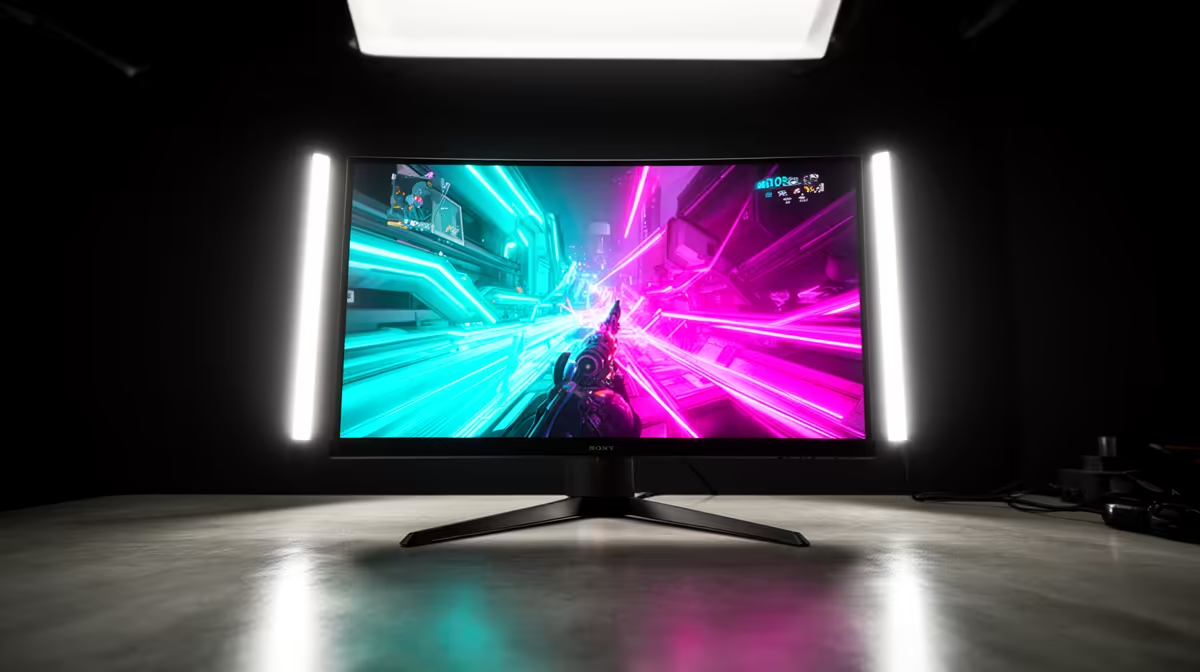
For rand-conscious South African gamers, the optimal balance is a 27-inch FHD panel at 144Hz to 165Hz with FreeSync Premium, priced between R3,500 and R5,500. This combination delivers the largest competitive performance gain per rand, leaves budget for a GPU that can actually feed the refresh rate, and avoids premiums for 1440p or 250Hz until your build is GPU-ready for those tiers.
How to Frame Your Monitor Budget in ZAR 💰
A useful starting rule for South African gamers: allocate 15 to 20% of your total system budget to the monitor. On a R25,000 system, that is R3,750 to R5,000 for the monitor. On a R40,000 system, R6,000 to R8,000. This prevents both under-investing (using a 60Hz monitor on a GPU that can sustain 200fps) and over-investing (spending R12,000 on a 1440p panel paired with a GPU that struggles past 80fps at that resolution). Within the monitor budget, the highest value feature order is: refresh rate, adaptive sync certification, response time, then panel size. This ordering reflects which specs produce visible gaming improvement per rand at each tier.
Screen Size vs Refresh Rate: Which Buys More Per Rand 🖥️
At identical panel technology, stepping from 27-inch to 31.5-inch at the same refresh rate costs R500 to R1,500 more in South Africa. Stepping from 144Hz to 250Hz at the same 27-inch size costs R2,000 to R3,500 more. For competitive gaming, the 250Hz upgrade delivers more measurable gameplay benefit than the size increase to 31.5 inches, assuming your GPU can feed 250Hz. For mixed use (gaming plus productivity), the 31.5-inch at 144Hz often provides more day-to-day benefit because the size improvement is useful every hour, while the 250Hz advantage is only active during high-fps gaming. The rand-conscious decision depends on your actual daily usage split.
Smooth Gameplay Without Overspending 🎮
Smooth gameplay at 144Hz requires your GPU to consistently deliver frames at or above that rate. An RX 7600 (currently stocked locally at around R5,500 to R6,500) sustains 144fps and above in Valorant, Apex Legends, and CS2 at FHD maximum settings. Pairing this card with a 144Hz FreeSync Premium monitor at R4,000 to R5,000 creates a complete smooth competitive setup for a combined monitor-plus-GPU spend of roughly R10,000 to R12,000. This is substantially more efficient than spending R9,000 on a 250Hz panel without the GPU to match it. Within the 144Hz tier, FreeSync Premium's LFC handles the moments when the GPU dips during explosive scenes, keeping gameplay consistently smooth without requiring perfect 144fps every frame.
Build the GPU-Monitor Ladder One Rung at a Time ⚡
Upgrade GPU and monitor in tandem. When your current GPU sustains 200fps average in your main game, that is the signal to step up to 250Hz. When 1080p starts feeling limiting for daily use, that is the signal to move to 1440p, paired with a GPU upgrade. Buying the monitor tier before the GPU tier means paying for headroom you cannot use yet.
FAQ
What is the best 27-inch FHD gaming monitor value in South Africa right now?
The R4,000 to R5,500 range at 27-inch FHD 144Hz to 165Hz from brands like AOC, MSI, and ASUS with FreeSync Premium represents the current SA value tier. These panels include DisplayPort 1.4, Fast-IPS or Fast-VA panels, and local warranty.
Is it worth waiting for rand prices to drop before buying a gaming monitor?
Monitor pricing in South Africa tracks the rand-dollar exchange rate closely. When the rand weakens, import prices rise.
Can I get a quality 250Hz experience on a tight South African budget?
At a tight budget under R5,000, 250Hz at FHD is available at 24-inch or 27-inch from some brands, though selection is narrower than the 144Hz tier. The more important constraint is whether your GPU can sustain 200fps in your game.
Trying to get the most gaming monitor per rand in South Africa?
Evetech carries high-refresh gaming monitors across every screen size and budget tier, all stocked locally with warranty.