Quick Answer
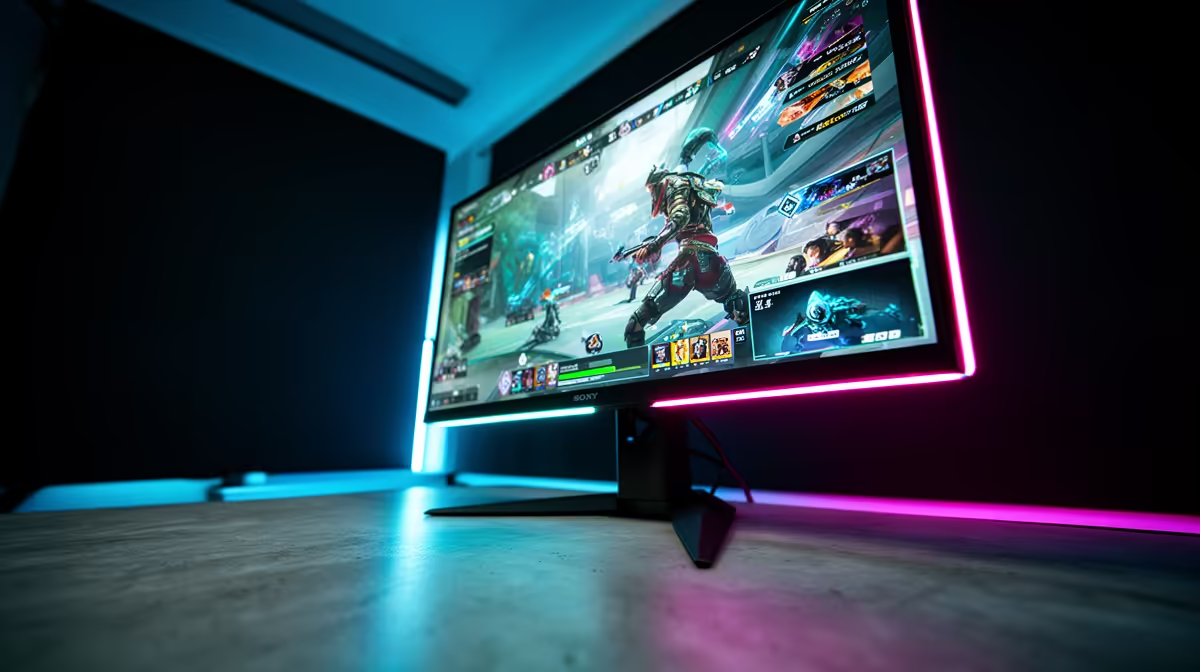
300Hz makes financial sense for your SA setup when you own or are buying a GPU sustaining 250 fps or more in your primary game, you compete regularly at ranked or LAN level, and you are upgrading from 144Hz or lower. Buying 300Hz as a casual player on a mid-range GPU is a poor Rand-per-frame investment.
The Frame Rate Prerequisite Before Spending on 300Hz 💰
A 300Hz monitor costs R3,000 to R6,000 more than an equivalent 144Hz panel. That premium is only recoverable if your GPU pushes frames into the 250 to 300 fps range consistently. An RTX 4070 Super averages 300 to 400 fps in Valorant at 1080p with low settings, and 250 to 300 fps in CS2. At 1440p those numbers drop 30 percent. If you play at 1440p on an RTX 4060 or RX 7600, average frame rates stay below 200 fps in most titles, meaning you spend most gaming time in the 144Hz to 200Hz adaptive sync range rather than near 300Hz. A premium 165Hz IPS at R6,500 to R8,000 is the smarter Rand decision in that scenario.
When the Upgrade Pays Off 🎮
The 300Hz upgrade makes sense in three scenarios. First, upgrading from 60Hz or 75Hz: the jump to 300Hz is transformative and you will feel it in every game. Second, competing at LAN events or ranked play where the opponent refresh rate disadvantage is measurable. Third, owning or simultaneously buying a high-end GPU like an RTX 5070 Ti or RTX 5080 (stocked at Evetech in the R18,000 to R28,000 range) that will sustain high frame rates for three to four years. Buying monitor and GPU together as a system usually produces a better long-term Rand result than staggered upgrades.
What to Look for in a 300Hz Panel in SA 🇿🇦
Prioritise sub-1ms GtG at medium overdrive (avoiding inverse ghosting), FreeSync Premium Pro or G-Sync Compatible certification, and a matte anti-glare coating suitable for bright SA rooms. Confirm 300Hz is available over DisplayPort 1.4, since some models limit HDMI to 240Hz. Warranty support matters locally: brands with SA warranty servicing save you cross-border RMA frustration. ASUS, LG, and BenQ available at Evetech carry local warranty support.
Buy Monitor and GPU Together Where Possible ⚡
If upgrading both GPU and monitor, buy them in the same order rather than staggering. A 300Hz monitor running on a GPU that cannot reach 240 fps is an expensive 144Hz monitor until the GPU arrives. Months of underutilising the premium panel you have already paid for is avoidable with coordinated purchasing.
FAQ
Is 360Hz worth more than 300Hz for SA buyers?
360Hz panels command a premium of R2,000 to R4,000 over 300Hz equivalents. The perceptual difference between 300Hz and 360Hz is marginal for most players. Unless you are a top-ranked FPS player competing nationally, 300Hz is the practical ceiling where per-Hz cost becomes very difficult to justify in Rands.
Can I run a 300Hz monitor at 144Hz to save power?
Yes. Every modern 300Hz monitor supports selecting a lower refresh rate in Windows display settings. Running at 144Hz draws less power and produces less heat, which can be relevant during SA summer months when ambient temperatures are high.
Do 300Hz monitors work well for single-player games and content?
Perfectly. A 300Hz monitor displays single-player games and video at whatever frame rate the source delivers. For 60fps film content the high refresh rate is transparent. For 144fps gameplay it adapts via FreeSync/G-Sync. You lose nothing by owning a fast panel for mixed use.
Weighing up the upgrade to 300Hz?
Evetech's monitor range covers 144Hz through 360Hz across 1080p and 1440p, making it easy to find the refresh rate and resolution that matches your GPU and budget.