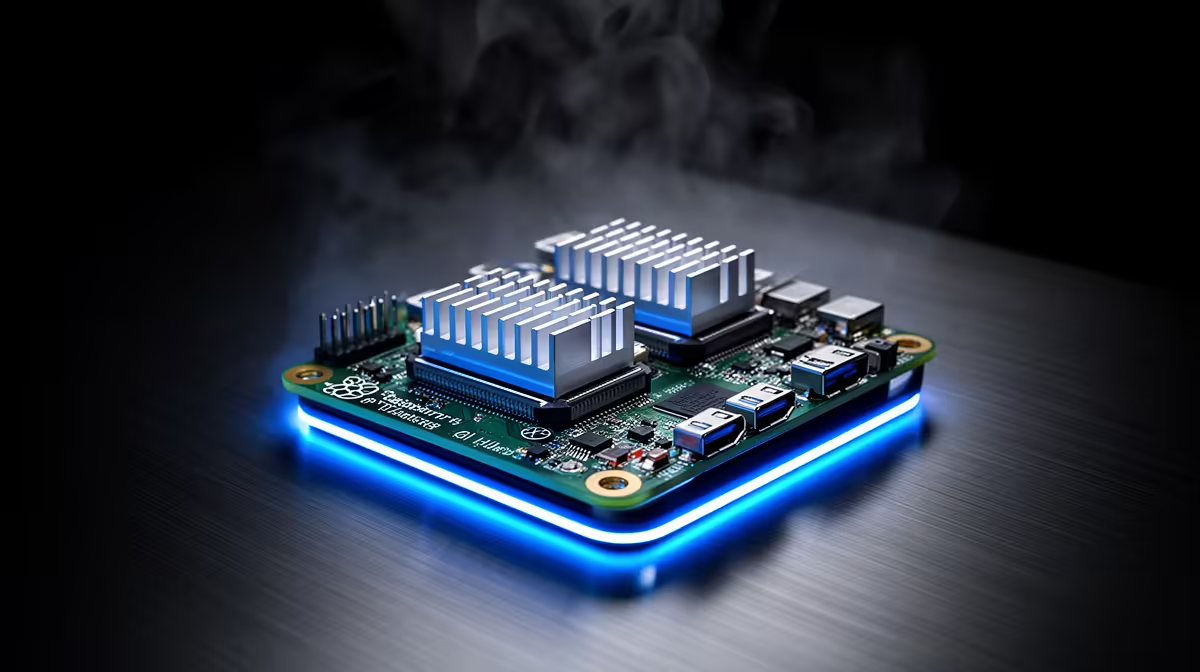
Bolting AI inference onto a Raspberry Pi 5 used to mean shipping frames off to a cloud service. The Raspberry Pi AI HAT+ changes that by adding a Hailo neural processing unit directly on the board, so object detection and computer vision run on-device. The only real decision is which version to buy: the 13 TOPS model or the 26 TOPS one. Get that right by matching the chip to how complex your pipeline actually is.
Quick Answer
The Raspberry Pi AI HAT+ comes in two flavours. The 13 TOPS version uses the Hailo-8L and suits hobbyist computer vision, single-stream object detection, and NVR-style camera work. The 26 TOPS version uses the full Hailo-8, roughly double the chip, and handles multi-stream inference and several neural networks at once. Both connect over PCIe Gen 3. Choose by pipeline complexity, not by reflexively buying the bigger number.
What the AI HAT+ actually does
A standard Raspberry Pi 5 CPU can run small neural networks, but it does so slowly and at the cost of everything else the board is doing. The AI HAT+ offloads that work to a dedicated Hailo NPU, a chip built specifically for running trained vision models efficiently. The HAT attaches over the Pi 5's PCIe Gen 3 interface, which gives the accelerator the bandwidth it needs to take in camera frames and return detections fast.
TOPS measures how many neural-network operations the accelerator can execute each second. Higher TOPS means the chip can run larger models, push more frames per second, or run several models in parallel without stalling. Raw TOPS only matters relative to what you are asking the accelerator to do, which is why the choice hinges on your pipeline's complexity rather than on the spec sheet alone.
The 13 TOPS version (Hailo-8L)
The 13 TOPS HAT carries the Hailo-8L accelerator and is the sensible starting point for most makers. It comfortably runs single-stream object detection, pose estimation, and the kind of computer-vision projects a hobbyist builds: a smart camera, a people-counter, a home NVR setup with motion-triggered recording. If your project watches one camera and looks for a handful of object types, this is enough silicon, and it is the more affordable of the two.
Crucially, models compiled for the Hailo-8L also run on the Hailo-8, so starting here does not lock you out of the bigger chip later. You can prototype on the 13 TOPS board and move up if your ambitions outgrow it.
The 26 TOPS version (Hailo-8)
The 26 TOPS HAT uses the full Hailo-8, which is roughly twice the accelerator. The headroom matters when your pipeline gets demanding: multiple camera streams analysed at once, several neural networks running in parallel, larger and more accurate models, or higher frame rates without dropping frames. A multi-camera security setup that runs detection on every feed simultaneously, or a project that chains several models, is exactly where the extra TOPS stop being a luxury.
There is one compatibility wrinkle to note. Models built specifically for the Hailo-8 may not run on the Hailo-8L, though lower-performance alternatives usually exist. So the Hailo-8 reads everything, while the Hailo-8L reads only what it was given. That asymmetry is part of why the 26 TOPS board is the safer pick if you are unsure how far you will push it.
How to actually decide
Map your pipeline before you buy. One camera, one or two models, hobbyist scope: the 13 TOPS Hailo-8L is the value choice and likely all you need. Multiple streams, parallel models, higher throughput, or a project you expect to grow: the 26 TOPS Hailo-8 buys headroom you will use. If you genuinely cannot predict, lean toward the 26 TOPS, because its broader model compatibility and spare capacity cover more futures.
Practical considerations beyond TOPS
A few realities shape how the HAT fits into a real build. The AI HAT+ occupies the Pi 5's PCIe interface and sits over the board, so it affects your cooling and case choices: you need airflow for both the Pi's processor and the accelerator under sustained inference, and a case that accommodates the HAT's height. Plan the physical build around it rather than treating it as an afterthought, because a cramped, hot enclosure undermines exactly the sustained performance you bought the accelerator for.
There is also a software side worth setting expectations on. The Hailo accelerators run models that have been compiled for them through Hailo's toolchain, and the Raspberry Pi software stack provides the integration that makes common vision tasks straightforward. For standard object detection and the popular pipelines, this is well-trodden ground with ready examples. If you intend to deploy a custom or unusual model, factor in the work of getting it compiled and running on the NPU, which is more involved than dropping a file into place.
Power and the bigger picture
Both HAT versions draw power through the Pi, and a heavier multi-model workload on the 26 TOPS board asks more of your power supply. Use a properly rated supply for the Pi 5 plus the HAT, because an underpowered setup causes instability that is easy to misdiagnose as a model or software fault. With clean power, adequate cooling, and a model suited to your chosen accelerator, the HAT turns a modest single-board computer into a genuinely capable edge-AI device, which is a remarkable amount of inference for the size and cost.
Putting it in context
The AI HAT+ turns a Pi 5 into a capable little edge-inference box, which is part of a wider shift toward running AI close to the data rather than in the cloud. Builders comparing a HAT-equipped Pi against other compact options will find the mini PC range at Evetech shows clearly where the Pi sits next to x86 alternatives. For those who prefer a complete, ready-to-run machine rather than assembling one from parts, the top-selling PCs at Evetech covers the turnkey end of that spectrum.
Frequently Asked Questions
What is the difference between the 13 and 26 TOPS AI HAT+?
The 13 TOPS version uses the Hailo-8L accelerator for hobbyist, single-stream vision work, while the 26 TOPS version uses the full Hailo-8, roughly double the chip, for multi-stream inference and parallel models. Both connect over PCIe Gen 3 to the Pi 5.
Which one should a beginner buy?
For most beginners and single-camera projects, the 13 TOPS Hailo-8L is the value choice and plenty capable for object detection and NVR work. Step up to 26 TOPS only if you need multiple streams, parallel models, or higher throughput.
Can I move my models between the two?
Models compiled for the Hailo-8L run on the Hailo-8, so upgrading is smooth. Models built specifically for the Hailo-8 may not run on the Hailo-8L, though lower-performance alternatives usually exist. The bigger chip is the more flexible of the two.
What can I build with the AI HAT+?
Common projects include smart security cameras with on-device detection, people and object counters, home NVR systems with motion triggers, and pose or gesture recognition. The 26 TOPS version extends this to multi-camera and multi-model pipelines.
Why use a Hailo NPU instead of the Pi's CPU?
The Pi 5 CPU can run small models but does so slowly and ties up the processor. The Hailo NPU is purpose-built for vision inference, running models far faster and freeing the CPU for the rest of your application. The PCIe Gen 3 link gives it the bandwidth to keep up.
Adding on-device AI to a Raspberry Pi 5 project? Size up your pipeline and compare small computing options in the mini PC range at Evetech before you commit to a HAT.