Quick Answer
Reducing PC noise without sacrificing cooling performance comes down to three changes: tuning a smarter fan curve rather than running fans at fixed high speeds, replacing low-quality sleeve-bearing fans with fluid-dynamic bearing models, and ensuring adequate case airflow so each fan works less hard to achieve the same thermal result.
Fan Curve Optimisation as the First Step 🔧
Most out-of-box BIOS fan profiles run fans at 60 to 80% speed by default to guarantee conservative temperatures across unknown build configurations. For a defined build with specific components and confirmed thermal headroom, a custom fan curve that keeps all fans below 1,000 RPM until the CPU reaches 65 degrees Celsius, then ramps smoothly to full speed above 80 degrees Celsius, typically reduces daily noise output by 30 to 40% compared to a stock profile. This adjustment is free, takes under five minutes in BIOS or a fan control application, and requires zero hardware changes.
Upgrading Fan Quality for Silent Operation 🌬️
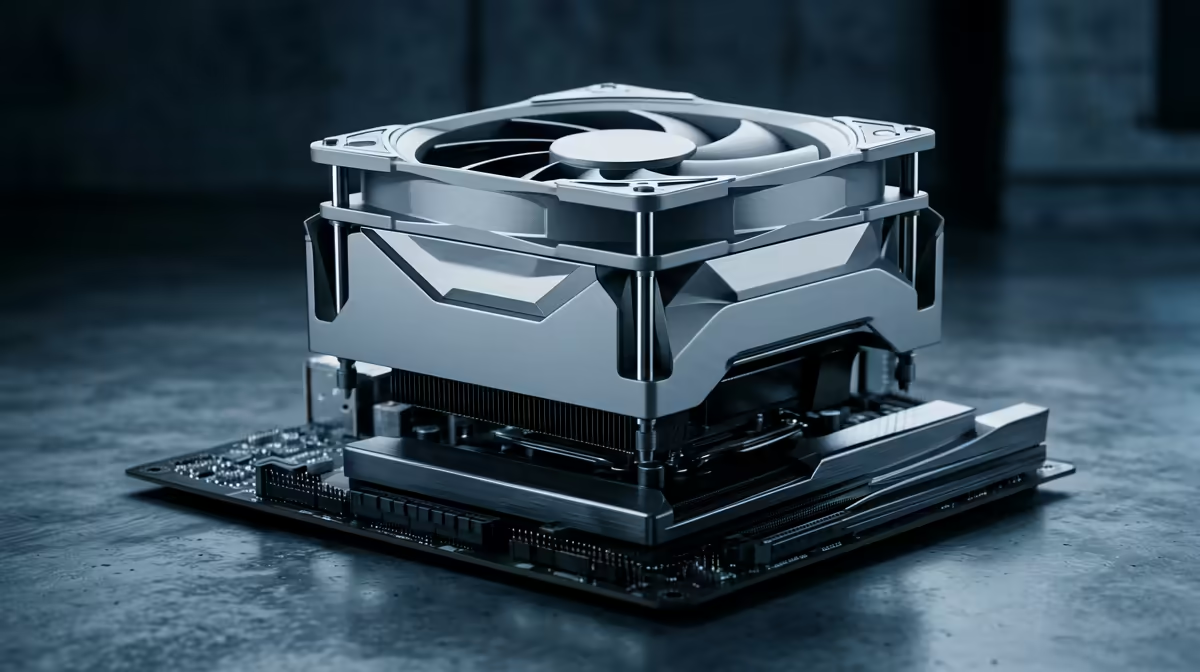
Sleeve-bearing fans, common in budget cases and cheaper coolers, generate a characteristic high-pitched buzz at RPM above 900. Replacing these with fluid-dynamic bearing (FDB) or rifle-bearing fans eliminates this noise signature while often delivering better airflow at the same speed. A set of three 120mm replacement fans with FDB bearings costs around R600 to R1,200 in SA depending on the brand, which is a more cost-effective noise reduction intervention than purchasing an entirely new cooler. The reduction in audible noise from this single upgrade is immediately noticeable; an FDB fan at 1,200 RPM is typically 4 to 6 dB quieter than a sleeve-bearing fan at the same speed.
Case Design and Placement for Passive Noise Reduction 🏠
Panel resonance amplifies fan noise significantly. A case with thin steel panels, particularly side panels lacking a damping layer, vibrates at the blade-pass frequency of internal fans, adding a low-frequency resonance that is often louder than the fans themselves. Cases with thick side panels, damping foam on interior surfaces, or tempered glass panels that do not resonate are inherently quieter independent of fan selection. In South African home setups where PCs sit on wood desks that can amplify vibration, placing the case on a rubber isolation pad further reduces transmitted sound.
Lower Ambient Temperature to Run Fans Slower ⚡
Cooling your room by 3 to 5 degrees Celsius, whether through an air conditioner or by improving room ventilation, directly reduces how hard your PC fans work. Every 1 degree Celsius reduction in ambient temperature gives your CPU approximately 1 degree Celsius more thermal headroom, allowing fans to run slower under the same workload.
FAQ
Will lowering fan speeds cause my CPU to throttle?
Not if your cooler is appropriately sized for your CPU's TDP. A correctly matched cooler maintains safe temperatures with fans at 70 to 80% speed. Throttling only occurs when the cooler cannot dissipate heat fast enough, which is a cooler sizing problem rather than a fan speed problem.
Is a larger cooler always quieter than a smaller one at similar performance levels?
Generally yes. A larger cooler distributes heat across more surface area, allowing its fans to spin slower for the same thermal output. A 360mm AIO or a dual-tower air cooler running near-silently at 900 RPM often matches the thermal performance of a 240mm AIO running loudly at 1,600 RPM.
Do acoustic case panels actually work for PC noise reduction?
Yes, but with diminishing returns. Dense acoustic foam bonded to case panels absorbs high-frequency fan noise effectively. The biggest acoustic gains come from fan quality and curve tuning first. If noise remains objectionable after those adjustments, adding acoustic dampening is a practical next step that costs under R300 for aftermarket panels.
Want to run a quieter PC without giving up cooling performance?
Explore the CPU cooler range at Evetech for quiet-tuned options that match your processor and build goals.