Quick Answer
Axial-Tech fans reduce system noise by pairing a compact motor hub with longer, barrier-ring-stiffened blades that move more air per revolution. Quality PSUs using this technology typically run below 25 dBA at moderate load, and most enter a zero-RPM semi-passive mode at idle, producing no audible sound.
How Axial-Tech Blades Cut Noise at the Source 🔧
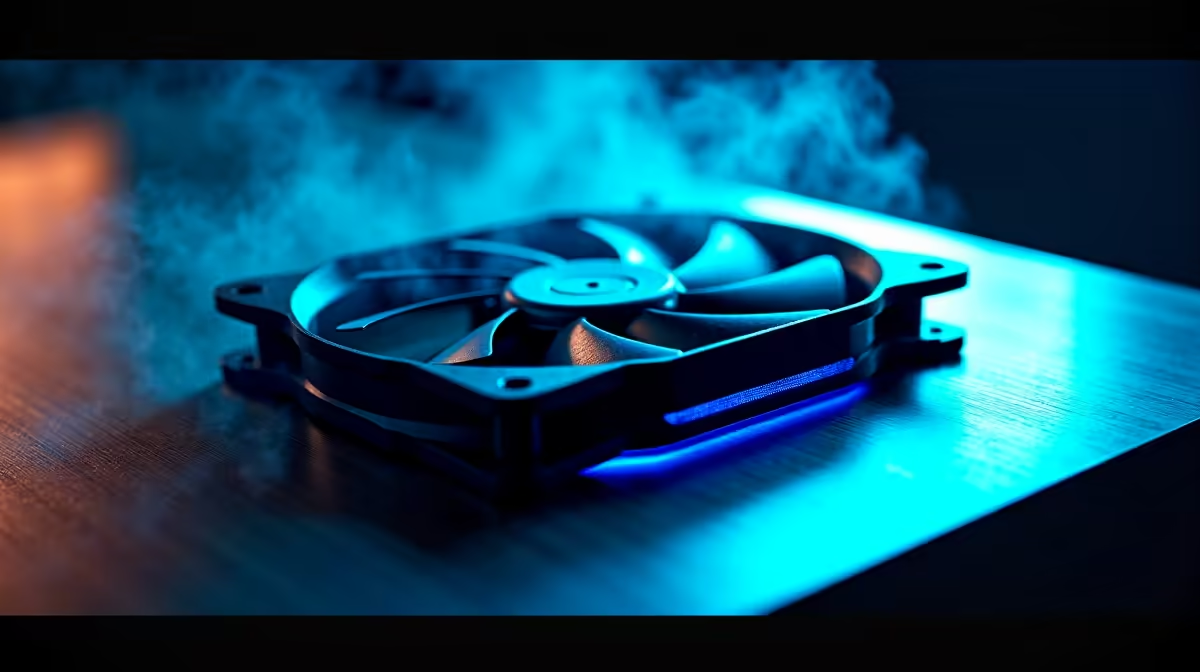
Conventional fans compensate for short blades by spinning faster. Axial-Tech inverts this: a smaller hub exposes more blade surface, and an outer barrier ring stiffens each blade against aerodynamic flex. The result is higher static pressure per revolution. In a 1200W PSU, this allows the fan to throttle down to 600 to 800 RPM while exhausting enough heat to stay within safe limits, versus 1,200 RPM or more for a conventional fan at the same duty. At 600 RPM, noise typically measures under 22 dBA, well below the 30 dBA threshold most people notice in a quiet room. Budget around R2,000 to R4,500 for an 850W to 1000W PSU with this fan technology, currently stocked at Evetech.
Semi-Passive Mode and Case Layout 🖥️
Axial-Tech-equipped PSUs commonly include a semi-passive mode that keeps the fan off until the unit crosses 40 to 50 percent load. A typical South African home-office setup drawing 300 to 500W enjoys near-silent operation for hours. When gaming loads push draw to 700W or more, the fan spins up, but barrier-ring blades suppress the turbulence-induced rattling common in cheaper units. Bottom-mounted PSU chambers with dust filters are the standard layout in local mid-towers. With this configuration the PSU draws cool air from below and exhausts through the rear, keeping its heat out of the main chamber. Pair this with three 120mm or 140mm case fans on a balanced curve and total system noise typically lands between 28 and 35 dBA under gaming load. For SA summer ambients reaching 35 degrees Celsius, a slightly steeper fan curve is necessary, but Axial-Tech blades maintain their noise advantage even at 900 to 1,000 RPM.
Mount PSU Fan Facing Down ⚡
Mount your PSU with the fan facing the case floor vent, not upward into the motherboard tray. Downward orientation pulls in the coolest outside air, lowering both noise and internal temperature simultaneously. Most mid-towers sold locally include a dedicated PSU shroud with a bottom vent for exactly this setup.
FAQ
Do Axial-Tech PSU fans last longer than sleeve-bearing fans?
Yes. Units typically use dual ball-bearing or FDB motors rated for 100,000 hours, versus 30,000 to 50,000 hours for sleeve bearings. Over a five-to-seven-year ownership cycle common among SA builders, this significantly reduces the chance of premature fan failure.
At what load does semi-passive mode deactivate?
Most implementations spin the fan up between 40 and 60 percent of rated wattage. On an 850W PSU that means the fan stays off below roughly 340 to 510W, covering most office and light gaming loads.
Will a quieter PSU fan make the GPU fans the dominant noise source?
In most builds, yes. Once PSU noise drops below 22 dBA, triple-fan GPU coolers at 50 to 70 percent speed become the loudest component. A custom GPU fan curve targeting 75 to 80 degrees Celsius rather than the default 83 recovers several dBA of headroom.
Ready to build a quieter rig?
Evetech stocks PSUs with Axial-Tech-style semi-passive fans from 650W to 1600W. Browse the power supply category to find a unit matched to your build's wattage needs.