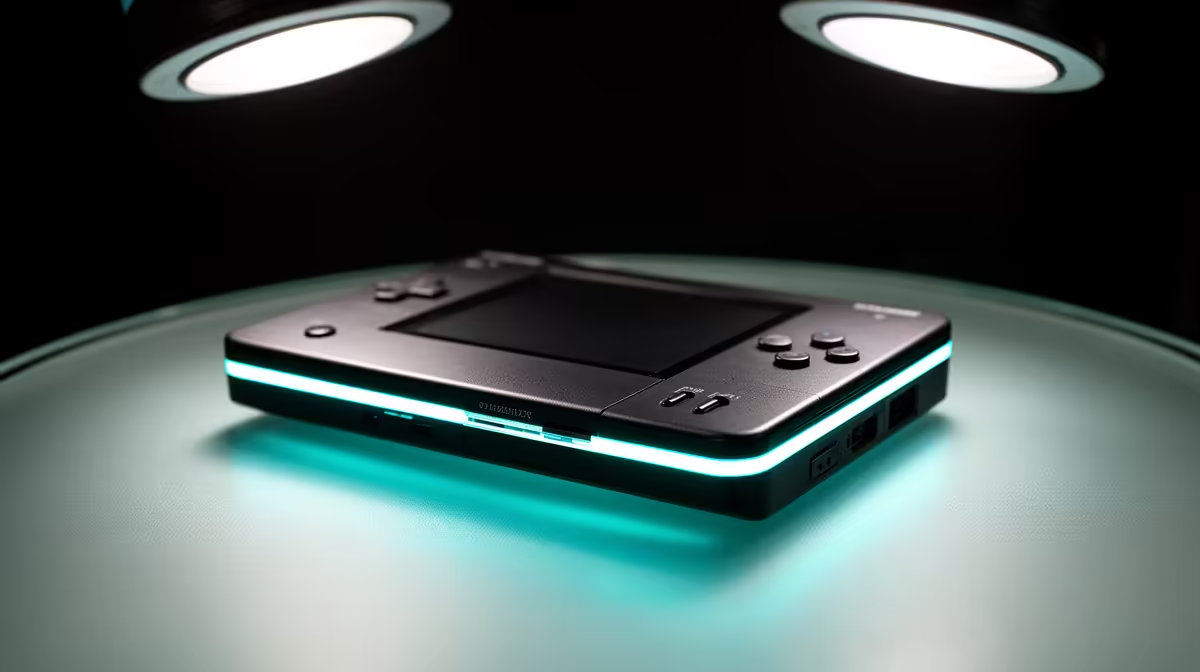
Five brand names dominate almost every emulation handheld conversation, and they do not all play the same game. Retro handheld brands split cleanly along two lines: the operating system they run, and the era of console they can realistically emulate. Anbernic and Powkiddy live in the affordable Linux space, Retroid and Ayn chase raw Android performance, and Miyoo carved out a cult following for tiny pocketable devices. For South African buyers the picture is complicated by one more reality: every one of these is import-only here, with no official local distributor carrying the full ranges.
Quick Answer
Anbernic and Powkiddy lead the budget Linux handheld space for 8-bit through PS1 and PSP emulation, while Retroid and Ayn focus on more powerful Android devices that reach GameCube, PS2 and beyond. Miyoo specialises in tiny pocket handhelds. All five are import-only in South Africa.
The Linux Budget Camp: Anbernic, Powkiddy and Miyoo
The Linux-based brands win on price and simplicity. They boot in seconds, sip battery and present a clean retro front end, which makes them ideal for older systems up to roughly the PS1 and PSP era.
Anbernic
Anbernic ships more models per quarter than anyone, and that volume is both its strength and its confusion. Devices mostly run Linux, either stock firmware or community options like muOS and KNULLI. The RG556 is widely treated as the all-round 2026 pick because it balances price, screen quality, build and a mature ecosystem. If you want a cheap, simple device for 8-bit through PS1, Anbernic is usually the best value entry point.
Miyoo
Miyoo built its reputation on tiny, genuinely pocketable handhelds and a thriving custom-firmware community. The Mini Plus is the reference point: brilliant for 8 and 16-bit titles with light PS1 work, but not built for Dreamcast or PSP. You buy a Miyoo for portability and a focused retro library, not for power.
Powkiddy
Powkiddy is the form-factor experimenter, willing to try shapes the others avoid. The RGB30 earned a cult following for its square 1:1 screen, which makes Game Boy and Game Boy Color titles run at near-perfect integer scaling. It is a niche pick that does one thing unusually well.
The Android Performance Camp: Retroid and Ayn
The Android brands trade simplicity for ceiling. They open up standalone emulators, app stores, streaming apps and the most demanding cores, at the cost of more setup time and a higher price.
Retroid
Retroid pushes performance into Switch and GameCube territory. The Pocket 5, built on a Snapdragon 865 with active cooling, runs Dolphin at full speed across much of the GameCube library. The common buying pattern is to start with an Anbernic for retro basics, then add a Retroid when you want PS2, GameCube and Android flexibility.
Ayn
Ayn sits at the premium Android end, building polished higher-performance units like the Odin line for buyers who want strong PS2-and-up emulation with better build quality. It is the brand you reach for when the budget Android tier no longer satisfies.
Firmware and software ecosystems
Choosing a brand is partly choosing a software community, and that matters more than the spec sheet in day-to-day use. Anbernic devices run muOS and KNULLI as the leading community options, both well-maintained with active forums. Miyoo's community built OnionOS into arguably the most polished custom firmware in the entire retro handheld scene, with cover art browsing, save state management and a fast game switcher that puts the stock firmware to shame. If you buy a Miyoo Mini Plus and skip OnionOS, you are leaving the best part of the device unused.
Powkiddy's community is smaller, which means fewer custom firmware options and slower support cycles when new games surface edge-case issues. That is not a dealbreaker for a device like the RGB30, which has a clear and narrow purpose, but it is worth knowing before you commit to the brand.
Retroid and Ayn run Android, which means the emulator ecosystem is maintained by Android developers rather than a device-specific community. That is a broader base, and emulators like Dolphin, DuckStation and AetherSX2 get regular updates regardless of which Android handheld you own. The trade-off is that Android updates and emulator updates are decoupled from the hardware maker, so you are less reliant on a single brand's support cycle.
Buying These in South Africa
Here is the honest part. None of these five brands has an official South African distributor stocking the full range, so devices arrive through importers and grey channels, which adds cost, lead time and warranty uncertainty. That changes the maths. A locally stocked, locally supported handheld can be the smarter purchase even if the spec sheet looks less exotic, because you are not gambling on cross-border returns. It is worth comparing what is held locally in the handheld gaming consoles category at Evetech against the import route before you commit, and the top-selling systems at Evetech give a sense of what the local market actually backs.
Frequently Asked Questions
Which retro handheld brand is best for beginners?
Anbernic is the usual starting point. Its Linux devices are inexpensive, boot quickly and handle 8-bit through PS1 and PSP smoothly without much setup. The RG556 is a strong all-round first device.
What is the difference between Linux and Android handhelds?
Linux devices like Anbernic and Powkiddy boot fast, last longer on battery and keep things simple for older systems. Android devices like Retroid and Ayn are more powerful and flexible, reaching PS2 and GameCube, but need more setup.
Can these handhelds emulate GameCube and PS2?
The Android performance units can. A Retroid Pocket 5 runs much of the GameCube library at full speed, and Ayn's higher-end devices handle PS2 well. Budget Linux handhelds top out around PS1 and PSP.
Are retro handhelds easy to buy in South Africa?
Not officially. None of the five brands has a local distributor carrying full ranges, so they arrive via importers, which raises price and complicates warranty. Locally stocked alternatives can be the safer buy.
Which brand has the best screen for Game Boy games?
Powkiddy's RGB30, with its square 1:1 display, is the standout for Game Boy and Game Boy Color because those titles scale to near-perfect integer ratios on that aspect.