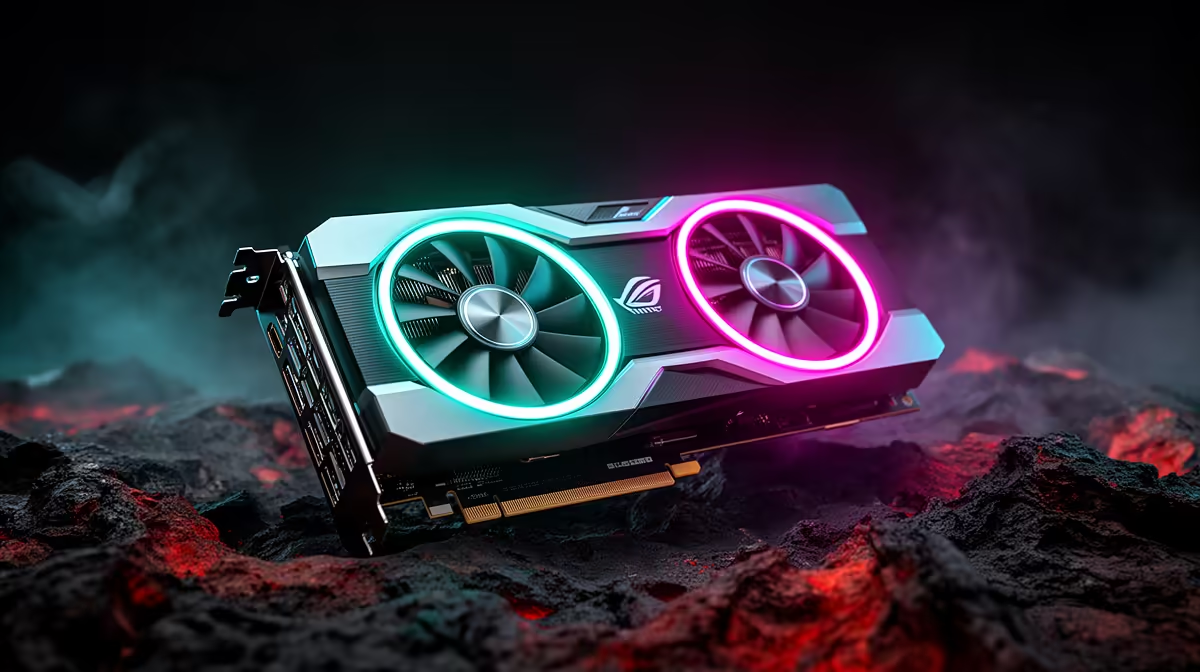
For AI art, the difference between the RTX 5080 and the RTX 5090 is not raw speed, it is the wall you hit when a model will not fit in memory. The 5080's 16GB of VRAM runs Stable Diffusion comfortably but cannot hold Flux.1 Dev at full FP16 quality, which needs around 33GB. The 5090's 32GB gets far closer to that ceiling and opens the door to local video generation. If your workflow lives at the edge of that limit, the VRAM, not the clock speed, makes the call.
Quick Answer
The RTX 5080's 16GB of VRAM cannot load Flux.1 Dev at full FP16, which needs roughly 33GB, so on the 5080 you run Flux quantised to FP8 or NF4. The RTX 5090's 32GB runs Flux with far less quantisation pressure and clears full SDXL plus multi-ControlNet pipelines with headroom for large resolutions and LoRAs. If you want uncompromised Flux quality or video, the 5090 is the card. If quantised Flux and Stable Diffusion are enough, the 5080 saves a large amount of money.
The VRAM Wall, Explained
AI image models live in VRAM while they run. If the model and its working data do not fit, you cannot run it at that precision, full stop. This is a hard limit, not a slowdown you can wait out.
Flux.1 Dev at full FP16 needs around 33GB. The RTX 5080 has 16GB. That gap is the wall: the 5080 simply cannot hold full-precision Flux. It can still run Flux, but only in a quantised form such as FP8 or NF4 that shrinks the model to fit. Flux at FP8 drops to roughly 13GB, sitting comfortably inside 16GB with room left for adapters. The RTX 5090's 32GB cannot fully load FP16 Flux either, but it is close enough to run it with lighter quantisation, fewer workarounds, and more headroom for multi-adapter pipelines.
For Stable Diffusion, this wall barely matters. SD models are far smaller and run happily on 16GB, so the 5080 is a strong, cost-effective choice if SD is your main tool.
What Quantisation Costs You on the 5080
Running Flux quantised on the 5080 is not the disaster it might sound like. Blackwell cards support low-precision floating-point formats in hardware, and FP8 in particular preserves much of the quality while halving the memory footprint. For many creators, FP8 Flux on a 5080 is close enough to full precision to be a non-issue.
A multi-LoRA plus ControlNet pipeline can push past 14GB on a 5080, putting the card right at its limit. FP8 quantisation cuts that heavy pipeline down to around 10GB, restoring headroom. So it is not just about the base model; it is about the full workflow. Complex stacked pipelines strain 16GB in ways that simpler image generation does not.
The trade-offs appear at the extremes. Very large resolutions, heavy stacks of LoRA adapters, or the most quality-sensitive work benefit from being closer to full precision, and that is where the 16GB ceiling forces compromises. If your output is mostly standard-resolution images, quantised Flux on the 5080 is a sensible, affordable path. The current lineup and what is in stock locally is worth checking in the graphics card best sellers at Evetech.
Where the 5090 Pulls Clear
Two things justify the 5090 for AI art. The first is reduced quantisation pressure on Flux: 32GB means tighter quantisation, less visible quality loss, and the ability to run large canvases and multiple adapters without fighting memory. The second is local video generation, which is far hungrier than still images. Video models like Mochi and CogVideoX require 20GB or more for workable quality -- the 5080's 16GB cannot run them at reasonable resolutions without severe degradation in frame count or quality, while the 5090 handles them at full intended settings.
The 5090 also generates faster on the same workload thanks to far more CUDA cores and roughly double the memory bandwidth compared with the 5080. But speed is the secondary reason to buy it; capability is the primary one. You pick the 5090 because it can do things the 5080 cannot, not merely because it is quicker. Builders putting together a serious local AI rig should look at the full platform in the AI PC range at Evetech, since the GPU is only useful with enough system RAM and storage behind it.
Who Should Buy Which
Choose the RTX 5080 if your work is Stable Diffusion and standard-resolution Flux, and you are comfortable running Flux in FP8. It is the value pick and handles the bulk of image generation well. It delivers 40 to 60 tokens per second on quantised models at roughly half the price of the 5090.
Choose the RTX 5090 if you want tighter quantisation on Flux with fewer memory compromises, if you generate at high resolutions with heavy adapter stacks, or if local video generation is part of your plan. The extra VRAM is the deciding factor, and for those workflows it is the difference between possible and impossible.
Frequently Asked Questions
Can the RTX 5080 run Flux.1 Dev at all?
Yes, but not at full FP16. The 5080's 16GB cannot hold the roughly 33GB that full-precision Flux needs, so you run it quantised to FP8 or NF4, which fits and stays close to FP16 quality for most output.
Why does the RTX 5090 handle Flux better than the 5080?
The 5090 has 32GB of VRAM against the 5080's 16GB. While FP16 Flux needs around 33GB and exceeds both cards, 32GB allows tighter quantisation with more headroom for adapters, larger canvases, and stacked LoRAs.
Is the 5090 worth it just for faster generation?
Speed alone is a weak reason. The real case for the 5090 is capability: tighter Flux precision, large resolutions, LoRA stacks, and local video that the 16GB card struggles with. If those matter to you, it is worth it.
Does the VRAM wall affect Stable Diffusion?
No. Stable Diffusion models are small enough to run comfortably on 16GB, so the 5080 handles them well. The wall appears most sharply with Flux at high precision and with video generation.
What about local AI video on these cards?
The 5090's 32GB fits local video models at workable quality that the 5080's 16GB cannot achieve, and its wider bandwidth speeds the work. For serious local video, the 5090 is the practical floor.
Building an AI art workstation? Match the card to your models. Compare current RTX options in the graphics card best sellers at Evetech and pick the VRAM that clears the wall your workflow hits.