Choosing between an RTX 5090 and the NVIDIA DGX Spark for local LLMs is not a question of which is faster, because they win on opposite axes. The 5090 pushes tokens out at blistering speed thanks to its memory bandwidth, while the DGX Spark holds models the 5090 physically cannot fit. The right pick depends entirely on the size of the model you run and how patient you are with the bigger ones.
Quick Answer
Pick the RTX 5090 if your models fit inside 32GB, because its 1,792 GB/s GDDR7 generates tokens far faster than anything the Spark can manage. Pick the DGX Spark if you need to run 70B-class or larger models locally, because its 128GB of unified memory holds them comfortably while the 5090 cannot load them at all without crippling offload.
The core trade-off: bandwidth versus capacity
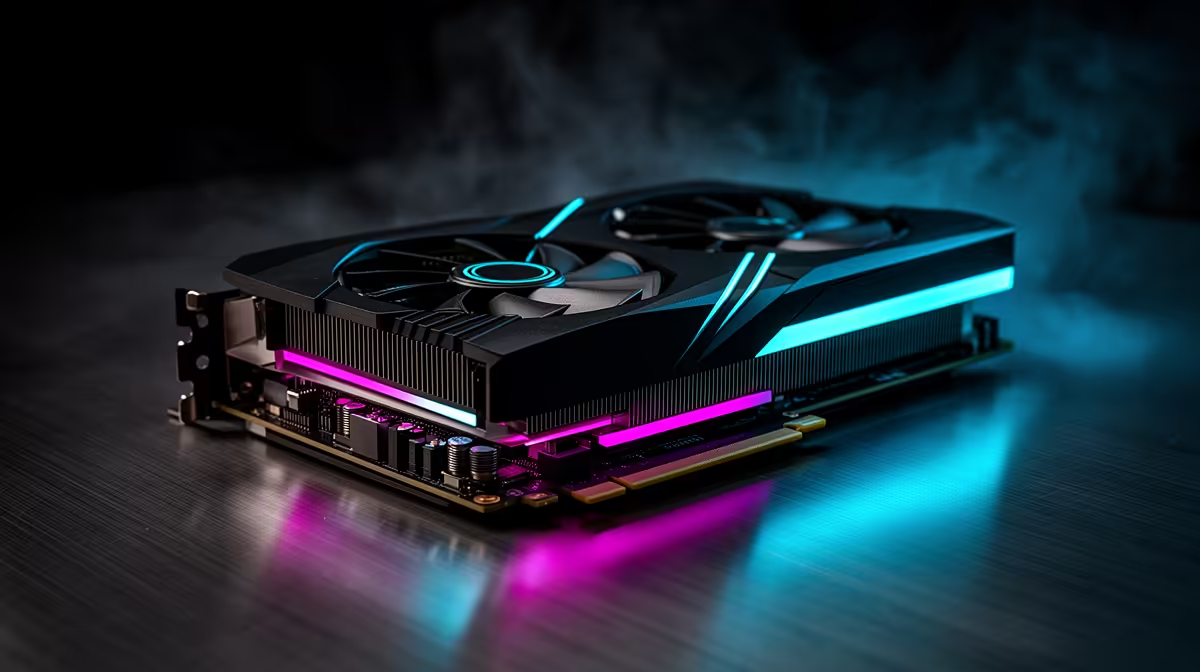
Local LLM speed is governed largely by memory bandwidth, since generating each token means streaming the model's weights through the chip. The RTX 5090's 32GB of GDDR7 delivers roughly 1,792 GB/s, which is why it can hit very high token rates on models that fit in its VRAM. The DGX Spark takes the opposite approach: 128GB of unified LPDDR5x memory at around 273 GB/s. That is a fraction of the 5090's bandwidth, so on a model both can run, the 5090 is dramatically faster, in some smaller-model tests by an order of magnitude. The Spark's advantage only appears once a model is too large for 32GB.
What "too large" actually means
A 70B-parameter model at Q4_K_M quantisation needs roughly 42GB once weights and context are loaded, which is already past the 5090's 32GB ceiling. On the 5090 you would either drop to a heavier, lower-quality quantisation or offload layers to system RAM, and offloading collapses throughput because the slow path now bottlenecks everything. The DGX Spark loads that same 70B model into unified memory with room to spare, and can hold even larger models such as a 120B-class build at reduced precision that the 5090 has no realistic way to run.
Where the RTX 5090 wins
For anyone working with models up to around 30B parameters, the 5090 is the better tool by a wide margin. On a mid-size model it can generate hundreds of tokens per second where the Spark manages a few dozen, which transforms the experience of interactive chat, code completion, and rapid iteration. If your workflow is built on 7B, 13B, or low-30s models, all of which fit in 32GB at sensible quantisation, you get near-instant responses and the headroom to run a model alongside other GPU work. The 5090 is also a full graphics card, so the same machine games, renders, and trains smaller models, making it the more flexible single purchase for most enthusiasts and developers.
The capacity ceiling you have to respect
The catch is hard: once a model needs more than 32GB, the 5090 stops being fast and starts being unusable for that model. There is no graceful degradation. You either fit in VRAM and fly, or you spill into system memory and crawl. That binary is the entire reason the DGX Spark exists, and it is the question every buyer has to answer honestly about the models they actually intend to run, not the ones they imagine running someday.
Where the DGX Spark wins
The DGX Spark is purpose-built for the large-model corner the 5090 cannot reach. Its 128GB of coherent unified memory lets it load 70B models without the quantisation compromises or multi-GPU complexity a discrete card would demand, and it can hold experimental builds well beyond that. For local fine-tuning, agentic workflows that keep a big model resident, or research where model size matters more than raw speed, the Spark removes the memory ceiling that defines desktop GPUs. It is slower per token, sometimes much slower, but it runs things the 5090 simply refuses to.
Living with lower bandwidth
You do feel the 273 GB/s. A 70B model on the Spark generates tokens at a pace that suits batch jobs, drafting, and tasks you can step away from rather than tight interactive coding. Plan for that rhythm. If your reason for wanting a 70B model is mostly curiosity and your real daily work is a 13B coding assistant, the Spark would leave you frustrated and the 5090 would serve you far better.
Which one fits your work
Match the hardware to the largest model you will use regularly, then to how interactive that use is. A developer running a 13B or 30B coding model all day wants the 5090's speed and would never touch the capacity headroom the Spark offers. A researcher or team that must run 70B-plus models locally, for privacy, cost, or experimentation, needs the Spark's memory and accepts the slower pace as the price of fitting the model at all. Some setups end up with both for different jobs, but for a single purchase the deciding line is clean: does your model fit in 32GB? If yes, the 5090 is the faster, more versatile machine. If no, the DGX Spark is the only one of the two that runs it properly. You can compare ready-built systems for either path in the AI PC range, and the broader PC best sellers list shows what current high-memory builds look like for local inference.
Frequently Asked Questions
Can the RTX 5090 run a 70B model at all?
Not practically. A 70B model at usable quantisation needs around 42GB, beyond the 5090's 32GB. You would have to offload layers to system RAM, which slows generation so severely that the model becomes impractical for real work.
Why is the DGX Spark slower if it has more memory?
Speed comes from bandwidth, not capacity. The Spark's unified memory runs at around 273 GB/s versus the 5090's roughly 1,792 GB/s, so it streams weights far more slowly. It trades per-token speed for the ability to hold much larger models.
Which is better for coding assistants?
For models up to about 30B, the RTX 5090, because its high bandwidth gives near-instant completions. Coding workflows favour fast interactive responses, which is exactly the 5090's strength on models that fit in 32GB.
Is the DGX Spark good for fine-tuning?
Yes, for fitting large models in memory without multi-GPU complexity. Its 128GB lets you experiment with and fine-tune bigger models locally, though the lower bandwidth means training and inference run slower than on a high-bandwidth discrete GPU.
Should I just buy both?
Only if your work genuinely spans both extremes: fast interactive use of mid-size models and local runs of 70B-plus models. For most people a single machine sized to their largest regular model is the sensible, cost-effective choice.