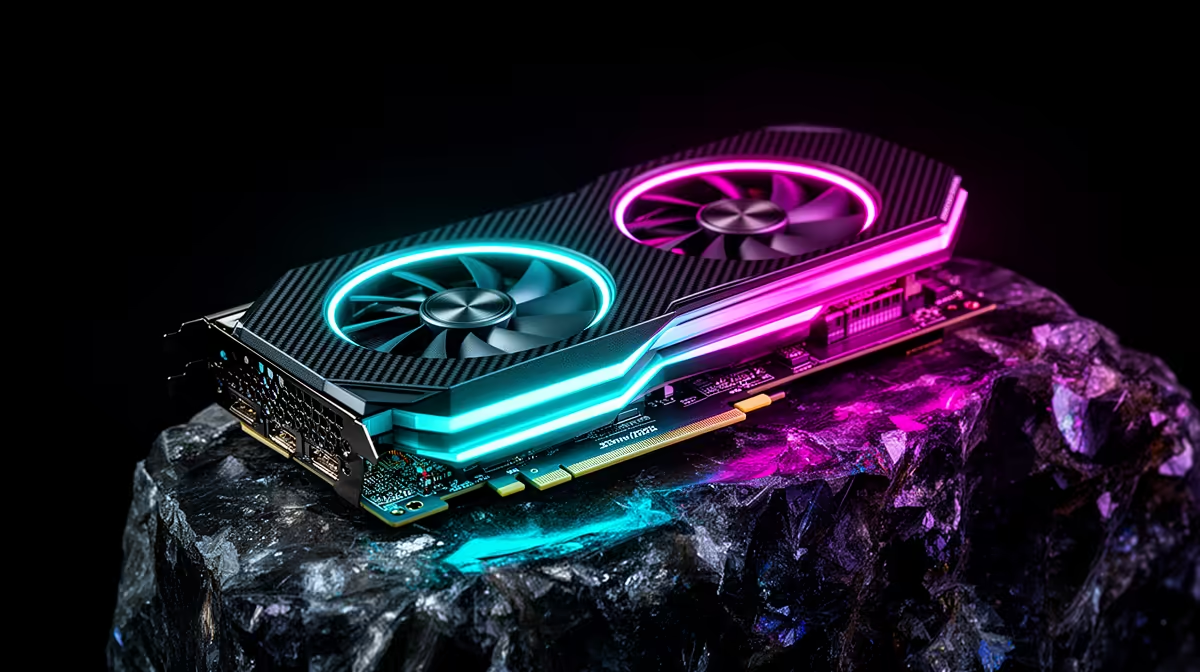
The RX 9070 versus RX 9070 XT decision gets easier once you stop paying for frames your display cannot show. Both cards target serious 1440p gaming. The standard model is enough for many builds, while the XT earns its premium through extra headroom in tougher games and higher frame-rate targets.
Quick Answer
Buy the RX 9070 for 1440p gaming when value and a balanced system matter most. Move to the RX 9070 XT if you run a fast 1440p or 4K display and its extra performance will be visible in the games you play. Evetech recorded a R13,299 graphics-card median as of July 2026, so judge the XT premium against a complete build rather than the GPU alone.
🎯 Start with the frame rate you want
Write down the native resolution and refresh rate of your monitor. Then pick two games that place the heaviest load on your current card. This gives the comparison a real target instead of turning it into a contest between model names.
At 1440p, the RX 9070 has enough performance for strong settings across a broad game library. The XT makes more sense when you want to hold higher minimum frame rates, turn on heavier effects or prepare for a move to 4K. A 1440p 60Hz screen gives the standard card an easier win because the panel limits what you can see.
Look across Evetech's graphics card range before deciding. The category page puts both Radeon and GeForce options in the same shopping context, which helps you spot when a nearby tier changes the value calculation.
🧠 The standard card already has 16GB
Both RX 9070 siblings give you a 16GB memory buffer. That matters because the XT premium is buying more rendering pace, not a larger pool for textures. If your concern is keeping high-resolution assets comfortable at 1440p, the standard model already answers it.
Memory capacity still cannot promise a particular frame rate. A game may lean on shader performance, ray tracing hardware or CPU speed long before it fills the buffer. Compare tests from your actual titles and look at low-frame behaviour as well as averages. Smooth delivery feels better than a high headline number interrupted by stutter.
Sixteen gigabytes also suits modded games and creation tasks that retain large assets in memory. If those workloads are central to your PC, check application support and measured results. The presence of a large buffer is useful; the software still decides how well it is used.
⚡ The XT needs the rest of the PC
A faster card can expose a processor limit in esports games and other light renderers. If your CPU already struggles to feed the RX 9070, the XT will spend more time waiting. At 4K or with heavier visual settings, the graphics card carries more of the load and the XT has a clearer path to showing its advantage.
Power supply quality, case clearance and airflow belong in the price comparison. Check the exact partner card's dimensions and connector guidance before ordering. A larger cooler may run quietly, but only when the case gives its fans access to fresh air.
If choosing the XT forces you to keep a weak power supply or an old 1080p monitor, the standard RX 9070 can produce the better gaming PC. Put the saved amount into the part that removes the next visible limit. That might be the display today and an SSD next year.
🎮 Compare features in your own games
Ray tracing can change the gap between cards, and the size of that change varies by engine. Test data from one showcase title cannot describe your full library. Pick the settings you would use every evening, then compare the two cards at those settings.
Upscaling can extend performance at 1440p and 4K. Begin with a quality preset and watch fine detail in motion. Lower internal resolutions can soften fences, hair and distant objects. Frame generation is most useful when the underlying frame rate already feels responsive, so do not use it to hide a weak base result.
The GPU best-seller list provides a useful check on the market around these cards. Compare exact listings because cooler design, warranty route and bundle details can move independently of the GPU chip.
💰 Put the premium through two tests
First, divide the price gap by the extra frames in your two hardest games. You do not need a formal score. You only need to see whether the XT asks for a large percentage more money while delivering a smaller gain at your settings.
Second, ask what happens if you keep the card for three years. A small premium can make sense when it delays the next upgrade or supports a planned 4K monitor. A large premium is harder to defend when you expect to stay at 1440p with a moderate refresh rate.
The RX 9070 is the default choice for a balanced 1440p machine. The XT becomes the right answer when your monitor and game list can use the margin from day one. That distinction keeps the decision tied to experience, not status.
Before buying, check the return path you would follow if the card arrives with a fault. Keep the packaging until the machine has passed long sessions and every display output has been tested. A fast card earns trust by behaving well across the games and cables you use, not through one clean benchmark.
Frequently Asked Questions
How big is the performance gap between the RX 9070 and RX 9070 XT?
It varies by game and setting. The XT has more headroom, while the standard card remains close enough to make current price the deciding factor for many 1440p builds.
Is the RX 9070 enough for 1440p gaming?
Yes. It is built for strong 1440p play and its 16GB buffer gives demanding textures room.
Does the RX 9070 have the same VRAM as the XT?
Yes, both have 16GB. The XT premium pays for additional processing performance.
When does the RX 9070 XT make more sense?
It fits a high-refresh 1440p display, heavier ray tracing or a move to 4K. Your CPU, case and power supply must also support the plan.
Should esports players buy the standard RX 9070?
Often, yes. Esports games can hit CPU or display limits before the XT's full graphics advantage appears.
Ready to choose your Radeon tier?
Compare the current RX 9070-class choices in Evetech's graphics card range against your monitor, games and complete build cost.