Quick Answer
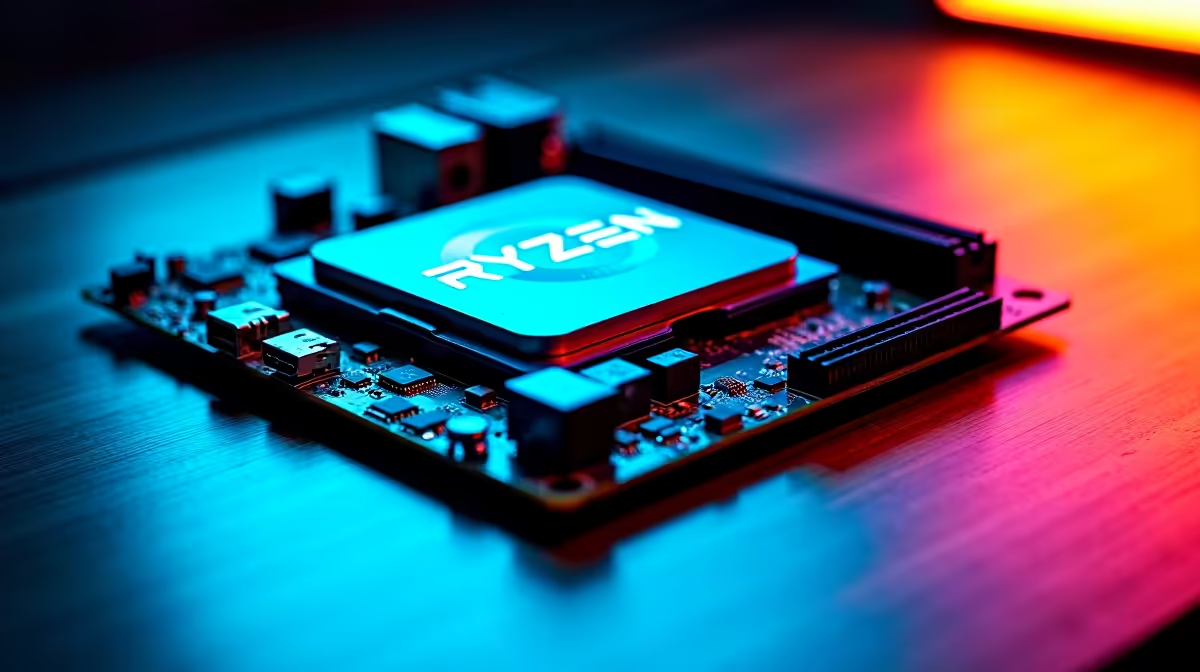
For a Ryzen 5 8600G in a small-form-factor build, choose a quality Mini-ITX B650 board. Good ITX options run around R4,500 to R7,500 locally because they pack VRM, Wi-Fi and M.2 into a 17x17cm board. Pick one with a strong VRM and a rear I/O that matches your peripherals before you commit to the small case.
What to look for on a Ryzen 5 8600G board
- A strong VRM despite the small board area (ITX runs hotter)
- The rear I/O you need, since ITX has limited back-panel space
- A single reinforced PCIe slot and one or two M.2 slots
- Bundled Wi-Fi, which most ITX boards include
Matching the board to your build and budget
Pair this board with a 6 cores, 12 threads (Radeon 760M iGPU) CPU and DDR5-6000 CL30 memory for a clean, fast platform. Do not overspend on a flagship if you run a single GPU and one SSD - the gaming frames are identical to a good mid-range board. Put the saved budget toward the GPU, a larger NVMe SSD or better cooling, all of which you will feel in daily use.
Buying it in South Africa
Budget around R5,000 to R6,500 for the Ryzen 5 8600G itself, then the board on top. Evetech stocks B650 boards locally with the chipset, ports and warranty you can check before buying. Confirm the board is on the current BIOS for your CPU, or use BIOS-flashback to update it on arrival.
FAQ
Can a Ryzen 5 8600G run cool in a Mini-ITX board?
Yes, with a board that has a strong VRM and a case with decent airflow. ITX boards run hotter due to tighter component spacing, so pair it with a capable cooler sized to the small case.
What do I give up going Mini-ITX?
Mainly expansion: one PCIe slot, fewer M.2 and SATA ports, and limited rear I/O. Gaming performance is identical to a larger board, so ITX is about size, not speed.
Will my GPU and cooler fit?
Check the case's GPU length and cooler height limits against your parts before buying. Small-form-factor cases are strict on clearance, so measure twice.
Pick the right board for your Ryzen 5 8600G
Browse Evetech's B650 motherboards, match the chipset and ports to your build, confirm it is in stock, then update the BIOS if needed before first boot.