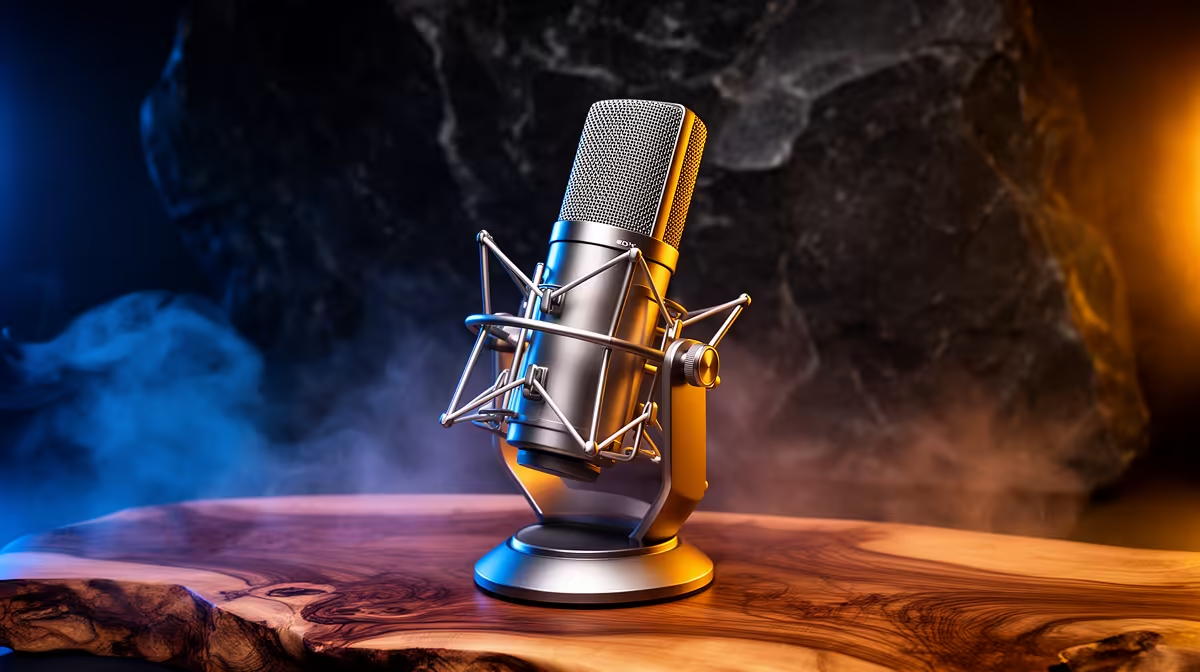
A separate pop filter clipped to a boom arm is the standard configuration in most home recording guides, but it is not the only valid one. Condenser microphones with integrated pop filters solve the plosive problem without the extra hardware, and for creators who want a clean desk and minimal setup steps, they are a genuinely compelling alternative. The key is knowing which specs indicate a well-built integrated filter rather than a cosmetic grille, and what diaphragm size and output resolution the vocal clarity you are after actually requires.
Quick Answer
For a condenser mic with an integrated pop filter, look for a 25mm large diaphragm, a cardioid polar pattern and 24-bit 48kHz output. The built-in filter handles plosives adequately for speech and streaming without a clip-on screen. Choose USB for plug-and-play setup and XLR only if you already have an interface.
🔧 What Makes an Integrated Pop Filter Actually Work
Not all built-in mesh is equal. The distinction between a functional integrated pop filter and a cosmetic grille is visible in how it handles the tap test: say a hard "p" directly into the mic at 10 centimetres and listen for a thump. If you hear a distinct low-frequency impact, the mesh is not doing enough.
A properly designed integrated filter sits at a precise distance from the capsule and uses a fine-enough mesh density to diffuse the air burst from plosive consonants before it reaches the diaphragm. A plosive fires a directed jet of air, not just a sound wave. The capsule responds to the pressure spike from that jet as a loud low-frequency thump below 200 Hz. A mesh that scatters the jet into slower, multi-directional airflow removes the spike while letting the acoustic pressure waves pass through with minimal attenuation.
The design variables that determine whether the mesh achieves this are its porosity, its stiffness and its standoff distance from the diaphragm. These are manufacturing details you cannot read from a photo, which is why the tap test or a recorded sample comparison is the most reliable pre-purchase check available.
For speech recording, podcasting and streaming, a well-executed integrated filter performs comparably to a standard clip-on screen in normal use. The gap only opens for very close, very loud singing or for performers who speak with unusually forceful plosives.
🎙️ Diaphragm Size and What It Actually Delivers
The diaphragm is the part of the condenser that converts sound pressure into an electrical signal. Its size determines how much acoustic information it can capture in each conversion cycle. A larger surface area means more detail in the transient response, a fuller low-frequency response and a warmer character to the voice signal.
A 25mm large-diaphragm capsule is the professional standard for vocal recording. At this size the capsule captures the full character of a speaking voice, including the subtle resonance that makes recorded speech sound natural and present rather than thin and distant. Budget mics often use 14mm small-diaphragm capsules to keep costs down. The difference is audible in side-by-side comparison, particularly in the warmth and presence of the fundamental voice frequency range between 100 and 1,000 Hz.
For content creators whose voice is the primary content, the diaphragm size is one of the two or three specs worth prioritising above all others. A large-diaphragm condenser with an integrated filter at the right price point is a better investment than a small-diaphragm mic with more features at the same price.
Sensitivity and the noise floor
Large-diaphragm condensers are inherently more sensitive than small ones, which cuts both ways. The higher sensitivity produces a richer signal with more detail. It also captures more of the room, making the mic less forgiving in an untreated space. For a reasonably quiet recording environment, high sensitivity is an advantage. For a room with significant ambient noise, it requires more attention to room treatment and mic placement.
A self-noise specification below 20 dB-A is the baseline for a condenser you will use in home recording. Below 15 dB-A is excellent. A quieter capsule requires less gain to achieve a healthy recording level, which keeps the entire signal chain cleaner.
⚡ Output Resolution: 24-Bit 48kHz as the Useful Minimum
Sample rate and bit depth define how accurately the digital conversion captures the analogue signal from the capsule. At 16-bit 44.1 kHz, the conversion is adequate for general audio. At 24-bit 48kHz, the digital representation has substantially more dynamic range and headroom.
The practical benefit of 24-bit for vocal recording is headroom below the signal. 24-bit provides 144 dB of theoretical dynamic range compared to 96 dB at 16-bit. That additional 48 dB of headroom means you can record at a lower input level, protecting against unexpected peaks, while still capturing quiet passages with full clarity. A 16-bit file at the same conservative level starts to lose resolution in the softer elements.
48kHz sample rate is the standard for audio recorded alongside video and matches the sample rate used in video production workflows. For a content creator whose audio often ends up in a video file, 24-bit 48kHz is the sensible default specification.
Pro Tip ⚡
Set your recording level so the loudest speaking passages peak at around -12 dB in your DAW or recording software. This leaves 12 dB of headroom for louder moments without clipping and keeps the quieter passages well above the noise floor at 24-bit depth. Adjust the physical gain dial to hit this level before you start recording rather than correcting it in post.
🔌 USB vs XLR for an Integrated-Filter Condenser
The connection type determines how much additional hardware the mic requires and how it integrates with your existing setup.
USB condensers with integrated pop filters are complete, self-contained recording solutions. They carry their own analogue-to-digital converter, connect directly to a PC's USB port and appear immediately in any recording or streaming software. For a solo creator setting up a desk recording environment, the USB path involves no additional cost, no compatibility questions and no interface to configure.
XLR condensers with integrated filters require an audio interface between the mic and the PC. The interface provides phantom power, a higher-quality preamp and analogue control over gain. The trade-off is the additional cost of the interface, typically R1,500 to R3,000 for a quality single-channel unit, and a slightly more complex signal chain to set up and troubleshoot.
The decision is straightforward: if you already own an audio interface, the XLR condenser with integrated filter is a sensible choice. If you are building from scratch and the interface is not in the immediate budget, a USB condenser at the same mic price delivers the integrated filter benefit without the extra hardware cost.
Frequently Asked Questions
What diaphragm size is best for vocal recording on a condenser?
A 25mm large diaphragm captures the full range of a speaking voice with better warmth, presence and transient detail than the 14mm small-diaphragm capsules common in budget mics. The larger surface area converts more acoustic information per cycle, which shows in the character of the recorded voice. For podcast, streaming and voiceover work, a large diaphragm is a meaningful upgrade at the same price point.
Does an integrated pop filter mean I do not need a separate clip-on screen?
For normal speech recording and streaming, yes. A well-designed built-in mesh scatters plosive air bursts effectively at standard recording distances of 15 to 20 centimetres. The exception is very close, forceful vocal styles where the air volume at impact is higher than the mesh is designed for. In those cases, adding a clip-on screen at 5 centimetres provides double protection, but it is unnecessary for everyday speech or podcasting use.
Why should I target 24-bit 48kHz output rather than 16-bit 44.1kHz?
24-bit depth provides significantly more dynamic headroom, allowing you to record at a conservative level that protects against clipping while retaining full resolution in the quieter parts of the signal. 48kHz sample rate matches the standard used in video production, making the audio compatible with video workflows without requiring sample rate conversion. For most content creators whose audio ends up in a video file, 24-bit 48kHz is the practical baseline.
Is a cardioid pattern necessary if the mic already has an integrated pop filter?
Yes, and for a different reason. The pop filter addresses plosive air bursts from the front. The cardioid pattern addresses ambient noise from the sides and rear. They solve independent problems. A cardioid pattern rejects roughly 20 dB of room noise from behind the capsule. An integrated filter handles plosives. Both working together produce a recording cleaner than either achieves alone.
How do I check that the integrated filter on a mic is actually effective?
The most reliable check is a recorded tap test before you commit to a purchase. Say a sharp "p" word, such as "podcast" or "pop filter", directly into the mic at 10 centimetres and review the waveform. A quality integrated mesh produces a clean signal. A poorly designed grille shows a visible thump below 200 Hz in the waveform. If purchasing online, look for reviewer audio samples rather than relying on the product description.
Ready to record vocals cleanly without the extra desk clutter?
Browse the condenser microphone range at Evetech and find an integrated-filter model that puts a large diaphragm and professional output resolution in a single plug-and-play package.