Quick Answer
Building an energy-efficient high-performance SA gaming PC in 2026 starts with the Ryzen 7 9800X3D (120W TDP, top-tier gaming performance), an RTX 5070 or RX 9070 (250 to 300W TDP), and an 850W 80 Plus Platinum PSU. This combination delivers flagship-adjacent gaming performance at approximately 500 to 600W total system draw, saving R400 to R700 per year in electricity costs versus an equivalent higher-TDP build at Eskom's current tariff.
CPU Selection for Efficiency and Performance 🖥️
The AMD Ryzen 7 9800X3D is the benchmark for gaming efficiency in 2026, delivering the best 1080p and 1440p gaming performance in its class at a 120W rated TDP. Compare this to the Intel Core Ultra 9 285K at 250W TDP: the Intel chip consumes roughly twice the CPU power for equivalent or lower gaming fps in most titles. For a South African builder running 5 hours of gaming daily at Johannesburg metro tariff rates, the Ryzen 7's 130W lower CPU draw saves approximately R285 per year compared to the Intel flagship.
GPU: Performance-Per-Watt Is the Key Metric 🎮
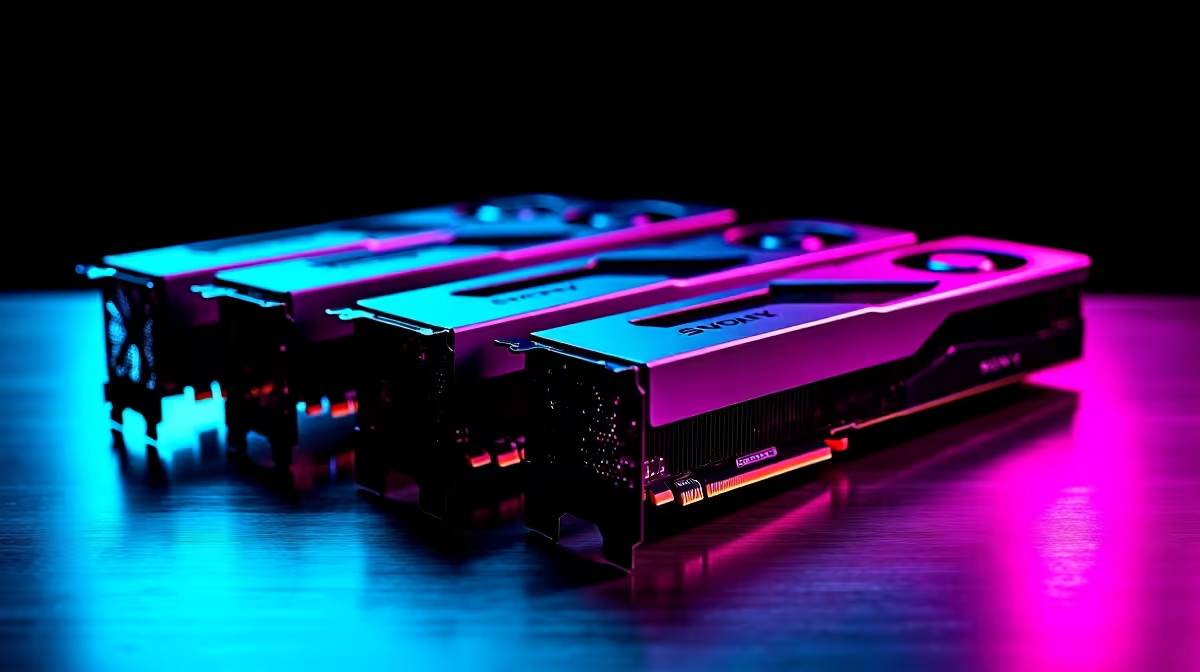
The RTX 5070 and RX 9070 represent the current-generation performance-per-watt leaders in the high-performance tier. Both deliver 4K gaming at 60 to 80 fps in demanding titles and 1440p gaming well above 100fps, with TDPs of 250 to 300W. Compare to the RTX 5090 at 575W: you pay more than double the electricity cost for the GPU alone to gain roughly 60 percent more raw performance. For South African gamers on monitored electricity budgets, the RTX 5070 or RX 9070 tier offers the most gaming performance per rand of running cost.
System-Level Efficiency: Memory, Storage, and Cooling 🔧
DDR5-6000 running on an AM5 platform delivers peak gaming memory bandwidth at roughly 10 to 12W draw. The memory speed choice has negligible impact on electricity cost compared to CPU and GPU choices. For storage, a quality NVMe SSD draws 3 to 7W under load, far more efficient than the mechanical drives they replace. Case cooling matters for efficiency: a case with good natural airflow allows fans to run at lower RPM, reducing cooling power draw and noise.
Enable Eco Mode for Desktop Tasks on AM5 ⚡
AMD's ECO mode in the BIOS reduces the Ryzen 7 9800X3D TDP to 65W during tasks where maximum CPU performance is not needed. For 8 hours of daily work including browsing, video calls, and light editing, ECO mode saves 55W continuously, equivalent to approximately R385 per year at SA tariff rates. Switch back to normal mode automatically when gaming.
FAQ
Does RGB lighting significantly affect power efficiency in a South African gaming PC?
A full RGB setup including motherboard headers, RAM, fans, and a GPU backplate typically adds 10 to 20W of continuous power draw. At SA tariff rates, that is R130 to R260 per year. Disabling RGB via software during work hours is a free efficiency gain, though for most builders it remains a minor cost relative to the GPU.
Is it worth buying a current-gen GPU now or waiting for next-generation cards in South Africa?
Current-gen RTX 5000 and RX 9000-series cards are live in SA retail now. Waiting for the next generation typically means 12 to 18 months of gaming on older hardware. The efficiency improvement of current-gen over previous-gen cards is already substantial, so the energy savings from upgrading now begin immediately.
How does water cooling compare to air cooling for efficiency in SA summer conditions?
All-in-one liquid cooling transfers heat from the CPU to the case exhaust more effectively than budget air coolers. Premium air coolers with large heatsinks achieve comparable results at lower total power draw since they eliminate the pump motor. For efficiency-focused SA builds, a quality twin-tower air cooler is marginally more efficient than an AIO, but either is vastly better than a boxed cooler.
Building an efficient high-performance SA gaming PC?
Evetech stocks the Ryzen 7 9800X3D, RTX 5070-series, and 80 Plus Platinum PSUs needed for the most power-efficient gaming builds available in South Africa.