South African offices looked very different in 2019. Peripheral procurement meant buying whatever was cheapest and replacing it when it broke. Hybrid work, rising RSI claim rates, and a sharper focus on long-term staff cost have changed the calculation, and ergo-certified productivity peripherals are no longer a fringe wellness expense in corporate SA. They are becoming standard desk issue at forward-thinking firms, and the shift is accelerating.
Quick Answer
SA corporates are adopting ergo-certified peripherals because hybrid work increased unsupervised desk time, RSI claims grew, and certified gear near R2,000 costs far less than a single occupational injury case. The certification confirms tested posture and force compliance, not just a marketing label.
🧠 The Business Case Driving Corporate Adoption
An RSI claim is not just a sick day. A repetitive strain injury involving the wrist or shoulder can require specialist assessment, physiotherapy, and several weeks of reduced productivity or full absence. In a medium-sized South African business, the direct and indirect cost of one such claim routinely exceeds R20,000 when legal, medical, and productivity losses are counted together.
An ergo-certified keyboard and vertical mouse for a single desk costs in the range of R1,500 to R3,000 depending on specification. The maths for a five-person team does not require a complex model: the kit for all five desks is still cheaper than the financial impact of a single injury. When HR and procurement teams run that comparison, the decision becomes straightforward.
The hybrid work shift multiplied the exposure. Staff spending three or four days a week working from home are using whatever surface and chair they have available, often with no ergonomic baseline at all. Corporate procurement of certified peripherals, sometimes issued as take-home kit, addresses a liability gap that did not exist when everyone sat in a monitored office environment.
What "Certified" Actually Requires
The word ergonomic has been applied to almost any peripheral with a slightly curved shape. Certification is different. An ergo-certified peripheral has passed physical testing by a recognised body for measurable criteria: neutral wrist angle during use, key travel and actuation force within low-strain limits, grip geometry that minimises forearm pronation, and surface materials that resist perspiration-related pressure points.
Buyers reading the word "ergonomic" on packaging get a design intention. Buyers reading a certified designation get documented test results. For a procurement team issuing peripherals at scale and managing occupational health compliance, that distinction is the difference between gear they can point to in an incident review and gear they cannot.
South African firms operating under the Occupational Health and Safety Act have additional motivation. Demonstrating reasonable effort to prevent known injury pathways, including RSI from repetitive keyboard and mouse use, is part of their compliance posture. Certified peripherals are a documented reasonable effort in a way that an uncertified product cannot be.
🔧 Which Peripherals Lead the Corporate Transition
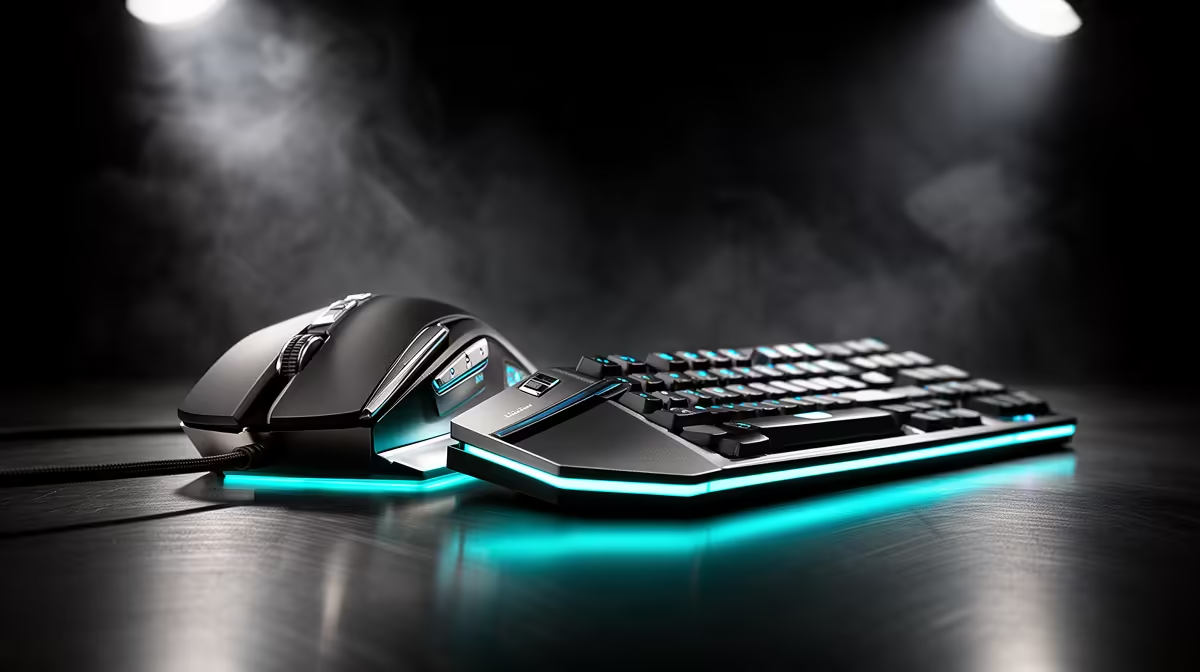
The vertical mouse has arrived at the top of corporate ergo procurement for a specific reason: it requires no retraining and produces an immediate, visible change in wrist position. A standard mouse keeps the forearm flat and rotated, which puts sustained torsional load on the muscles between wrist and elbow. A vertical design holds the hand in a handshake position, relieving that rotation and the tension it creates.
The ergonomic keyboard presents a wider range of options. Split-body keyboards separate the two halves to allow a shoulder-width typing position, which reduces inward arm angle and associated shoulder strain. Tented keyboards tilt the board on an angle that mirrors the natural slope of the wrist. Both designs address the same root cause: forcing the wrists to pronate fully flat on a standard keyboard for six or more hours.
Trackballs occupy a smaller but growing procurement segment, particularly for design and drafting roles where moving a thumb rather than the entire arm meaningfully reduces shoulder travel across the day.
The Portable Format Question
Hybrid workers need peripherals that travel, not ones that stay at the office. A vertical mouse small enough for a laptop bag side pocket, or a compact split keyboard that folds flat, serves both desks. Procurement teams are increasingly specifying portable ergo as a category for staff with flexible arrangements rather than treating the home desk as a separate, unaddressed problem.
✨ What the Transition Actually Looks Like
Corporate adoption typically starts with a single department, usually IT or design, where RSI awareness is highest. Feedback from that pilot, backed by any incident data, moves procurement toward a phased rollout.
The phased route also softens resistance. A vertical mouse feels unusual for the first few days before the neutral wrist position becomes normal. Letting staff trial alongside a standard mouse produces higher uptake than mandating the switch without a settling period. Organisations that have completed rollouts report fewer wrist complaints in post-adoption surveys and lower peripheral replacement rates, since certified hardware is built to a higher durability standard than entry-level gear.
Pro Tip ⚡
If your company is mid-rollout, prioritise staff who spend more than six hours per day on active keyboard and mouse tasks. Data capturers, developers, and administrators in that usage band show the highest RSI risk reduction when moved to certified gear, and their endorsement within the organisation drives broader adoption more effectively than any procurement mandate.
🎯 Evaluating Certified Options for Your Organisation
Not all certifications carry equal weight. Certifications from established occupational health or ergonomics organisations carry more evidential value than those issued by the manufacturer's own testing division. Ask the distributor or manufacturer for the specific standard a product was tested against and who issued the certification. A vague "ergonomically tested" claim with no named body is a yellow flag.
Entry-level certified keyboard and mouse sets around R1,500 to R2,000 suit standard office roles. Engineers and designers running precision tools for extended periods may benefit from higher-specification split boards and trackballs in the R3,000 to R5,000 range. The investment tracks hours of daily use more than job title.
Frequently Asked Questions
Why are SA corporates adopting ergo peripherals at a faster rate than before?
Three converging factors: hybrid work removed supervised ergonomic environments for a large share of the working week, RSI claim rates climbed as unsupervised desk setups worsened, and the financial calculation shifted in certified gear's favour once procurement teams compared kit cost against claim cost directly. The adoption is primarily cost-driven, with staff wellbeing as the mechanism through which cost savings arrive.
Does ergo certification guarantee that no one using the peripheral will develop RSI?
No. Certified gear reduces mechanical loading on wrists and forearms during normal use, but it does not eliminate risk from poor posture, insufficient breaks, or underlying health conditions. Certification lowers the dose of the injury mechanism, not the individual's full exposure to every contributing factor.
How does a vertical mouse specifically reduce forearm strain?
A standard mouse demands that the forearm lies nearly flat on the desk surface, a position that requires continuous muscular effort to maintain pronation across the duration of the working day. A vertical design allows the forearm to rest at an angle close to its natural resting position, which reduces the torsional demand on the muscles that run from the elbow to the wrist and are typically involved in RSI diagnoses.
Can companies use certified peripheral procurement to satisfy OHS requirements?
It contributes to a demonstration of reasonable precaution under the Occupational Health and Safety Act. Certified procurement is one component of a broader ergonomic programme alongside workstation assessment and break policies. It does not satisfy full OHS ergonomic compliance alone, but in an incident review it is documented evidence of a calibrated response to a known risk.
Is the peripherals-for-home-use model financially viable for most SA businesses?
For businesses with a formalised hybrid contract that includes home office provision, yes. Adding a certified mouse and compact keyboard to the home allocation is modest against the claim cost it offsets. Without that contract structure, some businesses offer the gear at cost as an opt-in benefit, achieving coverage without a mandatory company outlay.
Ready to equip your team with peripherals that reduce strain and hold up through a full working day?
Browse the ergonomic keyboard and mouse range at Evetech for South African offices running hybrid work schedules.