Quick Answer
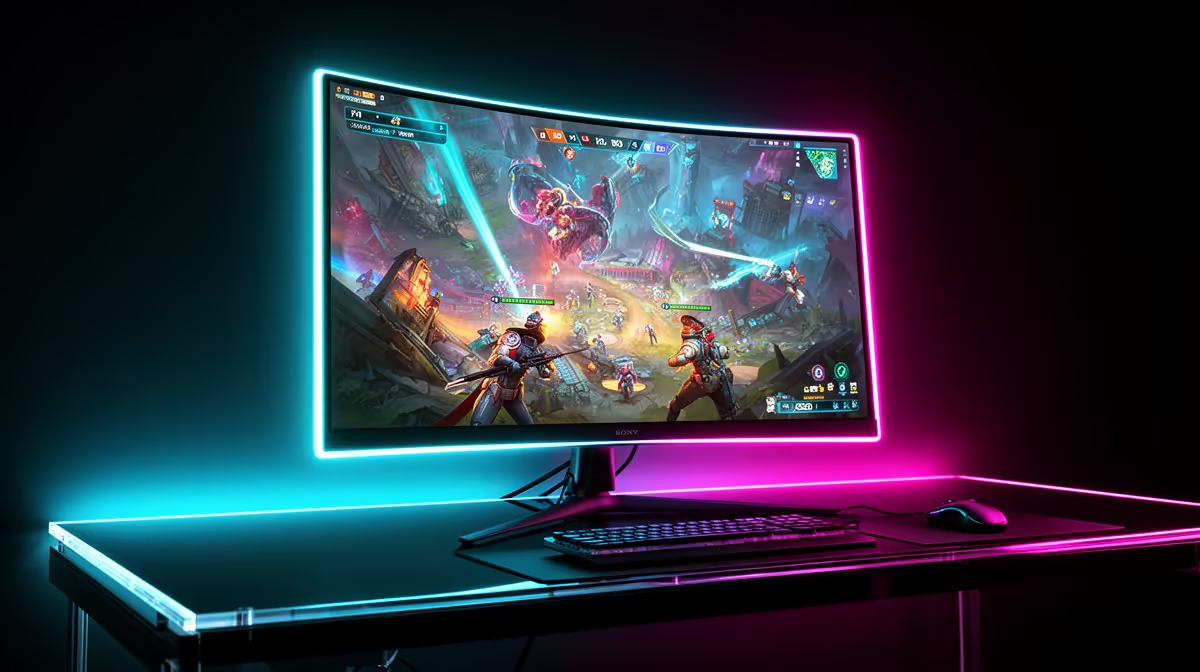
Yes, a 250 Hz monitor is a genuine upgrade for competitive FPS gaming if your GPU can sustain at least 200 to 250 fps in your target titles. The reduced motion blur and lower input lag compared to 144 Hz or 165 Hz displays translates to real competitive advantage in tracking fast-moving targets.
The Real Difference Between 165 Hz and 250 Hz 🎮
At 165 Hz the display refreshes every 6.06 ms. At 250 Hz it refreshes every 4 ms. This 2 ms reduction in frame delivery interval does several things simultaneously: motion blur from sample-and-hold pixel persistence drops proportionally, ghosting from trailing pixel transitions has less time to accumulate before the next frame, and the average input lag from game action to screen update decreases. In Valorant and CS2, where professional players routinely report aiming improvements from higher refresh rates, the jump from 165 to 250 Hz is comparable to the jump from 60 to 144 Hz, though the absolute gains become smaller as refresh rate increases.
GPU Requirements to Hit 250 fps in SA Esports Titles 💻
A 250 Hz monitor only delivers its advantage when the GPU is feeding it at or near 250 fps. In Valorant at FHD on low-to-medium settings, an RTX 4060 or RX 7600 consistently exceeds 250 fps. In CS2 at high settings, the same GPUs reach 200 to 280 fps depending on the scene. In Apex Legends at medium settings, expect 180 to 240 fps on mid-range hardware. If your current GPU regularly dips below 200 fps in your main title, the 250 Hz panel will spend significant time running at an effective frame rate that does not fully use its capability. In that case, upgrading your GPU before the monitor makes more sense for competitive improvement.
Cost Perspective for SA Buyers 💰
250 Hz gaming monitors in South Africa are currently available from around R5,500 to R10,000 for FHD and QHD IPS panels from established brands. This is a R1,000 to R2,500 premium over comparable 165 Hz models. For a serious FPS player who competes in local SA tournaments or ranked ladder play, this premium is justifiable. For casual players who play FPS titles several nights per week at a non-competitive level, 165 Hz delivers excellent performance and the saved rands are better directed toward a faster GPU or better peripheral gear.
Enable ELMB or ULMB on Your New Panel ⚡
Most 250 Hz gaming monitors include a motion blur reduction mode (ELMB, ULMB, or similar) that strobes the backlight in sync with the refresh cycle to sharpen moving images further. Enable this through the monitor OSD, but note that it typically requires disabling FreeSync or G-Sync. Use it during competitive play and switch it off for single-player titles where adaptive sync adds more value.
FAQ
Does a 250 Hz monitor make a difference if I am not a pro player?
Yes, even at a casual-competitive level. The smoother tracking and reduced motion blur are perceptible during normal play and make target tracking feel more precise. The benefit scales with how much time you spend in tracking-intensive situations, which is high in all FPS titles.
Is 1080p or 1440p better at 250 Hz for FPS games?
1080p is generally preferred for 250 Hz esports play because it is easier to run at the frame rates needed to fully utilise the panel. 1440p looks significantly sharper but requires a higher-tier GPU (RTX 4070 or RX 7900 XT range) to hit 250-plus fps consistently in demanding titles.
What response time should I look for in a 250 Hz gaming monitor?
Target 1 ms GtG (grey-to-grey) or 0.5 ms with overdrive enabled. At 250 Hz a response time above 4 ms causes ghosting because pixels have not fully transitioned before the next frame arrives. Check whether the quoted response time is GtG or MPRT (motion picture response time), as MPRT figures are typically more aggressive.
Ready to step up to 250 Hz for competitive FPS play in South Africa?
Evetech stocks 250 Hz gaming monitors suited to serious FPS and esports players. Browse current availability to find a panel that matches your GPU and gaming setup.