Quick Answer
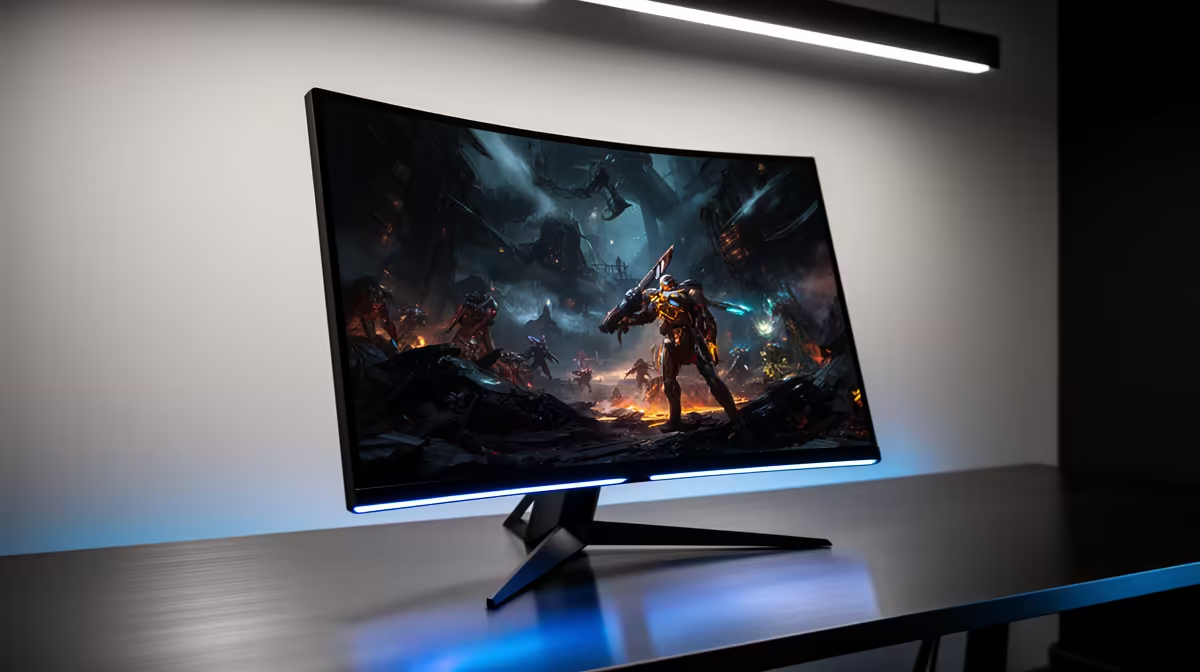
Choose QHD 1440p if your GPU can sustain 144 fps or higher at that resolution and you play a mix of competitive and visually demanding games. Stick with 1080p at 240Hz or 360Hz if you play only fast-paced esports titles and your GPU output is the priority over image sharpness.
Breaking Down the Resolution and Refresh Tradeoff 🖥️
On a 27-inch screen, the pixel density at 1080p is approximately 82 PPI, which makes individual pixels visible at a 60 to 70 cm viewing distance. At 1440p on the same screen size, PPI rises to 109, and the image reads as genuinely sharp without needing to zoom or scale.
The refresh rate side of the equation is GPU-constrained. If your card is an RTX 5060 Ti or RX 9060 XT, it will produce more than 200 fps in Valorant at 1080p on competitive settings, but may only reach 130 to 160 fps at 1440p. In that scenario, a 240Hz 1080p panel uses more of the monitor's capability than a 300Hz 1440p one.
South African Budget Reality 💰
A quality 27-inch QHD 300Hz IPS monitor costs R7,000 to R14,000 locally. A 1080p 240Hz panel starts at R3,000 to R6,000. The price gap is real: if your build budget is R20,000 total and you are choosing between a better GPU or a better monitor, the GPU upgrade has more impact on frame rate than the monitor resolution jump.
For a SA student or first-time builder on a constrained budget, a 1080p 165Hz or 240Hz monitor paired with a mid-range GPU gives a more complete experience than stretching to QHD with a GPU that cannot drive it well. A QHD monitor running at 90 fps in most games is a worse experience than a 1080p panel running at 150 fps.
Who Genuinely Benefits from QHD 🎮
QHD makes the most difference for players who split time between competitive titles and open-world or RPG games. The sharpness improvement in games like Elden Ring, Cyberpunk 2077, or Flight Simulators at 1440p is noticeable and adds to immersion. For a streamer or content creator who also plays games, a QHD monitor doubles as a usable colour-accurate workspace without needing a separate display.
For someone who plays CS2 and Valorant exclusively, the frame rate is the primary competitive variable. A 1080p 360Hz monitor paired with a GPU that can push 300 fps in those titles will give a sharper competitive experience than a QHD 300Hz monitor running at 180 fps on the same hardware.
Use Render Scale as a Middle-Ground Option ⚡
If you get a QHD monitor but your GPU struggles, use in-game render scale to drop to 85 or 90 percent resolution rather than changing monitor settings. This reduces GPU load while keeping the desktop and UI sharp at native 1440p, and many competitive players use this exact setting to balance frame rate and clarity.
FAQ
Can I use a QHD monitor at 1080p if my GPU is not strong enough?
Yes, you can run a 1440p monitor at 1080p, but the image will not be as sharp because the panel scales the resolution rather than displaying native pixels. On a 27-inch QHD screen, 1080p looks noticeably softer than on a native 1080p panel. For competitive play where sharp edges matter, running at native resolution is preferable.
Does 27 inches feel too large for desktop gaming?
At a typical viewing distance of 60 to 80 cm, 27 inches is the standard for competitive gaming desks and does not feel oversized for most players. Going to 32 inches on a typical desk requires moving the monitor further back to avoid eye strain, which affects fine detail perception.
What is the minimum GPU I should pair with a 27-inch QHD monitor?
For a satisfying QHD experience in both esports and AAA games, an RTX 5070 or RX 9070 is the minimum worthwhile pairing. Below that tier, the frame rate at 1440p in demanding titles drops enough to make a 1080p panel a more practical choice.
Not sure which monitor size and resolution suits your build?
Evetech stocks gaming monitors at 1080p, 1440p, and 4K across a range of refresh rates. Browse the monitors section or check current availability to compare options at your budget.