Quick Answer
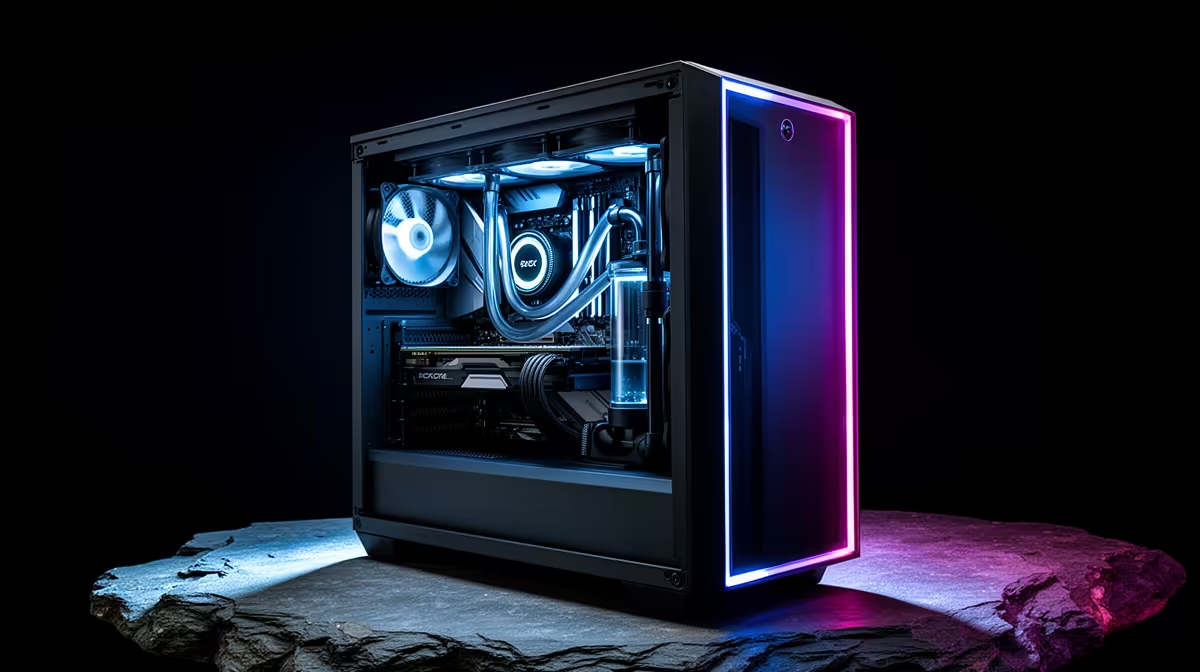
Yes, if your CPU has a TDP of 105W or higher. A 360mm radiator provides meaningfully better thermal headroom than a 240mm unit, and choosing a case that supports it from the start gives you upgrade flexibility even if you begin with a smaller AIO.
What 360mm Radiator Support Actually Enables 💧
A 360mm radiator has three 120mm fan stations versus a 240mm unit's two, giving 50 percent more radiator surface area. In practice, a 360mm AIO keeps a Ryzen 9 9950X below 75 degrees Celsius during all-core Cinebench runs; a 240mm AIO on the same CPU often pushes 85 to 88 degrees. For day-to-day gaming the difference is smaller, but the headroom is valuable during SA summer when ambient room temperatures can be 5 to 8 degrees warmer than winter.
Not all 360mm support is equal. Front 360mm mounting position cools air from outside the case through the radiator before it enters the chassis, which is thermally superior for processors above 125W TDP. Top-mounted positions exhaust warm case air through the radiator, which is warmer inlet air by 3 to 8 degrees compared to front mounting.
What to Check in the Case Specs 🔧
When reviewing a case spec sheet, look for: front radiator max size, top radiator max size, and whether both positions support 360mm simultaneously. Some mid-towers only support front 360mm if the HDD cage is removed, and only support top 240mm simultaneously. This limits dual-radiator builders.
Fan thickness compatibility matters too. A 360mm radiator mount that only accommodates 25mm fans restricts you from using 30mm high-static-pressure fans preferred for push-pull configurations. Cases that specify 30mm fan clearance at the radiator mount allow push-pull installations, improving heat rejection 8 to 15 percent over single-fan setups.
When 240mm Is Enough and When It Is Not 🌡️
For Ryzen 5 9600X (65W TDP) and Core i5-14600K class CPUs with mid-range GPUs like the RTX 5060 Ti, a 240mm AIO is entirely sufficient. Temperatures stay below 70 degrees Celsius under gaming load. Where 360mm earns its place: Ryzen 9 9900X and above, Core Ultra 9 285K, CPUs under sustained all-core workloads like video rendering alongside gaming, or any system in a warm SA summer room without air conditioning.
Choosing a 360mm-capable case costs nothing extra if the case would otherwise be equivalent, so it makes sense as a baseline spec for any build above the entry tier.
360mm Radiator Mounting Tip for SA Builders ⚡
When mounting a 360mm radiator in the front of the case, orient the pump head so the hoses exit from the top of the radiator toward the CPU socket. This prevents air bubbles from collecting in the pump head, which causes gurgling noise and reduces pumping efficiency over time.
FAQ
Does 360mm radiator support guarantee better cooling than a large air cooler?
Not always. A high-quality 120mm tower air cooler competes closely with 240mm AIOs and sometimes trails 360mm AIOs by only 3 to 5 degrees. For TDPs up to 125W, the choice between a top air cooler and a 360mm AIO often comes down to aesthetics and noise preference.
Can I fit a 360mm AIO in a standard ATX mid-tower?
Yes, if the case specifically lists 360mm front or top support. Not all mid-towers qualify. Confirm the spec sheet figure before purchasing either the case or the AIO.
Is 360mm relevant for gaming-only builds with no workstation tasks?
For gaming-only use, 240mm is typically sufficient for current CPUs. 360mm earns its place in builds doubling as workstations, in rooms without air conditioning, or in cases that limit airflow through their panel design.
Planning a liquid-cooled gaming PC?
Evetech stocks ATX and E-ATX gaming cases with 360mm front and top radiator support, alongside a full range of AIO liquid coolers to match.