Quick Answer
Yes, liquid crystal polymer (LCP) fan blades are worth choosing for any build where long-term durability and low noise matter. LCP blades resist flex and deformation at high RPM better than standard ABS or PBT, maintaining their aerofoil shape and reducing turbulence noise throughout the fan's lifespan.
What LCP Actually Is and Why It Matters 🔧
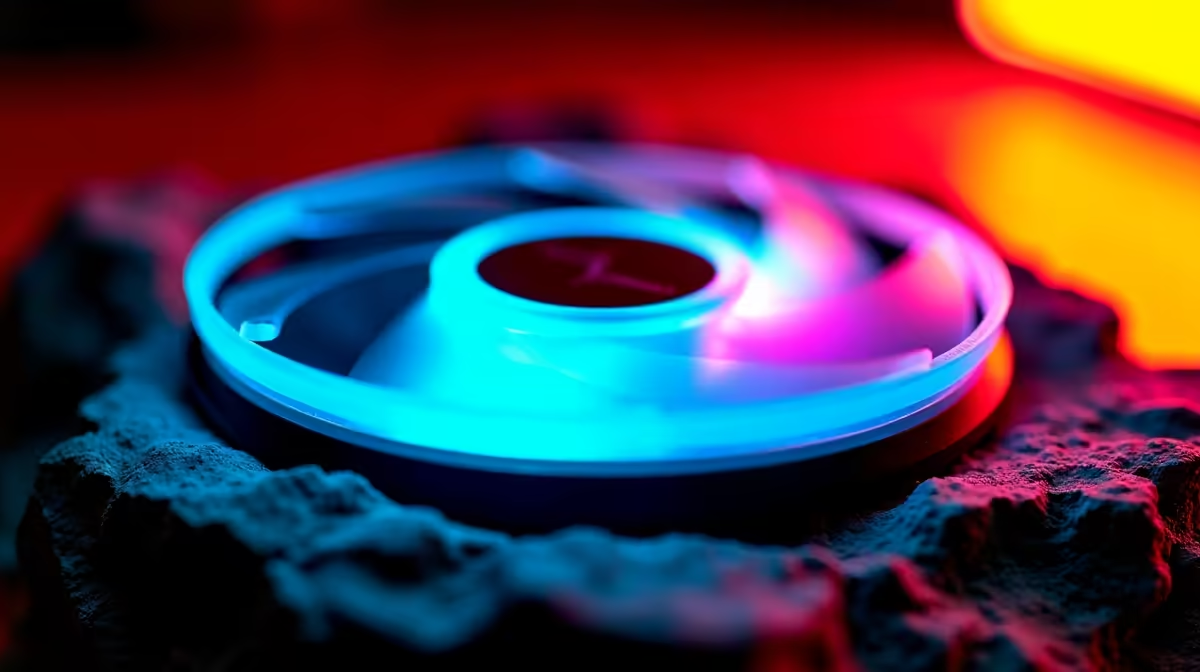
Liquid crystal polymer is a high-performance engineering thermoplastic used in aerospace, medical devices, and electronics for its exceptional stiffness-to-weight ratio. In fan blades, stiffness is critical because each blade is an aerofoil operating at speeds up to 2,000 RPM in a 120mm fan, generating centrifugal forces that flex weaker materials like standard ABS by 0.2 to 0.5 mm at the blade tip. That flex creates an uneven gap between the blade tip and the fan shroud, which increases turbulence and broadband noise. LCP blades maintain their designed cross-section under load, preserving tip clearance accuracy and delivering the CFM and static pressure values that the manufacturer rated the fan at, rather than a degraded real-world performance.
Durability Over Time in SA Conditions 🌡️
South African summers, particularly in Gauteng, push ambient temperatures above 30 degrees Celsius. Standard ABS blades soften slightly at sustained temperatures above 50 degrees Celsius, which can occur inside a case during a long gaming or render session. Repeated heat cycles cause ABS to fatigue and warp progressively over 12 to 24 months. LCP has a heat deflection temperature above 200 degrees Celsius, far beyond what any PC case environment reaches. This means LCP-bladed fans maintain dimensional accuracy and balance across years of operation in SA conditions, while ABS-bladed fans from the same era may develop vibration as their blades warp out of balance.
Noise Implications of Blade Stiffness 🖥️
Turbulence noise scales with the fourth to fifth power of blade tip speed in standard fan aerodynamic theory. Even a small improvement in tip clearance accuracy from stiffer blades produces a meaningful acoustic improvement, particularly at mid-to-high RPM where turbulence noise dominates. Fans with LCP blades typically test 2 to 4 dBA quieter than geometrically identical fans with ABS blades at 1,500 RPM. In a quiet home office or creator studio, 3 dBA is a clearly perceptible half-as-loud difference. The acoustic advantage of LCP is most pronounced at mid-speed (60 to 80% PWM duty) rather than at the extremes of the range.
Check Blade Material in Spec Sheets ⚡
Not all fan manufacturers list blade material prominently. Look for "LCP", "liquid crystal polymer", or "high-rigidity resin" in the technical specifications. Fans listing only "ABS" or "PC blend" use lower-rigidity materials regardless of their price tier. This single spec separates genuinely premium fans from mid-range units priced to look premium.
FAQ
Do LCP blades cost significantly more than ABS?
LCP-bladed fans typically retail at R350 to R480, compared to R150 to R280 for similar-sized ABS fans. The premium is R100 to R200 per fan, which over a five-year lifespan works out to R20 to R40 per year of quieter, more reliable operation.
Can I tell if a fan has LCP blades without looking at the spec sheet?
Not reliably by appearance. LCP blades look similar to ABS in colour and finish. The most reliable indicator is the manufacturer's published specifications. At Evetech, fan listings include material details in the technical tab.
Are LCP blades more fragile than ABS because they are stiffer?
No. LCP's stiffness comes from molecular alignment, not brittleness. LCP blades resist impact similarly to ABS in real-world handling. The stiffness prevents operational flex, not physical breakage from accidental contact.
Looking for fans that last longer and run quieter?
Evetech stocks premium 120mm and 140mm fans with LCP and high-rigidity blades. Check the cooling section to compare specs and find the right fans for your build.