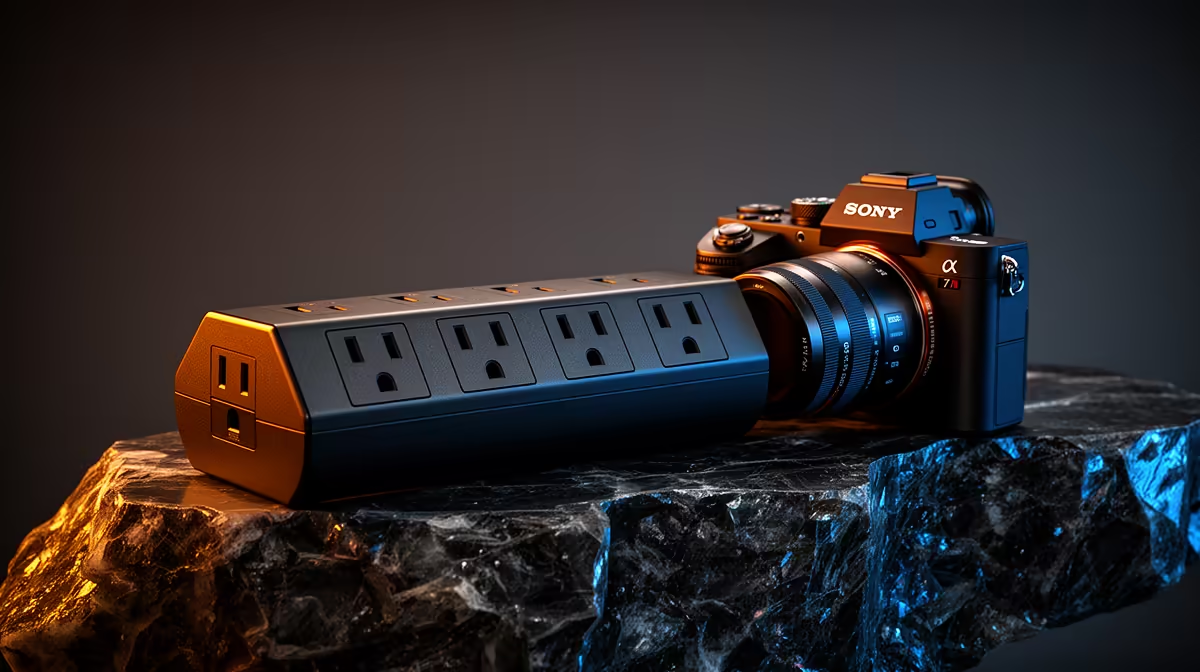
You have just spent serious money on a new Mac, and the question of how to protect it from South Africa's wobbly mains supply is a fair one. The honest answer splits two ways: a surge protector or UPS for your new Mac does two different jobs. A surge protector absorbs sudden voltage spikes. A UPS does that and keeps the machine running through dips and brief outages. For a R20,000-plus Apple purchase on local power, knowing which one you actually need saves both your wallet and your data.
Quick Answer
For a MacBook, a good surge-protected adaptor or power strip is usually enough, because the laptop battery already rides out short dips and cuts. For a Mac mini, Mac Studio or iMac with no battery, a compact line-interactive UPS is the smarter buy, since it bridges momentary outages and protects against the voltage swings common on SA mains. Budget from roughly R400 for a quality surge strip and from around R1,500 for an entry UPS.
What each device actually protects against
A surge protector clamps down on transient voltage spikes, the brief but violent jumps that follow a power cut returning, nearby lightning, or heavy appliances switching on. It shunts that excess energy away before it reaches your Mac's sensitive power circuitry. What it does not do is hold power when the supply drops or vanishes.
A UPS, by contrast, sits between the wall and your device with a battery inside. When the mains dips, browns out, or cuts entirely, it switches to battery within milliseconds, giving you a clean, steady supply. A line-interactive UPS also regulates voltage continuously, smoothing the over and under-voltage that plagues many SA suburbs and complexes.
Why South African mains makes this matter
SA power has long been hard on electronics. Even with a stable grid, suburban and complex wiring delivers voltage that sags under load and spikes when supply returns. Sudden cuts and the surge that follows reconnection are exactly the events that quietly degrade power supplies and, occasionally, kill them outright.
A new Mac's internal power circuitry is robust but not invincible. Repeated spikes shorten component life even when nothing fails dramatically on day one. Spending a small fraction of the Mac's price on protection is cheap insurance against an expensive out-of-warranty repair.
MacBook owners: surge protection is usually enough
If your new Mac is a MacBook Air or Pro, the built-in battery already acts as a buffer. A momentary dip or a brief cut simply means the laptop draws from its own cells until power steadies. What the battery cannot do is absorb a hard voltage spike travelling down the charger, which is where a surge protector earns its place.
Plug the charger into a quality surge-protected strip or wall adaptor rated with a sensible joule absorption figure. That covers the realistic risk for a laptop without the cost or bulk of a UPS. If you want to browse Apple options and accessories together, the MacBook lineup at Evetech is a useful starting point for matching protection to your specific model.
Desktop Macs: a UPS earns its keep
A Mac mini, Mac Studio or iMac has no internal battery. When the power cuts, it simply switches off, and an unexpected shutdown mid-task risks file corruption and lost work. Here a UPS is the right call.
Sizing the UPS
For a desktop Mac plus a monitor, a UPS rated around 650VA to 1000VA gives you several minutes of runtime, enough to save your work and shut down cleanly. You are not buying hours of uptime; you are buying a safe landing. Choose a line-interactive model so it also smooths everyday voltage fluctuation, not just full outages.
What to plug in
Connect the Mac and its primary display to the battery-backed outlets. Printers and other high-draw peripherals belong on the surge-only sockets if the unit has them, since they would drain the battery fast without adding any protection benefit.
Reading the spec sheet without the jargon
A few numbers tell you whether a protector or UPS is actually any good. On a surge protector, the joule rating shows how much energy it can absorb before it stops protecting; a higher figure means a longer useful life against repeated spikes. A clamping voltage shows how soon it kicks in, where lower is better. On a UPS, the VA rating sets how much load it can carry, and the runtime figure tells you how long it holds that load on battery.
Look too for the UPS topology. A line-interactive unit, the type most worth buying for home use, continuously trims over and under-voltage as well as switching to battery during a cut. A basic standby UPS only steps in when power fails entirely, offering less everyday smoothing. For SA conditions, where voltage wanders even when the lights stay on, line-interactive is the sensible default.
Don't forget the rest of the desk
Your Mac is rarely alone on the desk. An external monitor, a Thunderbolt dock, an external drive and a router all share the same unstable mains, and any of them can pass a spike along a cable into the Mac. A spike that hits your monitor's power and travels down the video cable, or one that reaches an external drive mid-write, can still cause grief even if the Mac itself is protected.
The practical answer is to protect the cluster, not just the one device. Put the Mac and monitor behind battery backup, and run the rest through surge-protected outlets. An external drive holding your backups especially deserves protection, since losing the backup at the same moment as a power event defeats the point of having one.
Choosing between the two
Decide by asking one question: does the Mac have its own battery? If yes, a surge protector handles the spike risk and the internal cells handle the dips. If no, a UPS gives you both surge protection and the runtime to shut down safely. Many SA buyers with a desktop Mac end up with a UPS for the machine and simple surge strips for the rest of the desk. To see what pairs well with a new Apple purchase, it is worth scanning the popular laptop picks and accessories other buyers add alongside their machines.
Frequently Asked Questions
Do I really need a UPS for a MacBook?
Usually not. The MacBook's battery already rides out brief dips and cuts, so a quality surge protector on the charger covers the main risk, which is voltage spikes. A UPS is more relevant for desktop Macs with no internal battery.
What size UPS suits a Mac mini or Studio?
A 650VA to 1000VA line-interactive UPS comfortably runs a desktop Mac and monitor for a few minutes, which is enough to save your work and shut down properly. Larger units only add runtime, not extra protection.
Will a surge protector stop my Mac being damaged by a power cut?
It protects against the voltage spike that often follows power returning, but it cannot keep the machine running during the cut itself. For uninterrupted operation through outages you need a UPS.
Is the wall socket's own protection enough?
Standard SA wall sockets offer no surge suppression and no backup. Relying on them alone leaves an expensive Mac exposed to spikes and abrupt shutdowns, so dedicated protection is well worth it.
Can I plug other devices into the same UPS?
Yes, but reserve the battery-backed outlets for the Mac and monitor. Put high-draw items like printers on surge-only sockets so they do not drain the battery during an outage.
Protect that new Mac the smart way. Browse Apple machines and matching gear at Evetech (https://www.evetech.co.za/macbooks/l/3284) and pair a surge protector or compact UPS so SA power never costs you a repair bill or a lost file.